Trip Facts
Country:
Nepal
Duration:
17 Days
Max Altitude:
French Pass, 5,360 m (17,585 ft)
Activities:
Remote high-altitude camping expedition
Region:
Dhaulagiri region
Starting Point:
Kathmandu
Ending Point:
Kathmandu
Grade:
Challenging
Group Size:
2 to 12 trekkers (private and custom departures available)
Accomodation:
Full-board tented camps on the trek, hotels in Kathmandu and Pokhara
Best Season:
Apr-May & late Sep-Oct
Notice
The Dhaulagiri Circuit is a remote camping expedition, not a teahouse walk. From Italian Base Camp on, there are no lodges. So you sleep in tents with a full crew and a cook.
The route circles Dhaulagiri (8,167 m), the seventh-highest peak on earth. It crosses two high passes: the French Pass (5,360 m) and the Dhampus Pass (5,240 m).
This is one of Nepal’s toughest treks, with glacier travel and long days above 5,000 m. So it suits fit, experienced trekkers only. A guide and crew are required, and Spade Himalaya arranges everything.
Overview of Dhaulagiri Circuit Trek 17-Days
Quick answer: The Dhaulagiri Circuit Trek is a remote, 17-day camping expedition around Dhaulagiri (8,167 m), the seventh-highest mountain on earth. It crosses the French Pass (5,360 m) and the Dhampus Pass (5,240 m), through Dhaulagiri Base Camp and the Hidden Valley. It is a full tented trek for fit, experienced trekkers, and it needs a guide and crew (Nepal Tourism Board, retrieved 2026-06-30).
The Dhaulagiri Circuit Trek is a 17-day camping expedition around the great Dhaulagiri massif in western Nepal. The name Dhaulagiri means “white mountain” in Sanskrit. So the trek circles a wall of white giants, led by Dhaulagiri I (8,167 m), the seventh-highest peak on earth. This is a wild, roadless route, far from the teahouse trails.
The trek starts low, in the green Myagdi Khola gorge. First, you walk through farms and forest to the last village at Boghara. Then the trail turns raw and remote. You follow the river deep into the gorge, past Italian Base Camp and Glacier Camp, to Dhaulagiri Base Camp (4,750 m). Here you camp below the huge, icy north face of the mountain.
The heart of the trek is the crossing of two high passes. First, you climb the French Pass (5,360 m), the top of the route. So you cross into the strange, empty Hidden Valley, ringed by peaks. Then you climb the Dhampus Pass (5,240 m) and drop down toward Mustang. Finally, you reach the apple village of Marpha, on the Annapurna Circuit, and fly out from Jomsom.
This is a serious, expedition-grade trek. There are no lodges past Italian Base Camp, so you live in tents with a full crew. The passes involve glacier travel, and the guide may fix ropes on steep, icy ground. So you need strong fitness, good gear, and ideally past trekking above 5,000 m. The plan builds in two rest days, at Italian Base Camp and at Dhaulagiri Base Camp.
Spade Himalaya runs this trek with licensed Nepali guides. So your guide sets a safe pace, watches the weather, and checks your health each day. You also get a cook and a full mountain crew, because this is a camping expedition. Want a different wild route? Then see the remote Upper Dolpo Trek, the Makalu Base Camp Trek, or the Manaslu Circuit Trek. For a teahouse trek nearby, see the Annapurna Circuit Trek or read our Annapurna region trekking guide.
Trips Highlights
- Circle Dhaulagiri (8,167 m), the seventh-highest mountain in the world.
- Cross the high French Pass (5,360 m) and the Dhampus Pass (5,240 m).
- Camp at Dhaulagiri Base Camp (4,750 m), below the mountain's huge north face.
- Walk through the eerie, high Hidden Valley, ringed by peaks.
- Trek one of the most remote and wild routes in all of Nepal.
- Live a true tented expedition, far from roads and lodges.
- Follow the deep Myagdi Khola gorge from green forest to glacier.
- See Tukuche Peak, the Dhaulagiris, and, near Marpha, the Nilgiris.
- Finish in the apple village of Marpha, on the Annapurna Circuit.
- Meet the warm people of the Myagdi and Mustang valleys.
Kathmandu (1,400 m) → Pokhara (822 m) → drive to Darbang (1,100 m) → Dharapani (1,560 m) → Muri (1,850 m) → Boghara (2,080 m) → Dobang (2,520 m) → Sallaghari (3,110 m) → Italian Base Camp (3,660 m) → Glacier Camp (4,250 m) → Dhaulagiri Base Camp (4,750 m) → French Pass (5,360 m) → Hidden Valley (5,050 m) → Dhampus Pass (5,240 m) → Yak Kharka (3,680 m) → Marpha (2,670 m) → Jomsom → fly to Pokhara → Kathmandu.
In short, you drive to Darbang and walk up the Myagdi gorge to Dhaulagiri Base Camp. Then you cross the French Pass into the Hidden Valley. After the Dhampus Pass, you drop to Marpha and Jomsom. Finally, you fly to Pokhara and on to Kathmandu.
Trips Itinerary
A Spade Himalaya representative meets you at the airport and drives you into Thamel, about thirty minutes away. Dhaulagiri is a camping expedition rather than a teahouse trek, so there is a good deal more kit to check over here than on most trips we run.
Kathmandu is at 1,400 m, so there is nothing to get used to yet. Your guide runs the briefing in the late afternoon and goes through the camping side of the trip as well as the route, so bring your passport, several photographs and a copy of your insurance.
- Duration: about 30 min drive
- Max Altitude: 1,400 m
- Accommodation: 3 Star Hotel (shared)
You travel west to Pokhara today, either on a tourist bus or by short flight, following the Trishuli and Marsyangdi rivers through the green middle hills.
Pokhara is at 822 m and the 200 km road journey takes six or seven hours because the highway is slow and winding, while the flight takes under half an hour. The rest of the day is free beside Phewa Lake, so use the evening to pack properly for an early start.
- Duration: 6 to 7 hrs drive (200 km)
- Max Altitude: 1,400 m
- Meals: Breakfast Included
- Accommodation: Star Hotel (shared)
A rough jeep drive up the Myagdi valley to Darbang, then the walking begins. You cross the river on a suspension bridge and climb through farmland to Dharapani.
Dharapani is at 1,560 m, about 8 km and three or four hours of walking after several hours in the vehicle. It is a deliberately gentle start to a long and demanding trek.
The lower valley is Magar country, with terraced fields of millet and maize and small stone villages. The crew sets up camp while you rest, and this is how every night works from here on.
- Duration: 3 to 4 hrs walk (8 km)
- Max Altitude: 1,560 m
- Meals: Breakfast, Lunch & Dinner
- Accommodation: Tented Camp
You climb higher into Magar country today, winding through fields and then rising and falling along the side of the valley, crossing streams as you go.
Muri is at 1,850 m, about 12 km in five or six hours. The net gain is small but the trail dips and climbs repeatedly, so it is more work than the figures show. Somewhere along the way you get your first sight of the Dhaulagiri peaks ahead, which tends to lift the whole group.
- Duration: 5 to 6 hrs walk (12 km)
- Max Altitude: 1,850 m
- Meals: Breakfast, Lunch & Dinner
- Accommodation: Tented Camp
The farms fall behind today and the country turns wild. You drop to the Myagdi Khola, cross it, then climb and fall along the steep forested valley side.
Boghara is at 2,080 m, about 13 km in six or seven hours. The path is narrow in places with long drops down to the river, so stay close behind your guide on those sections.
The forest here is oak and rhododendron and full of birds. Boghara is the last real village on the route, and everything beyond it is uninhabited country.
- Duration: 6 to 7 hrs walk (13 km)
- Max Altitude: 2,080 m
- Meals: Breakfast, Lunch & Dinner
- Accommodation: Tented Camp
You enter the deep gorge of the Myagdi Khola today, and from here on there are no villages at all, just forest, waterfalls and the river far below you.
Dobang is at 2,520 m, about 11 km in five or six hours. The trail climbs and drops along the gorge wall and crosses the river more than once on simple bridges.
The going is rough and your guide leads on the awkward sections. Dobang is a clearing in the forest rather than a settlement, and camp there feels genuinely remote.
- Duration: 5 to 6 hrs walk (11 km)
- Max Altitude: 2,520 m
- Meals: Breakfast, Lunch & Dinner
- Accommodation: Tented Camp
A steady climb up the gorge toward the high mountains, with the forest thinning out as you gain height and the river roaring away below you for the whole day.
Sallaghari is at 3,110 m, about 10 km in five or six hours. You cross 3,000 m for the first time today, so the pace slows and the evening turns properly cold.
You pass the Choriban Khola where a side stream comes down. The icy flanks of Dhaulagiri start to show themselves ahead, and Sallaghari camps among the last of the trees.
- Duration: 5 to 6 hrs walk(10 km)
- Max Altitude: 3,110 m
- Meals: Breakfast, Lunch & Dinner
- Accommodation: Tented Camp
You reach the first of the high camps today. The trail leaves the trees behind for open rocky ground and the valley opens out into full mountain country.
Italian Base Camp is at 3,660 m, about 8 km in four or five hours. It is steep in places but it is a short day, which is exactly what you want at this height.
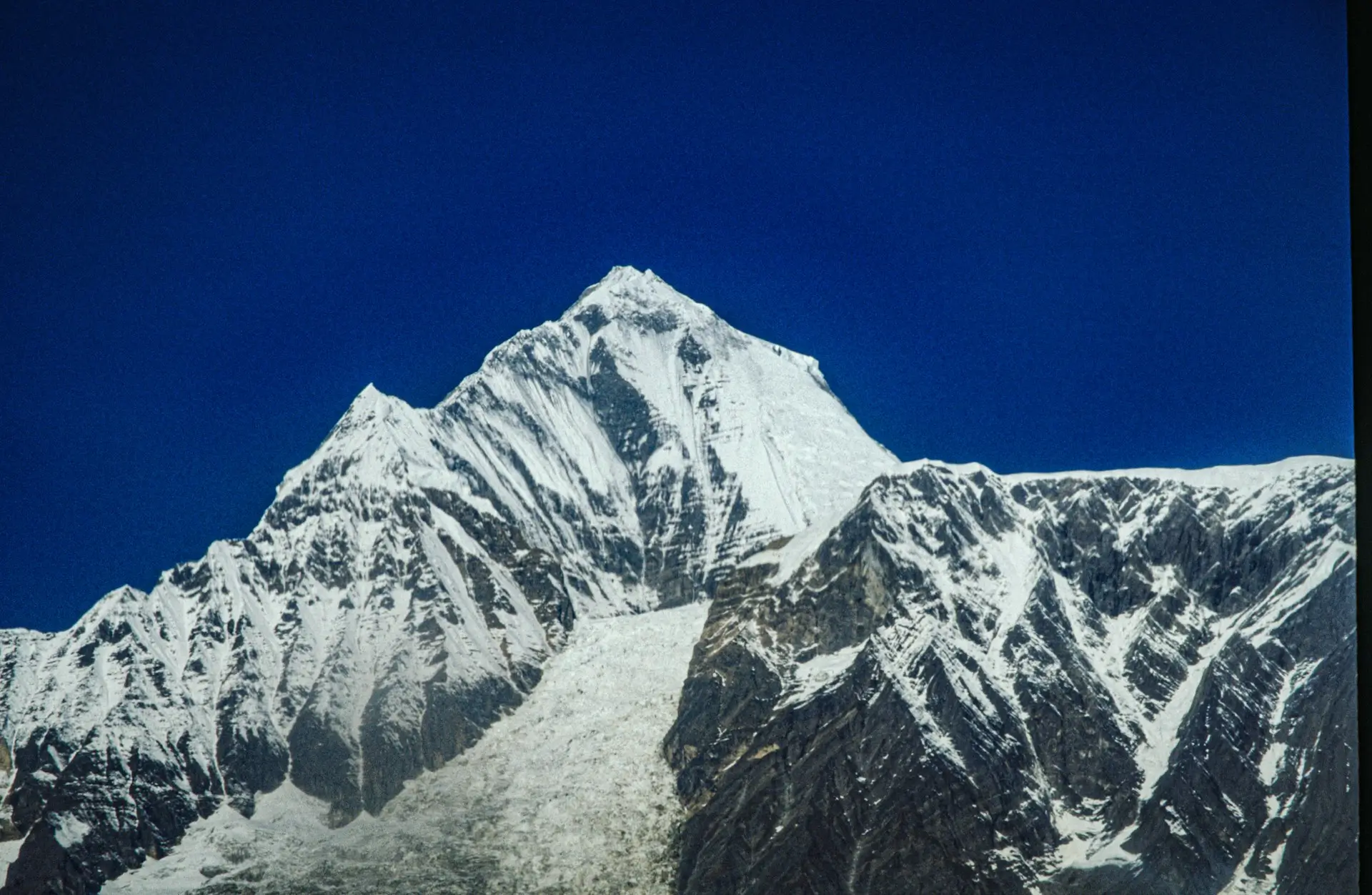
This is your first close view of Dhaulagiri I at 8,167 m, the seventh highest mountain in the world, standing right at the head of the valley ahead of you.
You camp here for two nights below a wall of ice and rock. There is nothing else in the valley at all, and no way out of it except the way you walked in.
- Duration: 4 to 5 hrs walk (8 km)
- Max Altitude: 3,660 m
- Meals: Breakfast, Lunch & Dinner
- Accommodation: Tented Camp
A rest day at Italian Base Camp, with an easy walk up the ridge above camp in the morning and then a return to sleep back down at the lower height again.
The walk reaches around 3,900 m and takes two or three hours. Climbing a few hundred metres and then sleeping low again is what makes the days above here possible. Back at camp, drink plenty, eat what the crew puts in front of you and get to sleep early.
- Duration: 2 to 3 hrs walk
- Max Altitude: up to about 3,900 m
- Meals: Breakfast, Lunch & Dinner
- Accommodation: Tented Camp
The trek turns properly alpine today. You leave the last plants behind and follow the edge of the Chhonbardan Glacier below the north face of Dhaulagiri.
Glacier Camp is at 4,250 m, about 10 km in four or five hours. The ground is loose moraine and boulders, so your guide picks the line and the going is slow.
People also call this Japanese Base Camp. The mountain is huge and close on your left for the whole walk, and you camp on scoured ground in a ring of peaks.
- Duration: 4 to 5 hrs walk(10 km)
- Max Altitude: 4,250 m
- Meals: Breakfast, Lunch & Dinner
- Accommodation: Tented Camp
You follow the glacier higher today over rock and ice, with ice towers and cliffs above the route, until the valley opens out at Dhaulagiri Base Camp.
Base Camp is at 4,750 m, about 10 km in four or five hours. The walking is slow in this thin air and there is no benefit at all in trying to hurry any of it.
You are standing directly below the north face of an 8,000 m peak in a raw bowl of ice, and there is nobody else here. You camp two nights before the pass.
- Duration: 4 to 5 hrs hike (10 km)
- Max Altitude: 4,750 m
- Meals: Breakfast, Lunch & Dinner
- Accommodation: Tented Camp
A rest day that matters more than any other on this trek. You walk slowly a little way toward the pass in the morning and then come back down to camp.
The walk reaches around 5,000 m and takes two or three hours. Your guide checks everyone with a pulse oximeter, because from here the trek commits to two high passes.
The views take in Dhaulagiri I, Tukuche Peak and a long wall of ice. Eat well, drink a great deal and sleep early, because tomorrow is the biggest day of the trip.
- Duration: 2 to 3 hrs
- Max Altitude: up to about 5,000 m
- Meals: Breakfast, Lunch & Dinner
- Accommodation: Tented Camp
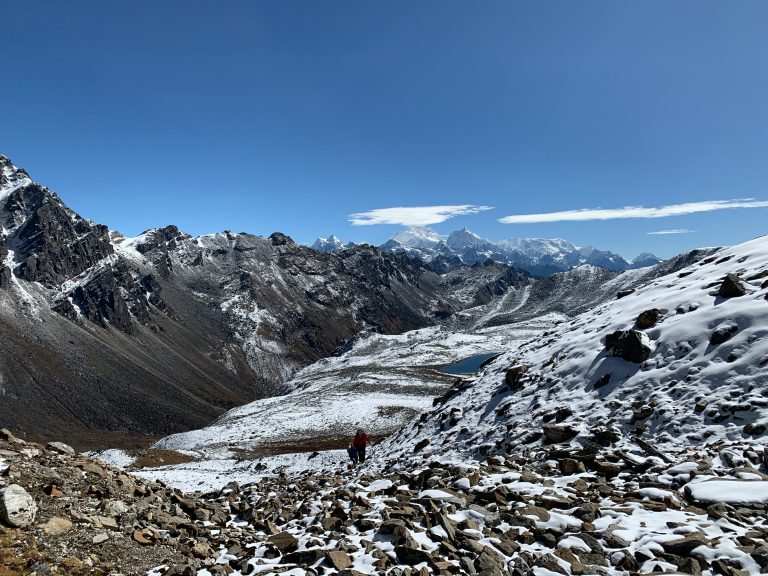
The big day of the trek. You start very early in the cold and dark, climb the glacier up to the French Pass, then drop into the Hidden Valley on the far side.
The pass is 5,360 m and the Hidden Valley camp is at about 5,050 m, roughly 14 km across seven or eight hours. It is the highest ground of the whole trek.
On the steep or icy sections the crew may fix a rope, and the group moves together rather than spreading out along the slope in ones and twos the way it usually does.
From the top of the pass you look across Sita Chuchura and Tashi Kang, and the Hidden Valley beyond it is one of the emptiest places anywhere in Nepal.
- Duration: 7 to 8 hrs walk (14 km)
- Max Altitude: 5,360 m
- Meals: Breakfast, Lunch & Dinner
- Accommodation: Tented Camp
You cross the second high pass of the trek today and then begin the long descent that takes you out of the high country and back down toward inhabited ground.
The Dhampus Pass is 5,240 m and Yak Kharka is at 3,680 m, about 12 km in six or seven hours. That is a short climb and then more than 1,500 m of descent.
The drop off the pass is a long steep slope of scree, so use poles and take it carefully. The air thickens noticeably as you go and the yak pastures feel almost lush after the ice.
- Duration: 6 to 7 hrs walk (12 km)
- Max Altitude: 5,240 m
- Meals: Breakfast, Lunch & Dinner
- Accommodation: Tented Camp
You complete the circuit today, descending a long trail down into the Kali Gandaki valley and rejoining the trekking world again at the village of Marpha.
Marpha is at 2,670 m, about 15 km in five or six hours. You are in the rain shadow now, so the country is dry and Tibetan in character all the way down.
Nilgiri at 7,061 m and Tukuche Peak stand over the descent. Marpha is a Thakali village of whitewashed stone houses known for its apples, its pie and its apple brandy.
- Duration: 5 to 6 hrs (15 km)
- Max Altitude: Yak Kharka 3,680 m
- Meals: Breakfast, Lunch & Dinner
- Accommodation: Guest House
A short walk down the Kali Gandaki to Jomsom, past apple orchards and windswept open ground, and then an early flight over the mountains down to Pokhara.
Jomsom is at 2,720 m and the walk takes two or three hours. The flight to Pokhara at 822 m takes about twenty five minutes and leaves early because of the valley wind, running down the gorge with Dhaulagiri on one side and the Annapurnas on the other.
- Duration: 2 to 3 hrs walk
- Max Altitude: Jomsom 2,720 m
- Meals: Breakfast Included
- Accommodation: Star Hotel (Shared)
You return to Kathmandu by tourist bus or short flight, then either rest at the hotel or go straight on to the airport. You leave having walked a genuine expedition route with two passes above 5,000 m on it.
- Duration: Driving or flying
- Max Altitude: 1,400 m
- Meals: Breakfast Included
Trips Include
- All airport transfers in a private vehicle.
- 3 nights' hotel in Kathmandu and Pokhara (3-star, twin share) with breakfast.
- Tourist bus or flight between Kathmandu and Pokhara.
- Private jeep from Pokhara to Darbang (the trek start).
- Jomsom to Pokhara flight after the trek.
- Full-board tented camp accommodation during the trek (tents, mattresses, dining and toilet tents).
- All meals (breakfast, lunch, dinner) during the trek, cooked by our camp kitchen.
- Annapurna Conservation Area Permit (ACAP) and TIMS card.
- A licensed, experienced Nepali guide, plus a cook and full kitchen crew.
- Porter support to carry all camp gear and your duffel bag.
- Group climbing gear for the passes (rope and basic safety kit), a first-aid kit, and a pulse oximeter.
- Trip-completion certificate and all government taxes.
Trips Exclude
- International airfare to and from Nepal.
- Nepal entry visa (US$30 for 15 Days, US$50 for 30 days, US$125 for 90 days).
- Lunches and dinners in Kathmandu and Pokhara.
- Travel and medical insurance (mandatory; must cover trekking above 5,000 m and helicopter evacuation).
- Personal trekking and camping gear, such as boots, crampons, and trekking poles.
- All drinks, snacks, hot showers, and device charging on the trek.
- Tips for the guide, cook, and crew.
- Personal expenses and any costs from early departure or itinerary changes.
- Anything not listed under Cost Includes.
Trips Altitude
Packing List
General
- Four-season (minus 20 degree) sleeping bag.
- Sleeping bag liner and an inflatable sleeping mat
- Puffy down jacket.
- Duffel bag.
- Daypack, 35 to 45 litres, with a rain cover
Upper Body
- Warm hat and a sun hat
- Buff, scarf, or neck gaiter
- Sunglasses and goggles with full UV protection (vital for glacier glare)
- Headlamp with spare batteries (needed for the pre-dawn pass starts)
- Sunscreen (SPF 50) and lip balm
- Technical base-layer tops (light and heavy)
- Fleece jacket and an insulated mid layer
- Waterproof, windproof shell jacket
Lower Body
- Technical base-layer trousers
- Trekking trousers (2 pairs)
- Insulated or soft-shell trousers for the high camps
- Waterproof, windproof shell trousers
Hands
- Wool or technical liner gloves
- Warm insulated gloves or mittens for the passes
Feet
- Sturdy, waterproof trekking or mountaineering boots (well broken in)
- Warm wool socks and sock liners (several pairs)
- Camp shoes for the evenings
- Crampons and gaiters for the glacier and the passes
- Trekking poles
Undergarments
- Quick-drying technical underwear
- Sports bras (women)
- Thermal base-layer set for the cold nights
First Aid Kits
(Your guide carries a full kit, medication, and a pulse oximeter, but a personal kit is strongly recommended.)
- Sunscreen, lip balm, and blister care
- Antiseptic ointment and pain relief
- Personal medication and any altitude medication advised by your doctor
- Water-purification tablets or a UV purifier
- Hand sanitiser and basic cold or stomach medicine
Others
- Passport and several extra passport photos (for the permits)
- Insulated water bottles and a hydration bladder
- Toiletry kit, quick-dry towel, wet wipes, toilet paper
- High-energy snacks (bars, nuts, dried fruit)
- Waterproof or dry bags for documents and clothes
Optional
- Power bank and a solar charger (there is no power on the trek)
- Camera or phone for photos
- Binoculars
- Cards or a book
- Thermos for hot water
Good to Know
This is one of the last great wilderness treks in Nepal. So it circles an 8,000 m peak with almost no roads, lodges, or crowds. You live in tents, cross two high passes, and walk through raw, glaciated country. In short, it is a real expedition, for trekkers who want a serious challenge. The reward is a wild beauty that few people ever see.
This is a full tented trek, so a large crew makes it possible. Your team includes a guide, a cook, kitchen helpers, and porters. So they carry the tents, the food, and the kitchen, and set up camp each day. You sleep in a two-person tent and eat hot meals in a dining tent. So all you carry is a daypack with your day gear.
The French Pass and the Dhampus Pass are the crux of the trek. So you cross them early in the day, before the weather turns. The ground can be icy, so you may wear crampons and rope up in places. Your guide checks the conditions first and will wait for a safe window. The views from the top make the hard work worth it.
The plan follows the climb-high, sleep-low rule, with two rest days. So take those days seriously, and hike high but sleep low. Drink 3 to 4 litres of water a day, and walk slowly. Skip alcohol up high, and eat the good camp food for energy. If you feel unwell, tell your guide at once. Your guide carries an oximeter and a first-aid kit.
You leave the mountains by a short flight from Jomsom to Pokhara. So the flight depends on clear morning weather, like all mountain flights. If it is delayed, your guide will plan the safest option. So it is wise to keep a spare day before your international flight home. A little flexibility keeps the trip smooth.
Trips Reviews
No reviews found.
Trips FAQs
Permits, Guide & Insurance
You need two. First, the Annapurna Conservation Area Permit, which is about NPR 3,000 (Nepal Tourism Board, retrieved 2026-06-30). Second, the TIMS card, about NPR 2,000 (Nepal Tourism Board, retrieved 2026-06-30). The Dhaulagiri Circuit is not a restricted area, so no special restricted permit is needed. Spade Himalaya arranges both.
Yes. Nepal requires a licensed guide, and this remote camping trek would be unsafe without a full crew. So Spade Himalaya gives you a licensed Nepali guide, a cook, and a mountain crew. They handle the route, the camps, the food, and your health. This is not a trek to try on your own.
Yes, it is a must. Your policy has to cover trekking above 5,000 m and a helicopter rescue. Many normal policies do not, so check the wording first. This trek is remote, so rescue can be slow and costly. Arrange good cover at home before you fly, and leave a copy with Spade Himalaya.
Trek Difficulty & Altitude
It is graded challenging, and it is one of the toughest treks in Nepal. You walk 4 to 8 hours a day, cross two passes above 5,200 m, and camp in tents the whole way. The passes involve glacier travel, and the crew may fix ropes on icy ground. So you need strong fitness, warm gear, and ideally past trekking above 5,000 m.
This plan is 17 days from Kathmandu to Kathmandu. That includes the travel, the trek, and two rest days for acclimatization. The trek itself covers about 102 km around the Dhaulagiri massif. We can also adjust the length to fit your time and pace.
Both passes are high and cold, and they cross glaciers and snow. The French Pass at 5,360 m is the high point of the trek. So you start before dawn, move slowly, and follow your guide. On steep or icy sections, the crew may fix a rope for safety. Micro spikes or crampons help, and your guide will tell you when to wear them.
It is a real risk, because you cross 5,360 m and sleep for nights above 4,000 m. So the plan adds two rest days, at Italian Base Camp and Dhaulagiri Base Camp. Your guide checks your oxygen with a pulse oximeter each day. Drink 3 to 4 litres of water daily, walk slowly, and tell your guide early if you feel unwell. Going down is the best cure.
Best Time to Trek
Spring (April to May) and autumn (late September to October) are best. Both give stable weather and safe pass crossings. Winter buries the passes in deep snow, so the trek closes. The summer monsoon brings rain, cloud, and leeches in the gorge, so most people avoid it.
Accommodation & Facilities
Yes. Past Italian Base Camp, there are no lodges or teahouses at all. So you sleep in tents, with a full crew, a cook, and a camp kitchen. Spade Himalaya brings all the camping gear, so you only carry your daypack. This is a true tented expedition, far from the teahouse trails.