Trip Facts
Country:
Annapurna
Duration:
12 Days
Max Altitude:
5,416m
Activities:
Trekking
Region:
Annapurna Region
Starting Point:
Kathmandu
Ending Point:
Kathmandu
Grade:
Moderate
Group Size:
Min 2
Accomodation:
Hotel/Teahouse
Notice
The Annapurna Circuit is a classic loop around the Annapurna massif. The high point is the Thorong La Pass (5,416 m), crossed on Day 8.
This 12-day plan uses a short drive to skip the lower, dusty road sections. So you spend your time on the scenic high country.
The trek lies inside the Annapurna Conservation Area, so a licensed guide and permits are required. Spade Himalaya arranges your guide, the ACAP permit, and the TIMS card.
Overview of Annapurna Circuit Trek 12-Days
Quick answer: The Annapurna Circuit earns its fame honestly. In 12 days the trail climbs from subtropical rice terraces to the windswept crest of Thorong La at 5,416 m, and no two days look alike. Both the ACAP permit and a TIMS card come arranged with your booking. Prices start at US$ 1,080. So if you want one trek that shows you all of Nepal, this is the one our guides recommend first.
The Annapurna Circuit Trek is a 12-day loop around the Annapurna massif. It is one of Nepal’s classic high-altitude treks. So it packs the country’s full range into one trip. You climb from green river valleys to a cold, wind-scoured pass, then drop to a holy temple town.
The high point is the Thorong La Pass (5,416 m), one of the highest trekking passes in the world (Wikipedia: Annapurna Circuit, retrieved 2026-06-26). First, you drive to Chame and trek up through Pisang to the Tibetan-style village of Manang (3,540 m). Then you take an acclimatization day before the climb to the pass. After the crossing, you reach the sacred temple of Muktinath (3,800 m), holy to both Hindus and Buddhists.
The trek then drops to the hot springs at Tatopani, climbs to Ghorepani, and finishes with the famous sunrise from Poon Hill (3,210 m). Along the way, you see giants like Annapurna I (8,091 m) and Dhaulagiri (8,167 m), and the deep Kali Gandaki gorge. So the trail keeps changing, day after day, from rice terraces to high desert that looks like Tibet.
This trek is graded moderate to strenuous. There is no technical climbing. The challenge is the altitude and the long days, not the terrain. So the plan builds in an acclimatization day at Manang and climbs slowly to the pass.
Spade Himalaya runs this trek with licensed Nepali guides. So your guide sets a safe pace, watches the weather, and checks your health each day. Want a shorter or easier trek in the same region? See the Annapurna Base Camp Trek, the quiet Mardi Himal Trek, or the easy Ghorepani Poon Hill Trek. For more culture and Mustang, see the 15-day Annapurna Circuit via Thorong La Pass.
Planning your trip? Read our Annapurna Circuit cost guide, our Thorong La Pass guide, and our Annapurna Circuit in winter guide. Deciding between treks? Then read Annapurna Circuit vs Annapurna Base Camp. For the full region, see our Annapurna region guide.
Trips Highlights
- Cross the Thorong La Pass (5,416 m), one of the highest trekking passes on earth
- Walk a full loop around the Annapurna massif, from green valleys to high desert
- Visit the Tibetan-style village of Manang (3,540 m) and its old monasteries
- Reach the sacred temple of Muktinath, holy to Hindus and Buddhists
- Soak in the natural hot springs at Tatopani after the high days
- Catch the famous sunrise over the peaks from Poon Hill (3,210 m)
- See Annapurna I (8,091 m), Dhaulagiri (8,167 m), and the deep Kali Gandaki gorge
- Cross from rice terraces to wind-scoured Tibetan high desert in one trek
- Taste local food like dal bhat, potatoes, and Tibetan bread in mountain teahouses
- Trek Nepal's classic loop with a licensed Spade Himalaya guide
Route Details
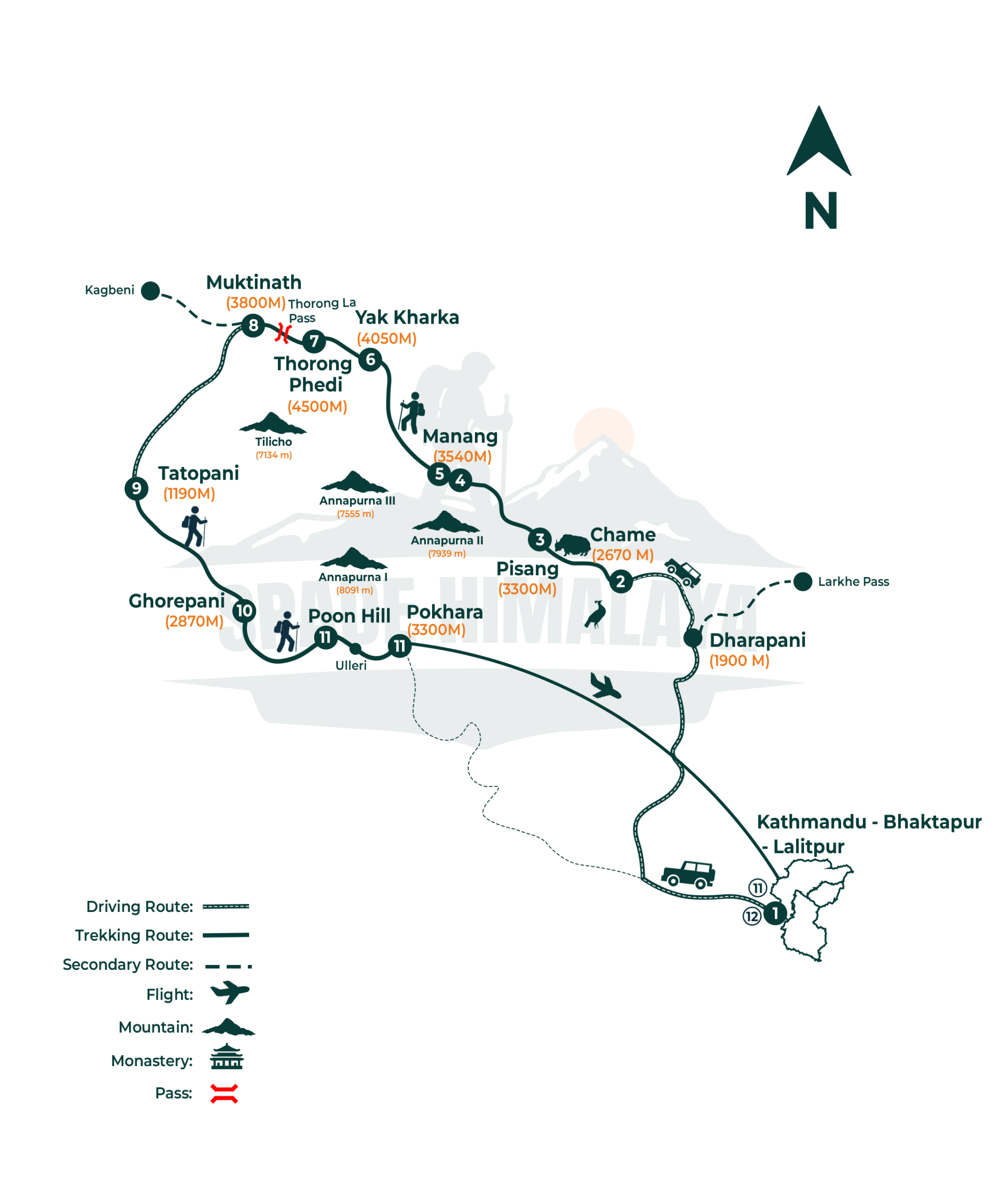
Kathmandu (1,400 m) → drive to Chame (2,710 m) → Pisang (3,300 m) → Manang (3,540 m) → acclimatization day → Yak Kharka (4,050 m) → Thorong Phedi (4,500 m) → Thorong La (5,416 m) → Muktinath (3,800 m) → drive to Tatopani (1,190 m) → Ghorepani (2,870 m) → Poon Hill (3,210 m) → Pokhara → Kathmandu.
In short, you drive to Chame and trek up the valley to Manang. Then you acclimatize and climb to the Thorong La pass. After the crossing, you reach Muktinath, drop to the Tatopani hot springs, climb to Ghorepani for the Poon Hill sunrise, and return through Pokhara to Kathmandu.
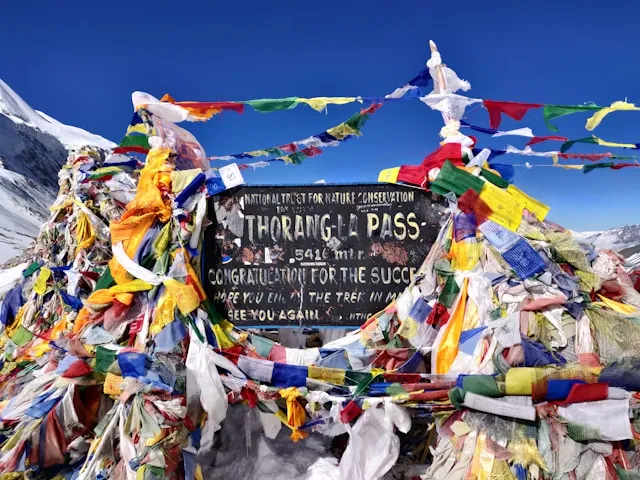
Thorongla Pass in Annapurna circuit Trek
Trips Itinerary
A Spade Himalaya guide meets you at the airport. Then a private car takes you to your hotel in Thamel. So you can rest or explore the lively market nearby. In the evening, you meet your guide for a full briefing on the trek. They check your gear and explain the route and the safety plan. So bring your passport, photos, and a copy of your insurance.
- Duration: Driving: about 30 min
- Max Altitude: 1400 m
Today is a long, scenic drive into the mountains. First, you follow the highway to Besisahar. Then you switch to a rough mountain road up the Marsyangdi valley. The road climbs past waterfalls, terraced fields, and small towns. By late afternoon, you reach Chame, the district headquarters of Manang. So you settle into your lodge and rest for the trek ahead.
- Duration: Driving: 9 to 10 hrs
- Max Altitude: 2710 m
- Meals: Breakfast, Lunch & Dinner Included
- Accommodation: Guest House
The trek begins today. First, the trail climbs through pine and fir forest beside the river. Then the valley opens, and you see the huge curved rock face of Paungda Danda. Soon, the peaks of Pisang and Annapurna II come into view. By afternoon, you reach Pisang, an old village with a small monastery. So you spend a calm night with mountain views.
- Duration: Walking: 5 to 6 hrs
- Max Altitude: 3300 m
- Meals: Breakfast, Lunch & Dinner Included
- Accommodation: Guest House
Today the land grows dry and Tibetan in feel. The trail climbs the upper Pisang route for the best views, or takes the lower path. Either way, you reach the high, open country of Manang. Along the way, you pass mani walls, chortens, and stone villages. By afternoon, you reach Manang, a large village below the peaks. So you rest and prepare for the acclimatization day.
- Duration: Walking: 6 to 7 hrs
- Max Altitude: 3540 m
- Meals: Breakfast, Lunch & Dinner Included
- Accommodation: Guest House
Today is a rest and exploration day. It also helps your body adjust to the height. The top option is a hike toward the Ice Lake or the Gangapurna viewpoint. Both climb high and come back down to sleep. A gentler choice is a walk to a nearby village or monastery. So you keep active but rest, which is the best way to acclimatize.
- Duration: Walking: 3 to 5 hrs if hiking
- Max Altitude: 4600 m
- Meals: Breakfast, Lunch & Dinner Included
- Accommodation: Guest House
Today you start the climb toward the pass. The trail leaves the valley floor and rises onto open slopes. The air grows thin, so you walk slowly and steadily. You pass grazing yaks and a few small teahouses. By afternoon, you reach Yak Kharka, a quiet high pasture. So you rest early, because the altitude is climbing fast.
- Duration: Walking: 4 to 5 hrs
- Max Altitude: 4050 m
- Meals: Breakfast, Lunch & Dinner Included
- Accommodation: Guest House
Today is short but high. The trail climbs along the valley, crossing a couple of streams and a landslide section. So you take it slow and careful. By midday, you reach Thorong Phedi, the base for the pass. The afternoon is for rest and an early dinner. So you sleep well before the big crossing day.
- Duration: Walking: 3 to 4 hrs
- Max Altitude: 4500 m
- Meals: Breakfast, Lunch & Dinner Included
- Accommodation: Guest House
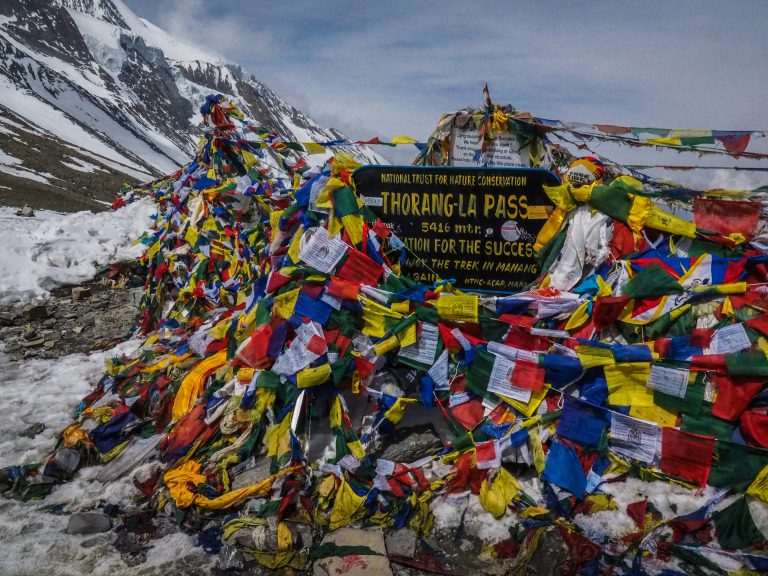
This is the biggest day of the trek. First, you start before dawn, around 4 a.m., to beat the wind. Then you climb slowly to the prayer flags at the top of Thorong La (5,416 m). From the pass, the views are huge in every direction. After a short rest, you begin the long descent to Muktinath. So trekking poles help your knees on the way down. You finish at the sacred temple town of Muktinath.
- Duration: Walking: 8 to 9 hrs
- Max Altitude: 5416 m
- Meals: Breakfast, Lunch & Dinner Included
- Accommodation: Guest House
Today you visit the Muktinath temple, holy to Hindus and Buddhists. Then you drive down the Kali Gandaki valley by jeep. The road passes Jomsom and the apple village of Marpha. The deep gorge runs between Dhaulagiri and Annapurna. By afternoon, you reach Tatopani, known for its natural hot springs. So you can soak your tired legs in the warm water.
- Duration: Driving: 5 to 6 hrs
- Max Altitude: 3800 m
- Meals: Breakfast, Lunch & Dinner Included
- Accommodation: Guest House
Today is a long uphill day. The trail climbs through forest and terraced farms. You pass Magar and Gurung villages full of life. As you rise, the rhododendron forest gets thicker. In spring, it blooms in red and pink. By evening, you reach Ghorepani, a ridge village with a fine view. So you rest before the early sunrise hike.
- Duration: Walking: 7 to 8 hrs
- Max Altitude: 2870 m
- Meals: Breakfast, Lunch & Dinner Included
- Accommodation: Guest House
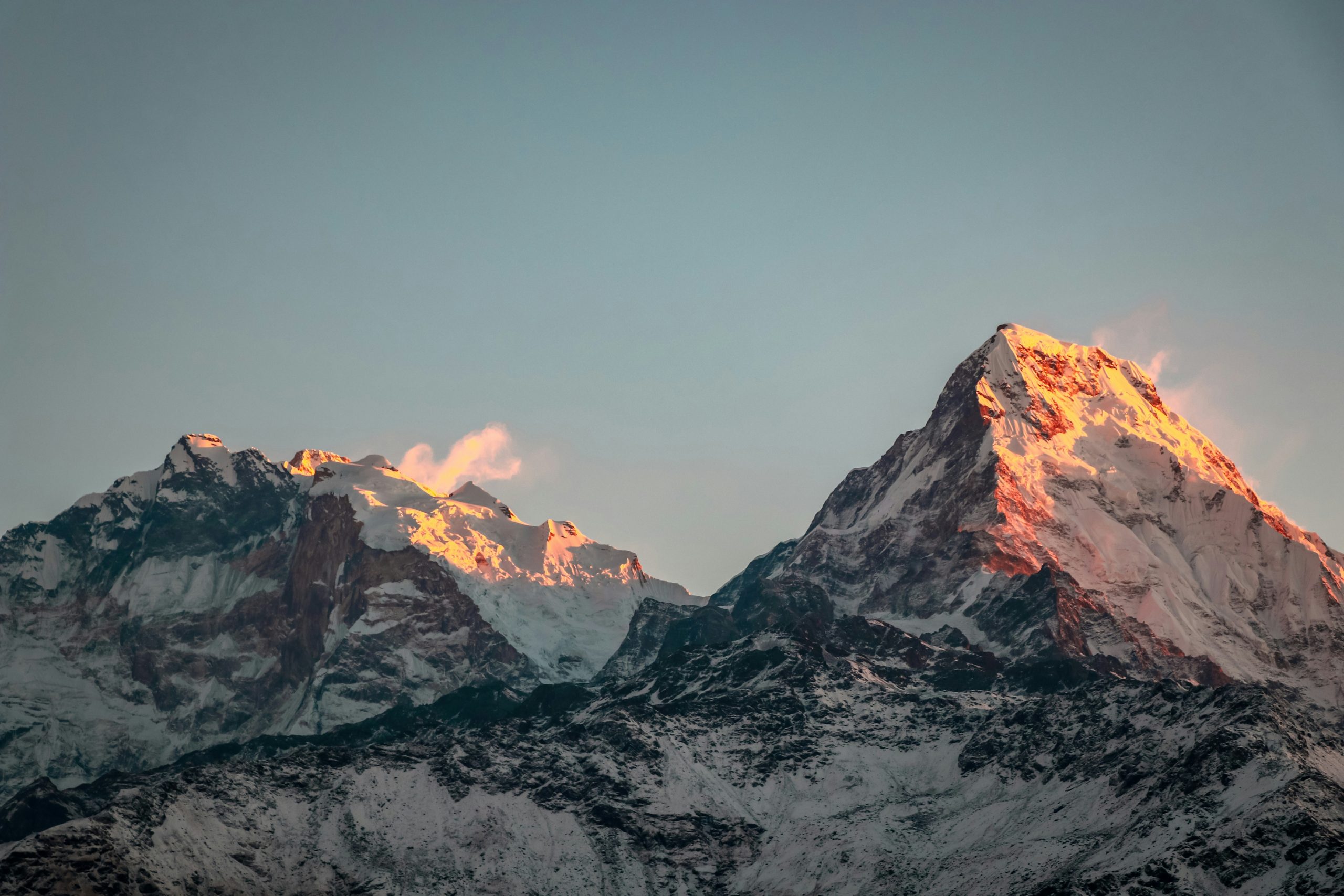
You start early for the climb to Poon Hill (3,210 m). At dawn, the sun lights up Annapurna and Dhaulagiri in gold. It is one of the best sunrise views in Nepal. Then you walk back down to Ghorepani and on through Ulleri to the road. After that, a vehicle takes you to Pokhara. So you can relax by the lake, with a long trek behind you.
- Duration: 4 hrs trek, 2 hrs drive and 30 min flight
- Max Altitude: 3210 m
- Meals: Breakfast & Lunch Included
- Accommodation: Shared Star Hotel
This is the last day of your trip. After breakfast, you travel from Pokhara to Kathmandu by tourist bus or a short flight. Then a Spade Himalaya guide drives you to the airport for your flight home. So you leave with photos of a high pass, a holy temple, and a famous sunrise.
- Max Altitude: 1,400 m
- Meals: Breakfast Included
Trips Include
- Shared star hotel in kathmandu for 2 nights (arrival and post-trek), with breakfast Included. (Private room can be organized at extra cost).
- Airport pick-up and drop-off service.
- Return flight from Pokhara to Kathmandu.
- Three meals a day during the trek (breakfast, lunch, and dinner)
- Experienced English-speaking guide.
- Comfortable accommodation in hotels and tea houses.
- Safe drinking water using a filter or purification tablets.
- Porters to carry your luggage.
- All necessary permits (ACAP and TIMS).
- First aid medical kit.
- All ground transportation as per itinerary.
Trips Exclude
- International airfare.
- Lunches and dinners in Kathmandu.
- Nepal entry visa (US$30 for 15 days, US$50 for 30 days, US$125 for 90 days).
- Drinks, snacks, hot showers, Wi-Fi, and device charging on the trail.
- Tips for guide and porters.
- Travel and medical insurance.
- Personal expenses and any costs from early departure.
- Any othere that is not mentioned on included.
Trips Altitude
Trips Map
Trips Gallery
Packing List
Upper Body
- Thermal base layers (top)
- Long-sleeve t-shirts
- Fleece or wool mid-layer
- Windproof and waterproof shell jacket
Lower Body
- Thermal base layers (bottom)
- Windproof and waterproof shell trousers
- Comfortable trekking trousers
- Warm trousers
Others
- Warm hat that covers the ears
- Neck warmer
- Sunglasses
- Sunscreen (SPF 35–60)
- Headlamp with spare batteries
Hands
- Liner gloves
- Warm shell glove
Feet
- Waterproof trekking boots (broken in)
- 4–5 pairs of wool socks
- Sock liners
- Sandals or light shoes for the evenings
First Aid Kits
- Diamox (125–250 mg) for altitude
- Ibuprofen
- Blister care
- Water-purification tablets
- Adhesive bandages
- Anti-itch cream
Others
Documents & Extras
- Passport
- 4 passport photos
- Refillable water bottle with filter
- Small daypack (the porter carries your duffel)
Optional
- Power bank
- Camera with chargers and spare batteries
Good to Know
Before You Go
Bring your passport, two passport photos, and a readable copy of your travel insurance to the pre-trip meeting so Spade Himalaya can arrange your Annapurna Conservation Area Permit (ACAP) and licensed guide, both mandatory on the circuit. The ACAP costs NPR 3,000 for foreign nationals and is checked at posts from Besisahar to Jomsom, so carry the printed copy; phone photos aren’t accepted.
The Annapurna Circuit packs Nepal’s full range into 12 days. You move from green valleys to high desert, cross a 5,416 m pass, and visit a holy temple. So it feels like several treks in one. Best of all, you walk Nepal’s classic loop with a licensed local guide.
Spring and autumn are the prime seasons. In spring, the rhododendron forests bloom red and pink. In autumn, the air is clear after the rains, so the views are sharp. Winter is cold, and snow can block Thorong La. The summer monsoon brings rain and leeches lower down, so most trekkers skip it.
This trek is moderate to strenuous, and it is long. So train before you come. Build your stamina with regular cardio, like walking, jogging, or cycling. Also strengthen your legs for the climbs and the long descent. A few practice hikes with a daypack help a lot. The fitter you are, the more you will enjoy the pass.
The plan climbs slowly and adds a rest day at Manang. So your body has time to adjust before the pass. Drink 3 to 4 litres of water a day, and walk at an easy pace. Skip alcohol up high, and eat well for energy. Tell your guide early if you feel a headache or nausea. Going down is the best cure, and your guide carries an oximeter.
The trek runs through the Annapurna Conservation Area, so foreigners must trek with a licensed guide. You also need the ACAP permit and a TIMS card. Spade Himalaya is a registered agency, so the guide and permits are all handled for you. You only need your passport, photos, and insurance copy.
The high trail runs on cash, and ATMs are only in Pokhara and a few lower towns. So carry enough Nepalese rupees. Hot showers, Wi-Fi, and charging all cost a small fee that rises with altitude. A power bank and a local SIM are smart to bring. So keep some small notes handy for the villages.
You can extend or shorten the trek to fit your time. For more culture, add Muktinath, Mustang, and Marpha on the 15-day Annapurna Circuit via Thorong La Pass. For a shorter trip, see the Annapurna Base Camp Trek or the Ghorepani Poon Hill Trek. So just tell Spade Himalaya your dates and ideas, and we plan the right route.
Trips Reviews
Smooth and flexible itinerary in winter
Strong safety management in harsh conditions
Excellent organization on a demanding winter route
An Amazing Trek with Incredible Landscapes Every Single Day

Trips FAQs
Trek Difficulty & Fitness
It is graded moderate to strenuous. The difficulty comes from the altitude and the long days, not technical climbing. You walk 5 to 8 hours a day, and the high point is Thorong La at 5,416 m. There is no climbing gear needed. So fit trekkers who train first and pace themselves can complete it well.
Yes, if you are reasonably fit. You do not need past trekking experience. Still, you should be able to walk 5 to 6 hours a day and handle uphill sections. A few months of cardio and hill training makes a real difference. So a slow, guided pace handles the rest.
Guide Requirement & Trek Regulations
Yes. Since 2023, foreign trekkers must use a licensed guide in the Annapurna region (Nepal Tourism Board, retrieved 2026-06-26). You also need two permits: the Annapurna Conservation Area Permit (ACAP) and a TIMS card. Spade Himalaya arranges the guide and both permits for you.
The ACAP permit is about NPR 3,000 (around US$25) for foreign trekkers (Nepal Tourism Board, retrieved 2026-06-26). The TIMS card is about NPR 2,000 (around US$15). So the permits total roughly US$40 per person. Spade Himalaya includes both in the trip cost.
Accommodation, Connectivity & Trail Facilities
ATMs are found only in Pokhara and on the lower trail. So carry enough Nepalese rupees in cash for the high section. You pay cash for snacks, drinks, charging, Wi-Fi, hot showers, and tips. Most teahouses do not accept cards.
You sleep in simple teahouses, usually in twin rooms with shared bathrooms. Lower down, some have private bathrooms. The food is hearty and varied. Dal bhat (rice and lentils) is the staple, with free refills. You can also get potatoes, Tibetan bread, noodles, and soup. Vegetarian meals are easy to find.
Insurance, Safety & Health
Yes, it is a must. Your policy has to cover trekking above 5,000 m and a helicopter rescue. Many normal policies do not, so check the wording first. Arrange it at home before you fly. Then leave a copy with Spade Himalaya at the briefing.
It is a real risk, since you cross 5,416 m. In one study of Nepali Himalaya trekkers, AMS affected about 51% of people at 4,500 to 5,000 m (PubMed, retrieved 2026-06-26). So the plan adds an acclimatization day at Manang and climbs slowly. Drink plenty of water, skip alcohol up high, and tell your guide early if you feel unwell.
Best Time
Spring (March to May) and autumn (late September to November) are best. Both give clear skies and an open pass. Autumn is the most popular and the clearest. Winter can block Thorong La with snow, and the monsoon brings rain lower down, so most trekkers avoid those seasons.