Trip Facts
Duration:
24 Days
Max Altitude:
Kang La pass, 5,360 m (17,585 ft)
Activities:
Remote high-altitude camping trek
Region:
Dolpo (Shey Phoksundo National Park)
Starting Point:
Kathmandu
Ending Point:
Kathmandu
Grade:
Challenging
Group Size:
Min 2
Best Season:
April-May and September-October
Notice
Upper Dolpo is a restricted area. By law you must trek with a government-licensed guide through a registered agency and carry a special restricted-area permit. Spade Himalaya arranges every permit and runs the trip as a fully supported camping expedition.
This is a 24-day fully catered camping trek, not a teahouse walk. Food and lodging are scarce in Dolpo, so you sleep in tents with a full crew and cook. The high point is Kang La pass (5,360 m), with several nights above 4,000 m.
The trek is remote and demanding and is best suited to fit, experienced trekkers. It reaches the ancient Crystal Monastery (Shey Gompa) and the turquoise Phoksundo Lake in one of the most isolated corners of the Himalaya.
Overview of Upper Dolpo Trek 24-Days
The Upper Dolpo Trek is a 24-day camping expedition into the high Tibetan-influenced country of western Nepal, a region that stayed closed to outsiders until 1989 and still feels like another world. Cut off behind the Dhaulagiri range and the Tibetan Plateau, Dolpo is a land of barren high-desert valleys, deep gorges, ancient Buddhist and Bon villages, and some of the warmest hospitality you will find anywhere in Nepal. It is the setting of Peter Matthiessen’s classic 1978 book The Snow Leopard and of the Oscar-nominated 1999 film Himalaya (released in some countries as Caravan).
The whole route lies inside Shey Phoksundo National Park, at 3,555 km² the largest and only trans-Himalayan national park in Nepal, established in 1984. The park protects snow leopard, grey wolf, musk deer, and blue sheep, and holds the jewel of the trek, Phoksundo Lake (3,612 m), a striking turquoise lake up to 145 m deep, among the deepest in the country. The cultural heart of the journey is the centuries-old Crystal Monastery (Shey Gompa), one of the most revered gompas in Nepal, reached over the Kang La pass at 5,360 m, the highest point of the trek.
From the airstrip at Jhupal the trail follows the Phoksundo river to the lake, crosses Kang La and Saldang La (about 5,010 m) into the hidden valleys of Saldang and Dho Tarap, then descends the long Tarap valley back to Dunai. Along the way you pass Bon villages where a pre-Buddhist faith still shapes daily life, mani walls and chortens, and views toward Dhaulagiri and the peaks of the Kanjiroba Himal. Because Dolpo sits in the rain shadow of the main Himalaya, it stays relatively dry even in the monsoon, which makes its trekking window unusually flexible.
Spade Himalaya runs this trek as a full camping expedition with a licensed Dolpo-experienced guide, a cook and kitchen crew, and a pulse oximeter for daily health checks. This is not a first-timer’s trek: the remoteness, altitude, and camping demand strong fitness and ideally previous Himalayan experience. If you are after a less committing introduction, the Everest Base Camp Trek or Annapurna Base Camp Trek are gentler first journeys. For comparable wildness, the remote Makalu Base Camp Trek and the restricted Manaslu Circuit Trek are the closest cousins to Dolpo.
Dolpo demands more planning than any teahouse route. First, our Nepal trekking permits guide explains restricted area paperwork. Next, the packing list covers expedition gear. And our altitude sickness guide is required reading for three weeks above 4,000 m.
Trips Highlights
- Trek through Upper Dolpo, one of the most remote and restricted regions in Nepal.
- Visit the centuries-old Crystal Monastery (Shey Gompa), made famous by The Snow Leopard.
- Camp beside the turquoise Phoksundo Lake (3,612 m), one of Nepal's deepest lakes.
- Cross the high passes of Kang La (5,360 m) and Saldang La (about 5,010 m).
- Explore Shey Phoksundo National Park, Nepal's largest and only trans-Himalayan park.
- Walk through Tibetan-influenced Bon and Buddhist villages: Saldang, Dho Tarap, and Tarakot.
- See rugged, high-desert landscapes that feel more like Tibet than Nepal.
- Meet the warm, welcoming people of Dolpo, where children rush out to greet trekkers.
- Look out toward Dhaulagiri and the peaks of the Kanjiroba Himal.
- Experience a true tented camping expedition far beyond the teahouse trails.
Route Details
Fly into Jhupal, walk up the Phoksundo valley to the lake, cross Kang La to the Crystal Monastery, traverse via Saldang La into the Saldang and Dho Tarap valleys, then descend the Tarap gorge to Dunai for the flight home.
Kathmandu (1,400 m) → fly to Nepalgunj → fly to Jhupal (2,320 m) → Dunai (2,150 m) → Chhepka (2,838 m) → Rechi (2,940 m) → Phoksundo Lake (3,600 m) → Thulodhunga (3,607 m) → Phoksundo Bhanjyang (4,400 m) → Kang La pass (5,360 m) → Shey Gompa (4,126 m) → Saldang La pass (5,010 m) → Namgung (4,400 m) → Saldang (3,620 m) → Rakyo (4,160 m) → High Camp (4,560 m) → Tokyu (4,209 m) → Dho Tarap (4,040 m) → Nawarpani (3,470 m) → Laina Odar (3,370 m) → Tarakot (2,537 m) → Dunai → fly out via Jhupal and Nepalgunj to Kathmandu.
Trips Itinerary
A Spade Himalaya representative meets you at Tribhuvan International Airport and transfers you to your hotel, which is roughly thirty minutes from the terminal.
Kathmandu sits at 1,400 m, so there is no altitude to manage yet. Dolpo needs more preparation than most treks, so the briefing today is a long and detailed one.
Your guide checks your gear and completes the restricted area paperwork, so bring your passport, photographs and a copy of your insurance. The evening is then free in Thamel.
- Accommodation: 3 Star Hotel
A short guided tour of the Kathmandu highlights in the morning, and then an afternoon flight south to Nepalgunj, a city on the plains near the Indian border.
Nepalgunj is low, flat and hot, a real contrast with everything that follows. There is no direct flight from Kathmandu to Dolpo, which is why the night here is necessary, and it puts you in place for the early mountain flight tomorrow. Pack so your trekking kit is easy to reach.
- Duration: Flight: about 1 hr ·
- Accommodation: Hotel
A spectacular early flight lands on the small mountain airstrip at Jhupal, where you meet the camping crew and then walk down to the district town of Dunai.
Jhupal is at 2,320 m and Dunai at 2,150 m, three or four hours of easy walking through terraced fields and along the Bheri river. It is a gentle start to a long trip.
Dunai is the administrative centre of Dolpa district and the last town of any size you will see for three weeks. The camping routine starts here and runs until the very end.
- Duration: Walking: 3 to 4 hrs ·
- Accommodation: Tented Camp
You enter Shey Phoksundo National Park today and follow the Phoksundo river up a deep forested gorge, crossing suspension bridges and passing small settlements.
Chhepka is at 2,838 m after five or six hours, so you gain nearly 700 m. The climbing is steady rather than steep and the forest gives shade for most of the way.
Shey Phoksundo is the largest national park in Nepal, and this lower valley is the richest part of it for wildlife. The forest here is pine and walnut, so keep your eyes open.
- Duration: Walking: 5 to 6 hrs ·
- Accommodation: Tented Camp
A scenic day continuing up the river valley, weaving between forest, cliff and riverbank, with the country slowly opening out and drying as you climb.
Rechi is at 2,940 m, only 100 m above Chhepka, across five or six hours. The net gain is small but the trail rises and falls all day, so it is a proper walk. This is the border between the wet southern forests and the dry inner valleys, and you can watch it change as you go.
- Duration: Walking: 5 to 6 hrs ·
- Accommodation: Tented Camp
A shorter but genuinely rewarding day. A steep climb takes you to a ridge with a view of Nepal’s tallest waterfall, then drops to the shore of Phoksundo Lake.
The lake is at 3,600 m, which is 660 m above Rechi, across four or five hours. The climb to the ridge is the hard part and the rest is a descent down to the water.
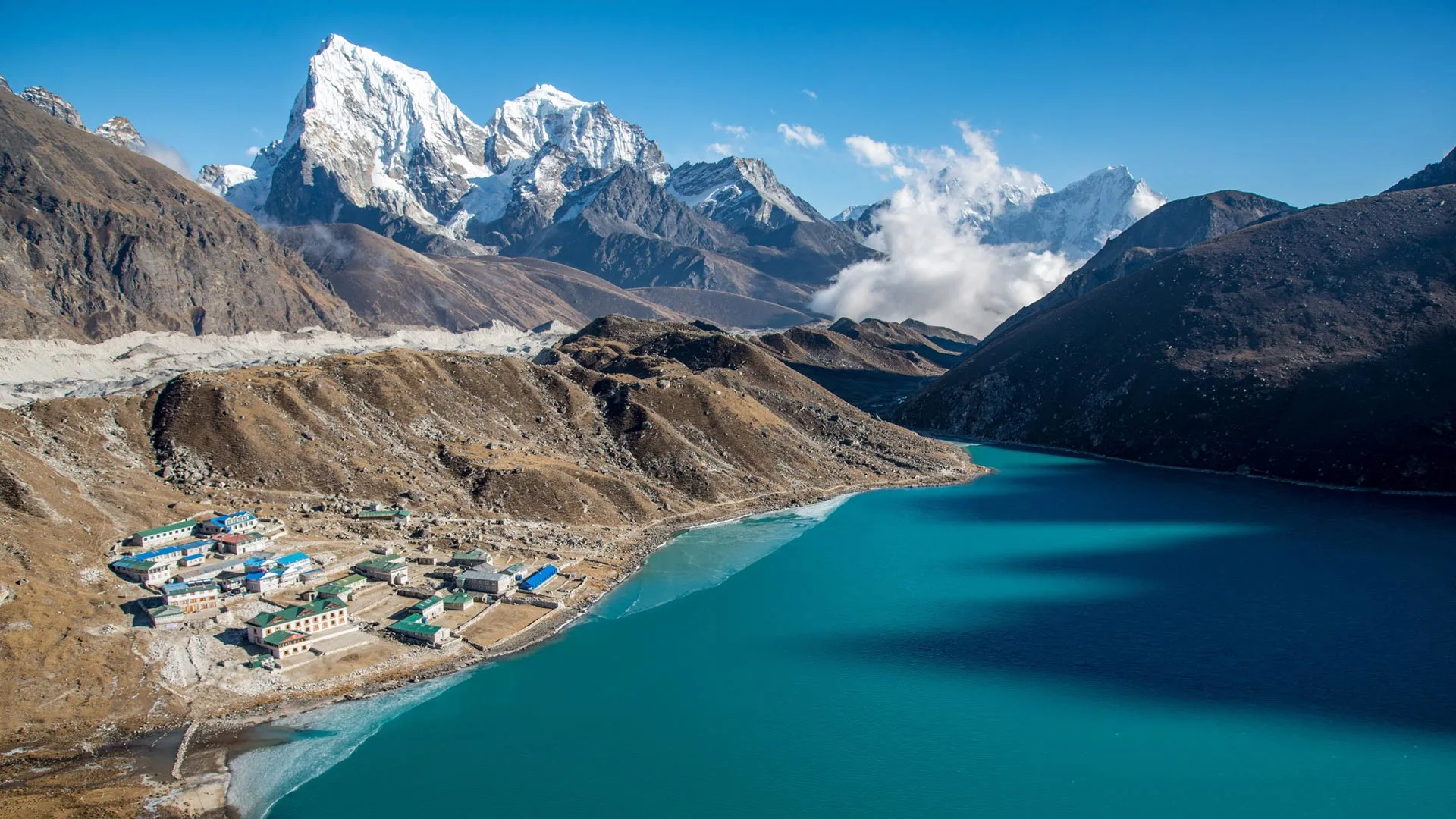
The first sight of that turquoise water below its ring of cliffs, with Ringmo village at the near end, is one of the great moments in Nepali trekking.
You camp beside the lake that night. Almost nobody who has seen it in photographs believes the colour is real until they are standing next to the water.
- Duration: Walking: 4 to 5 hrs ·
- Accommodation: Tented Camp
A rest day beside the lake, and one of the best settings anywhere to spend one. You can visit the Bon monastery above Ringmo or simply walk along the shore.
Any higher walking tops out a few hundred metres above the camp across two to four hours, then you come back down to sleep at 3,600 m, which is the point of the day.
Phoksundo is the deepest lake in Nepal and is protected as a Ramsar wetland site. Bon is an older tradition than Buddhism in this region and Ringmo is one of its strongholds.
- Duration: Walking: 2 to 4 hrs ·
- Accommodation: Tented Camp
You follow the famous trail cut into the cliff above the western shore of the lake, an exposed and dramatic path, then continue up the upper Phoksundo river.
Thulodhunga is at 3,607 m, so you finish almost exactly where you started, across five or six hours. The cliff path is the part of the day everyone remembers.
The trail is narrow with a long drop to the water, though it is well used and your crew will be moving loaded animals along it. The country turns wild beyond the lake.
- Duration: Walking: 5 to 6 hrs ·
- Accommodation: Tented Camp
A steady climb up the valley toward the foot of the Kang La, gaining real height and moving into open, barren country above the last of the vegetation.
Phoksundo Bhanjyang is at 4,400 m, so you gain nearly 800 m across five or six hours. The camp sits among meadows below the pass with nothing else around it at all, and this is an early night, because tomorrow is the highest day of the whole trek.
- Duration: Walking: 5 to 6 hrs ·
- Accommodation: Tented Camp
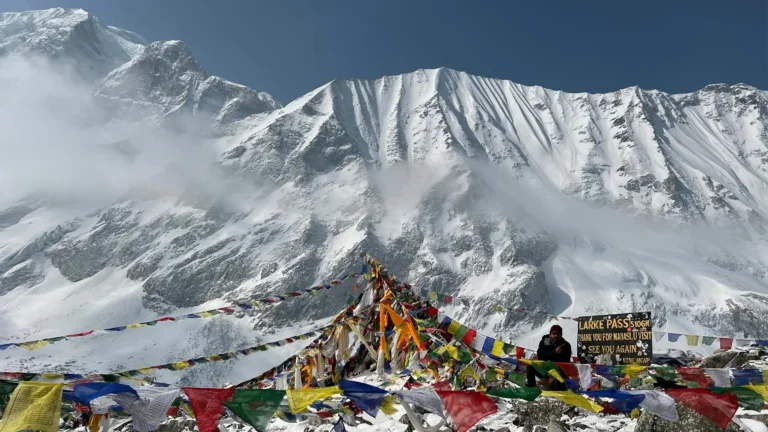
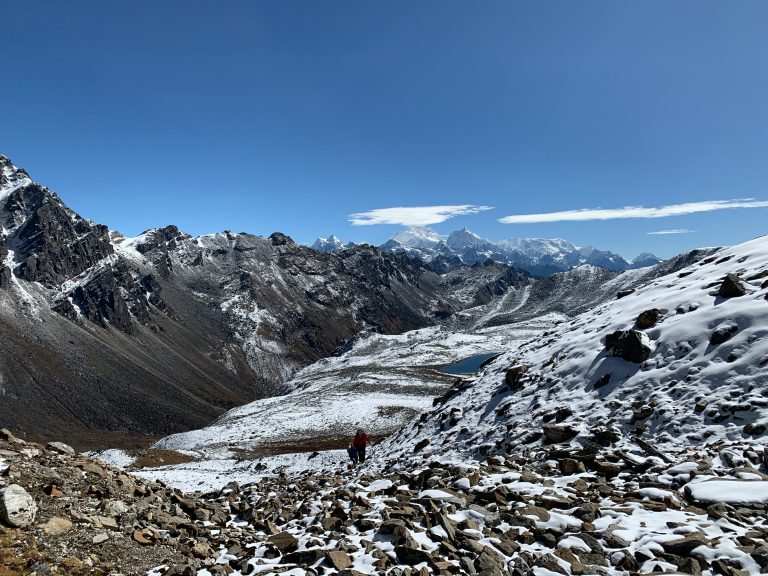
The highest day. A steady climb takes you to the prayer flags on top of the Kang La, and a long descent then drops into the hidden valley of the Crystal Monastery.
The Kang La is 5,360 m and Shey Gompa is at 4,126 m, six or seven hours in all. That is nearly 1,000 m up and then more than 1,200 m down in a single day.
The views from the top of the pass run across the Dolpo ranges in every direction, with nothing built and nothing farmed anywhere at all within sight of you.
Shey Gompa, the Crystal Monastery, is the spiritual centre of the whole of inner Dolpo, and you camp beneath Crystal Mountain itself at the end of the descent.
- Duration: Walking: 6 to 7 hrs .
- Accommodation: Tented Camp
A rest day at Shey Gompa, spent exploring the monastery and the valley around it, which is a place that very few outsiders have ever seen for themselves at all.
You stay at 4,126 m and any walking you do is two to four hours at most. The rest also does the quiet work of getting you ready for the next high pass.
Shey is an ancient site of pilgrimage for both Buddhists and followers of Bon. You can walk the kora circuit around Crystal Mountain, which is what pilgrims come here to do.
- Duration: Walking: 2 to 4 hrs ·
- Accommodation: Tented Camp
Another high crossing. The trail climbs to the Saldang La with more wide Dolpo views, then descends into the Nam Khong valley to the settlement of Namgung.
The Saldang La is around 5,010 m and Namgung is at 4,400 m, six or seven hours in all. It is about 900 m of climbing and then 600 m of descent on the far side.
The country here is stark, dry high desert under very big skies, and it looks a great deal more like Tibet than Nepal. Namgung is a small settlement built around its monastery.
- Duration: Walking: 6 to 7 hrs.
- Accommodation: Tented Camp
A shorter descending day brings you down to Saldang, one of the largest and best off villages in Upper Dolpo, strung out along the hillside above the river.
Saldang is at 3,620 m, so you drop around 780 m across four or five hours. After two high passes in three days, this is a very welcome and much easier stage. The village has terraced fields, long lines of chortens and old trading links over the passes into Tibet.
- Duration: Walking: 4 to 5 hrs ·
- Accommodation: Tented Camp
The trail leads through more Tibetan influenced villages and dry rolling country, past mani walls, chortens and grazing yaks, on the long way up to Rakyo.
Rakyo is at 4,160 m, so you climb back up around 540 m across five or six hours. You are in and out of side valleys all day rather than following one line, and each settlement along here has its own character and its own gompa.
- Duration: Walking: 5 to 6 hrs ·
- Accommodation: Tented Camp
A climb up to a high camp set among open pasture and ridges, which puts you in position for the crossing over into the Tarap valley early tomorrow morning.
High Camp is at 4,560 m, about 400 m above Rakyo, across five or six hours. Sleeping this high under canvas is one of the genuine demands of this trek.
There is nothing here but grazing ground, the crew and the tents. The compensation is the silence and the night sky, which on a clear night in Dolpo is remarkable.
- Duration: Walking: 5 to 6 hrs ·
- Accommodation: Tented Camp
A long day crossing a high ridge near the Jeng La into the Tarap valley, with wide views back over all of the country you have already walked through.
Tokyu is at 4,209 m and the day takes six or seven hours. You climb to the ridge and then descend into the valley, so the effort comes early. Tokyu is a village with an old monastery, set among barley fields high in the Tarap valley, and this is the last of the big crossings.
- Duration: Walking: 6 to 7 hrs ·
- Accommodation: Tented Camp
A short and easy day walking down the Tarap valley to Dho Tarap, which leaves you with the whole of the afternoon free to look around the village properly.
Dho Tarap is at 4,040 m and the walk takes about two hours. It is one of the highest permanently inhabited settlements anywhere in this part of Nepal.
Bon and Buddhist traditions sit side by side here and the village has several gompas worth visiting. People in Dho Tarap are known for how welcoming they are to visitors.
- Duration: Walking: about 2 hrs
- Accommodation: Tented Camp
The long descent down the Tarap gorge begins today. The trail follows the Tarap Chu through a narrowing canyon, dropping steadily out of the high desert.
Nawarpani is at 3,470 m, so you lose around 570 m across six or seven hours. The change in the landscape, the plants and the air is striking over the course of a single day, and the canyon closes in around you as the valley drops away.
- Duration: Walking: 6 to 7 hrs ·
- Accommodation: Tented Camp
You continue down the gorge, crossing and recrossing the river on narrow trails and small bridges, through some of the wildest scenery of the whole trek.
Laina Odar is at 3,370 m, so it is only 100 m of net descent across five or six hours. The trail is rough and exposed in places, so it is slower than the figures suggest.
Camp is a riverside spot deep in the canyon with the sound of the water all around it. Blue sheep and, very rarely, snow leopard live in this country.
- Duration: Walking: 5 to 6 hrs ·
- Accommodation: Tented Camp
A scenic descent brings you out of the gorge to Tarakot, an old fortress village standing high above the Bheri river, with a very long history behind it.
Tarakot is at 2,537 m, so you drop over 800 m across five or six hours. The greenery and the warmth return quickly and the air feels properly thick again. Tarakot was once an important trading centre for this whole region, and the old fort above it is the reason for its position.
- Duration: Walking: 5 to 6 hrs ·
- Accommodation: Tented Camp
A final walk along the Bheri river back down to Dunai, and then a short drive up to Jhupal to spend the last night near the airstrip ready for the flight.
Dunai is at 2,150 m and Jhupal at 2,320 m, with five or six hours of relaxed walking and then a short drive back up the hill at the end of the afternoon.
This is the evening to thank the camping crew and settle tips, because they leave you here. It is also the first proper look back over three weeks of walking.
- Duration: Walking: 5 to 6 hrs
- Accommodation: Guest House
A morning flight from Jhupal to Nepalgunj and then another on to Kathmandu, weather permitting, which usually takes most of the day across the two legs.
Be ready for the fact that mountain flights in Dolpo are delayed regularly, so patience helps here more than anywhere else on the trip. A representative meets you and takes you to your hotel, and the rest of the day is free to rest and clean up after weeks in the field.
- Duration: Flight: most of the day ·
- Accommodation: 3 Star Hotel
A free or guided day in the Kathmandu valley, and it sits in the itinerary as a sensible buffer in case the Jhupal flight happened to have run late on you.
If everything went to plan, the day is yours to use however you like. You can revisit the valley sites, shop for gifts in Thamel or simply do nothing at all. In the evening Spade Himalaya presents your trip completion certificate.
- Duration: Walking: light ·
- Accommodation: 3 Star Hotel
Your trip ends today. A representative collects you from the hotel and transfers you to the airport, about thirty minutes from Thamel though traffic can stretch it. You leave having walked one of the most remote routes anywhere in Nepal.
Trips Include
- Airport transfers in a private vehicle.
- 3 nights' hotel in Kathmandu (twin share) with breakfast.
- 1 night hotel in Nepalgunj with breakfast.
- All domestic flights: Kathmandu to Nepalgunj to Jhupal and back, for clients and crew.
- Full-board meals during the camping trek, prepared by an expert cook, with tea and coffee, plus fresh fruit each evening.
- Shey Phoksundo National Park entry permit, the Upper Dolpo restricted-area permit, and the Lower Dolpo permit.
- A licensed, experienced English-speaking guide.
- Porter support, one porter per two trekkers.
- First-aid kit.
- Guided Kathmandu sightseeing.
Trips Exclude
- International airfare to and from Nepal.
- Nepal entry visa (US$30 for 15 days, US$50 for 30 days, US$125 for 90 days).
- Travel and medical insurance (mandatory; must cover high-altitude trekking and helicopter evacuation).
- Lunches and dinners in Kathmandu.
- Kathmandu sightseeing monument entrance fees (about US$30 per person).
- Drinks, snacks, and desserts beyond the catered meals.
- Hot showers and device charging where available.
- Tips for guide, crew, and porters.
- Excess baggage over 10 kg for the Jhupal flight.
- Personal expenses and any costs from early return, trip extension, or unforeseen events (weather, flight delays, strikes).
- Anything not listed under Cost Includes.
Trips Altitude
Packing List
General
- Four-season (zero degree) sleeping bag
- Sleeping bag liner
- Puffy down jacket
- Duffel bag
- Daypack, 30 to 45 litres, with a rain cover
Upper Body
- Warm hat or beanie that covers the ears
- Neck gaiter, buff, or scarf
- Sunglasses with UV protection (essential in the high desert glare)
- Headlamp with spare batteries
- Sunscreen (SPF 35 to 60) and lip balm
- Technical base-layer tops (long and short sleeve)
- Fleece jacket or wool pullover
- Waterproof, windproof shell jacket
Lower Body
- Thermal base-layer trousers
- Comfortable trekking trousers
- Casual or sport trousers for camp
- Waterproof, windproof shell trousers
Hands
- Wool or technical liner gloves
- Insulated shell outer gloves (the high passes are bitterly cold)
- Light gloves for using walking poles (optional)
Feet
- Waterproof trekking boots (well broken in)
- 4 to 5 pairs of warm wool socks and sock liners
- Light shoes or sandals for camp
- Micro spikes or instep crampons (useful on the passes with snow)
- Gaiters (light for dust, heavier for snow)
Undergarments
- Quick-drying technical underwear
- Sports bras (women)
- Thermal underwear set for cold nights
First Aid Kits
Your guide carries a comprehensive kit, medication, and a pulse oximeter, but a personal kit is strongly recommended in such a remote region.
- Assorted adhesive and butterfly bandages
- Blister treatment cream and antiseptic ointment
- Ibuprofen or other pain relief
- Altitude medication such as acetazolamide (Diamox), only if advised by your doctor
- Insect or anti-itch ointment
- Water-purification tablets
Others
- Passport, 4 passport-size photos, and a copy of your insurance and flight details
- Reusable water bottle and a water filter or purifier
- Toiletry kit, quick-dry towel, toilet paper, hand wipes, and soap
- High-energy snacks (bars, nuts, dried fruit)
- Waterproof or dry bags for documents and electronics
Optional
- Trekking poles
- Power bank and spare batteries (charging is rare in Dolpo)
- Camera with memory cards, charger, and spare batteries
Good to Know
Before you go
- Permits and ID. Bring your passport, four passport photos, and a readable copy of your insurance to the pre-trip meeting so Spade Himalaya can arrange the Upper Dolpo and Lower Dolpo restricted-area permits and the national park entry permit.
- Money. Carry enough Nepalese rupees in cash from Kathmandu. There are no ATMs or card facilities in Dolpo, and very little to buy on the trail, so budget for tips and a few personal extras only.
- Buffer days. Flights to and from Jhupal via Nepalgunj are weather-dependent and often delayed. Keep spare days before any onward international flight.
Reaching Dolpo means flying first to Nepalgunj on the southern plains, then onto the small mountain airstrip at Jhupal, since there is no direct flight from Kathmandu. As a restricted area, Upper Dolpo can only be trekked with a licensed guide on an organised, permitted trip. Spade Himalaya is a registered agency, so your permits, flights, camping logistics, and emergency cover are all handled end to end.
The itinerary follows the climb-high, sleep-low principle with rest days at Phoksundo Lake and Shey Gompa before and between the high passes. Drink 3 to 4 litres of water a day, walk slowly, avoid alcohol up high, and tell your guide early if you feel unwell. Carry altitude medication if your doctor advises it. Given the remoteness, descending and helicopter evacuation are the only serious responses to severe altitude sickness.
- Accommodation. Full-board tented camps throughout, with a dining tent, kitchen tent, and toilet tents, set up by your crew. Nights are cold, so the provided or personal sleeping bag matters.
- Food. All meals are cooked fresh by the expedition cook, with as much variety as the remote supply chain allows, plus fresh fruit in the evenings. Resources are scarce in Dolpo, so a flexible attitude helps.
- Drinking water. Refill and purify with tablets or a filter; bottled water is essentially unavailable in this region.
- Respecting Dolpo. This is a fragile, traditional culture. Walk clockwise around mani walls and chortens, ask before photographing people or shrines, and tread lightly in villages that see very few visitors.
Trips Reviews
An Extraordinary Journey Through One of Nepal’s Most Remote Regions
Trips FAQs
Trek Overview: Why Choose the Upper Dolpo Trek?
Shey Gompa, the Crystal Monastery, is a centuries-old and deeply revered Buddhist and Bon site in the hidden heart of inner Dolpo. It was made famous worldwide by Peter Matthiessen’s 1978 book The Snow Leopard. You reach it over the Kang La pass and spend a rest day there, walking the pilgrim kora around Crystal Mountain and visiting the gompa.
The trek runs through Shey Phoksundo National Park, home to snow leopard, grey wolf, musk deer, and blue sheep, though the snow leopard is famously elusive. Culturally, Dolpo is one of the last strongholds of the pre-Buddhist Bon religion, alongside Tibetan Buddhism, seen in its monasteries, mani walls, chortens, and the daily life of villages like Saldang and Dho Tarap.
Trek Difficulty: Who Can Trek?
It is graded challenging and is one of the hardest treks in Nepal. You spend over three weeks in a remote region, cross high passes including Kang La (5,360 m), sleep many nights above 4,000 m, and camp throughout. There is no technical climbing, but strong fitness and ideally previous Himalayan trekking experience are essential. This is not a beginner’s trek.
Guide Requirement & Trek Regulations
Yes. Upper Dolpo is a restricted area. So by law, you must trek with a licensed guide from a registered agency and carry a special permit. In March 2026, Nepal began letting solo travellers apply for a restricted-area permit, now through an online, pre-arrival system (Kathmandu Post, 2026). Still, a licensed guide and a registered agency are required. Spade Himalaya arranges the Upper Dolpo permit, the Lower Dolpo permit, and the national park entry permit. We also provide the licensed guide and the full camping crew.
The Upper Dolpo restricted-area permit costs US$500 per person for the first 10 days, then US$50 per person per day beyond that (Nepal Department of Immigration, retrieved 2026-06-17). You also need a Lower Dolpo permit and the Shey Phoksundo National Park entry fee (about NPR 3,000). Spade Himalaya includes all of these in the trip cost and handles the paperwork.
Accommodation and Camping Experience
It is a fully catered camping trek. Food and lodging are scarce in Dolpo and cannot be relied upon, so you sleep in tents with a full crew, including a cook, and all meals are prepared for you. Some basic teahouses exist in a few villages, but the trek is run as a self-sufficient expedition, which is part of what makes it such an adventure.
Best Time to Trek Upper Dolpo
Late spring (April to May) and autumn (September to October) are the best windows, with clear skies and a low chance of pass-blocking snow. Because Dolpo lies in the rain shadow behind the main Himalaya, it stays relatively dry even during the summer monsoon, so it is also one of the few regions in Nepal that can be trekked in the monsoon months.
Trekker's Well-Being & Safety
Very remote. Getting there means flying to Nepalgunj, then to the tiny Jhupal airstrip, where weather often delays flights, so build in buffer days. With several passes near or above 5,000 m, altitude is a real risk: the itinerary includes rest days at Phoksundo Lake and Shey Gompa, your guide carries a pulse oximeter, and evacuation here means a helicopter, which is why comprehensive insurance is essential.
Yes, it is mandatory and critical here. Your policy must explicitly cover high-altitude trekking and helicopter evacuation, since Dolpo is far from any road and a rescue can only be done by air. Arrange it in your home country before you fly, and leave a copy with Spade Himalaya at the pre-trip meeting so the team can act fast in an emergency.