Last updated: June 2026. Every fee here is checked against official Nepal government sources.
Quick answer: To trek in Nepal in 2026, you need two things. First, a park or conservation permit, which is NPR 3,000 per area for foreigners. In most regions you also need a TIMS card, at NPR 2,000. Since 31 March 2023, you must trek with a licensed guide through a registered agency on most main routes, though the Everest region is an exception. Restricted areas like Manaslu and Upper Dolpo need extra permits. (These are the trail permits. For entering Nepal itself, see our Nepal visa on arrival and eVisa guide.)
Nepal’s trekking permits are cheap and simple once you know the system. The rules changed in 2023, so older guides online are out of date. This page is the current, official 2026 reference: what each permit costs, who needs a guide, and which treks fall under restricted-area rules. Every figure here comes from Nepal government sources.
Key Takeaways
- The national park or conservation fee is NPR 3,000 per area for foreign trekkers, about US$23 (Nepal Tourism Board, retrieved 2026-06-29).
- The TIMS card is NPR 2,000 for foreigners, or NPR 1,000 for SAARC nationals.
- Since 31 March 2023, a licensed guide and a registered agency are required across 14 major trekking regions, including Annapurna. The Everest region is the exception, because its local municipality rejected the rule.
- Restricted areas (Manaslu, Tsum, Upper Dolpo, Upper Mustang, Nar Phu, Humla) need extra permits that only an agency can issue.
Do you need a guide to trek in Nepal in 2026?
On most main routes, yes. Since 31 March 2023, foreign trekkers must trek with a licensed guide booked through a registered agency. The Nepal Tourism Board brought in the rule. It covers 14 major trekking regions, and that list includes Everest, Annapurna, Langtang, Manaslu, Mustang, and Dolpo (Nepal Tourism Board, retrieved 2026-06-29).
The Everest region is the exception. Its local Khumbu Pasang Lhamu Rural Municipality rejected the rule and allows solo trekking (The Himalayan Times, 2023-03-28), so a guide is not legally required there. Because of the altitude, we still recommend one.
Elsewhere, fully solo, guide-free trekking on Nepal’s main trails is no longer allowed. One guide can lead a small group, so couples and friends share the cost. In practice, your agency buys every permit for you, which is why a guided trip is now the simplest way to trek here.
There is one 2026 update worth knowing. In March 2026, Nepal eased the rule for restricted areas. Now a solo traveller can get a permit alone. However, a licensed guide and a registered agency are still required, and one guide may lead up to seven trekkers.
What do national park and conservation permits cost?
Every main trekking region charges a flat NPR 3,000 entry fee for foreign trekkers, which is about US$23. This is the official rate on the Nepal Tourism Board park-fee list (Nepal Tourism Board, retrieved 2026-06-29). Children under 10 enter free.
| Protected area | Trek it covers | Fee (foreign) |
|---|---|---|
| Sagarmatha National Park | Everest Base Camp, Gokyo, Three Passes | NPR 3,000 |
| Annapurna Conservation Area (ACAP) | Annapurna Circuit, Base Camp, Poon Hill, Mardi | NPR 3,000 |
| Langtang National Park | Langtang Valley, Gosaikunda, Tamang Heritage | NPR 3,000 |
| Makalu Barun National Park | Makalu Base Camp | NPR 3,000 |
| Manaslu Conservation Area | Manaslu Circuit | NPR 3,000 |
SAARC nationals pay a reduced rate, and Nepali citizens pay a small token fee. You buy the permit once, and it covers your whole trek in that region.
What is the TIMS card, and who needs it?
The TIMS card is the Trekkers’ Information Management System card, and it keeps a safety record of you on the trail. It costs NPR 2,000 for foreign trekkers, or NPR 1,000 for SAARC nationals. The Nepal Tourism Board and TAAN, which run the system together, both confirm these rates (Nepal Tourism Board, retrieved 2026-06-29; TAAN, retrieved 2026-06-30). The card is now issued online through a registered agency, so the process is quick.
Most regions require it, with one notable exception. The Everest region has no TIMS card. Instead, you pay a local Khumbu permit of NPR 3,000. The local government collects it near Lukla or Monjo. That is NPR 1,000 more than a TIMS card.
Which regions need a TIMS card and a guide?
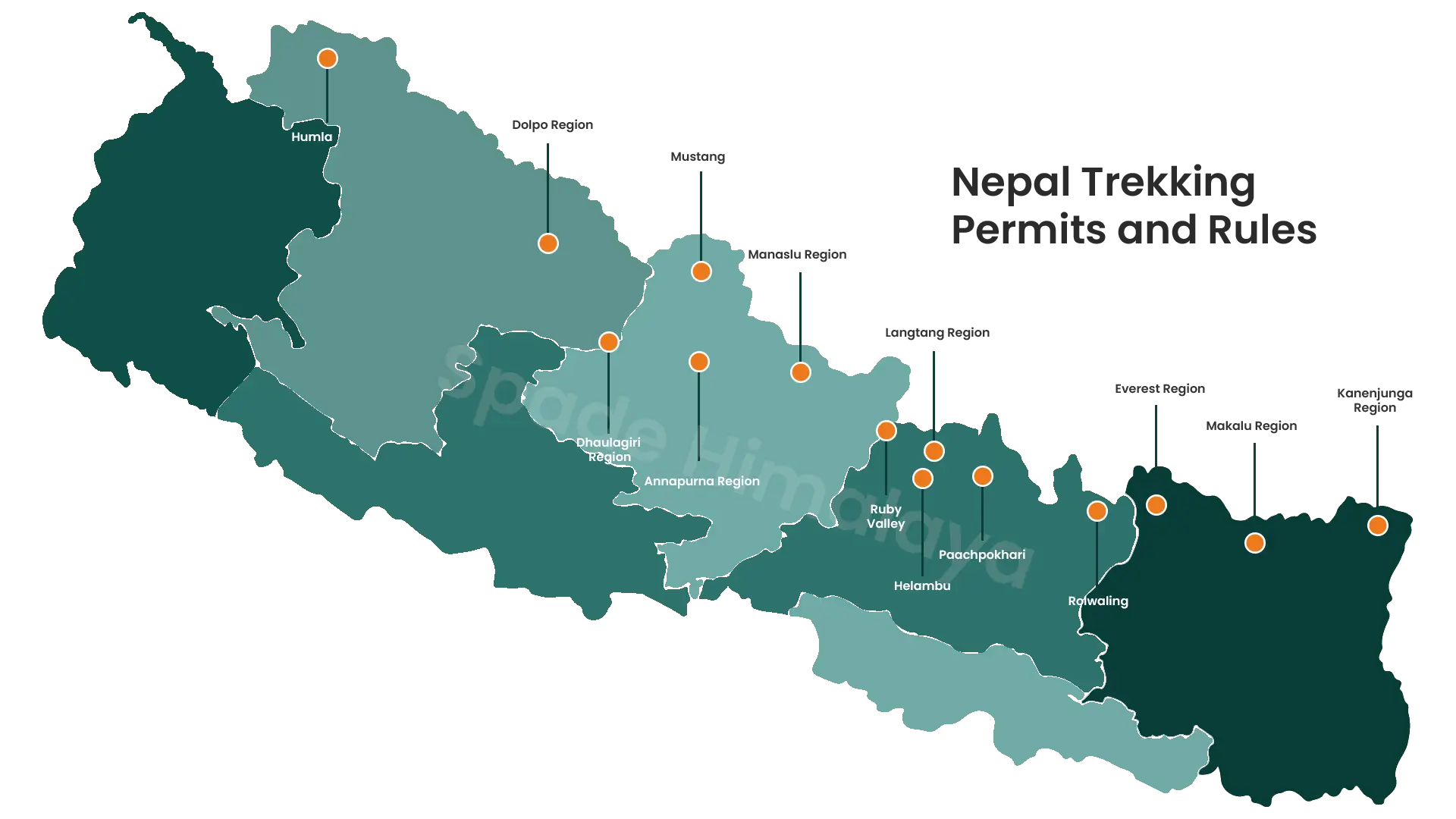
The TIMS and guide rules cover 14 official trekking regions, named by TAAN and the Nepal Tourism Board. If your trek falls in one of these, you need the permits and a licensed guide. Here is the full list (TAAN, retrieved 2026-06-30):
- Kanchenjunga
- Makalu Barun
- Everest
- Rolwaling
- Panchpokhari Bhairabkunda
- Helambu
- Langtang
- Ganesh Himal and Ruby Valley
- Manaslu
- Annapurna
- Mustang
- Dhaulagiri
- Dolpo
- Humla
One note on Everest. It is on this list, but the Khumbu region collects its own local permit in place of the TIMS card, as covered above. Its local municipality also rejected the 2023 guide rule, so a guide is not legally required there, though because of the altitude we recommend one.
Your permits are checked at official check posts along the trail. For example, you show them at Monjo on the Everest route, at Dhunche or Syabrubesi for Langtang, at Jagat for Manaslu, and at Birethanti for Annapurna. Your guide handles this for you.
Restricted-area trekking permits
Some regions sit near the Tibetan border. They need a special Restricted Area Permit (RAP), and only a registered agency can issue one. The Department of Immigration sets these fees, and they cost more than a standard park fee. You cannot get one as an individual walking up to a counter.
| Restricted area | Permit fee (foreign) |
|---|---|
| Manaslu (Gorkha) | Sep to Nov: US$100 for 7 days, then US$15/day. Dec to Aug: US$75 for 7 days, then US$10/day |
| Tsum Valley | Sep to Nov: US$40 per week. Dec to Aug: US$30 per week |
| Upper Mustang | US$500 per person for 10 days, then US$50/day |
| Upper Dolpo | US$500 per person for 10 days, then US$50/day |
| Nar Phu Valley | Sep to Nov: US$100 per week. Dec to Aug: US$75 per week |
| Humla (Limi Valley) | US$50 per week |
Figures are from the Nepal Department of Immigration (Department of Immigration, retrieved 2026-06-29). On restricted treks you also pay the relevant conservation permit. The Manaslu Circuit, for example, needs the Restricted Area Permit plus the Manaslu and Annapurna conservation permits. For the full breakdown, see our Manaslu Circuit permit guide.
Two points avoid confusion. First, the fee structures differ by region, so some are charged per week and others per 10 days. Second, a few other restricted areas exist too, such as Kanchenjunga, Api Nampa, and Gaurishankar. Their rates vary, so always confirm the current fee for your exact route with your agency.
Permits by popular trek
Here is a quick reference for the most popular routes. Each links to a deeper cost and permit guide.
| Trek | Permits you need | Rough total (foreign) |
|---|---|---|
| Everest Base Camp | Sagarmatha NP + Khumbu local permit | about US$45 |
| Annapurna treks | ACAP + TIMS | about US$38 |
| Langtang Valley | Langtang NP + TIMS | about US$40 |
| Manaslu Circuit | RAP + Manaslu CA + ACAP | about US$130 to US$170 |
| Makalu Base Camp | Makalu Barun NP + local + TIMS | about US$45 to US$60 |
A licensed guide is required on all of these except Everest Base Camp, where it is recommended rather than required. A guide costs roughly US$30 to US$35 per day. On a guided package, that cost and every permit are already included.
How do you get your permits?
The easiest way is through a registered trekking agency, which is now also the legal way. You give the agency your passport, two passport photos, and your trek dates. They buy the park permit, the TIMS card, and any restricted-area permit before you set off. Park fees and the TIMS card are paid in Nepalese rupees, while restricted-area permits are charged in US dollars. Your agency settles all of it for you.
So you do not queue at government offices yourself. On a Spade Himalaya trip, we arrange every permit and provide your licensed guide, so all you carry is your passport and your documents.
FAQs
Can you still trek solo in Nepal in 2026?
In the Everest region, yes. The local Khumbu Pasang Lhamu Rural Municipality rejected the 2023 guide rule, so independent trekking there is still allowed, though because of the altitude we recommend a guide. Elsewhere on the main routes, including Annapurna, foreign trekkers must use a licensed guide and a registered agency (Nepal Tourism Board, 2026). You can travel as a solo client, with a private guide.
How much do Nepal trekking permits cost in total?
For most treks, about US$38 to US$40 in permits: a NPR 3,000 park fee plus a NPR 2,000 TIMS card. Restricted areas cost more, for example the Manaslu Circuit runs about US$130 to US$170 in permits because of its special Restricted Area Permit.
Do you need a TIMS card for Everest Base Camp?
No. The Everest region does not use the TIMS card. Instead you pay the Sagarmatha National Park permit (NPR 3,000) and a local Khumbu permit (NPR 3,000), about US$45 in total. Both are arranged for you on a guided trip.
What is a restricted area in Nepal?
A restricted area is a sensitive border region that needs a special permit issued only through a registered agency. Manaslu, Tsum Valley, Upper Mustang, Upper Dolpo, Nar Phu, and Humla are the main ones. As of March 2026, a solo traveller can apply, but a licensed guide and agency are still required.
Who sets Nepal's trekking permit fees?
National park and conservation fees come from the Nepal Tourism Board, and restricted-area permit fees come from the Department of Immigration. Fees can change, so a good agency re-checks them before every departure.
Accuracy note: official fees, rules, and hard facts in this guide are cited inline from their sources; trail and price details are Spade Himalaya field research; route details reviewed by Yubaraj Katel, government-licensed trekking guide (Licence No. 19827) with 10 years of experience across the Everest, Annapurna, Langtang, and Manaslu regions.

Related Posts
Updated: 20 Jul, 2026
15 min
Everest Region Treks: Routes, Cost & Best Time (2026 Guide)
Quick answer: The Everest region, or Khumbu, is home to Everest Base Camp, the Gokyo Lakes,...
Updated: 15 Jul, 2026
12 min
Annapurna Region Treks: Routes, Cost & Best Time (2026 Guide)
Quick answer: The Annapurna region, near Pokhara, has Nepal’s widest range of treks: from the easy Poon...
Updated: 1 Sep, 2026
11 min
Langtang Region Trek: The Complete 2026 Guide
Route advisory, 1 September 2026. A glacial flood on 26 August 2026 destroyed road access in...