Trip Facts
Country:
Nepal
Duration:
1 Day
Max Altitude:
Kyanjin Gompa, 3,800 m (12,467 ft)
Activities:
Scenic helicopter tour with a mountain landing
Region:
Langtang Region (Langtang National Park)
Starting Point:
Kathmandu
Ending Point:
Kathmandu
Grade:
Easy (no trekking)
Group Size:
1 to 5 passengers, 4 if the group is heavy (whole-aircraft charter, 500 kg limit)
Accomodation:
None (day tour)
Best Season:
Oct - May, on clear mornings (flies year-round)
Notice
This is a 1-day helicopter tour from Kathmandu to Kyanjin Gompa (3,800 m) in the Langtang valley. First you fly up, then you land for about 30 minutes, and then you are back in Kathmandu before lunch. So there is no trekking at all. In short, it suits all ages and most fitness levels.
One thing matters this season. On 26 August 2026 a glacial flood destroyed the road into Rasuwa. So Langtang cannot currently be reached by vehicle. For now, a helicopter is one of the few ways into the valley.
How the price works. A helicopter is chartered as a whole aircraft, not by the seat. Ours carries 4 to 5 passengers depending on combined weight, with a 500 kg limit. So the cost per person depends on how many of you fly. In fact the charter price is the same whether one person boards or five.
Overview of Langtang Helicopter Tour from Kathmandu
Quick answer: The Langtang Helicopter Tour is a 1-day scenic flight from Kathmandu. First you fly north for about 25 to 30 minutes. Then you land at Kyanjin Gompa (3,800 m) for roughly half an hour. After that you fly back. So the whole trip takes 2 to 3 hours door to door. The aircraft is chartered as a unit at USD 2,750 for up to 5 passengers, and 4 if the group is heavy. So per person it costs USD 550 with a full helicopter. But if you fly alone, you pay the whole charter.
Key takeaways
- What it is: a 1-day helicopter day tour to the Langtang valley, run by Spade Himalaya, a trekking and tour company based in Kathmandu.
- Where it lands: Kyanjin Gompa, at 3,800 m, the last settlement up the valley.
- How long: 2 to 3 hours door to door, with about 30 minutes on the ground.
- What it costs: USD 2,750 for the whole aircraft, so USD 550 each with five aboard.
- Who it suits: travellers short on time, families, older visitors, and anyone who cannot manage a 10-day trek.
- Why now: the Rasuwa road was destroyed in August 2026, so flying is one of the few ways into Langtang this season.
- Verified: prices, permits and access checked in September 2026.
Why fly into Langtang rather than walk?
Because it takes hours instead of days, and this season because the road is gone. Normally the honest answer is just time. After all, Langtang on foot is a 10-day trip. However, not everyone has 10 days, or the knees for it.
Now there is a second answer. On 26 August 2026 a glacial lake outburst flood came down the Bhote Koshi. Then it destroyed the road through Rasuwa district. So Langtang, Gosaikunda and the Tamang Heritage trail all lost vehicle access at once. Still, the trails themselves are largely intact. But the way in is not.
So a helicopter is currently one of the few ways to reach the valley. But if you would rather walk, our Langtang Valley Trek page carries the current access position and the longer walk-in alternative.
What do you actually see?
Langtang Lirung at 7,234 m, the Langtang glacier, and the two ridge viewpoints above Kyanjin Gompa.
First the flight leaves Kathmandu and climbs north over terraced hills and river gorges. Then the valley narrows. After that the peaks arrive quickly.
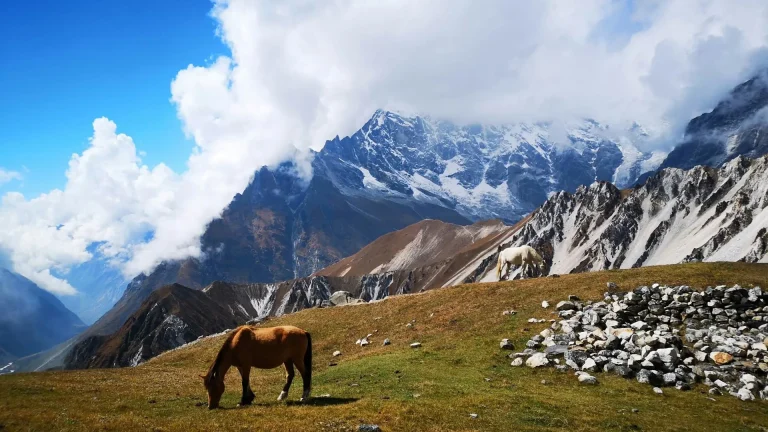
Then you land at Kyanjin Gompa. Here you look straight up at Langtang Lirung, the highest mountain in the range. Around it sit Kimshung, Yansa Tsenji and the Langtang glacier. Also above the village stand Kyanjin Ri (4,850 m) and Tserko Ri (4,984 m). So you see both viewpoints trekkers climb, and you walk neither.
Kyanjin Gompa itself is a small settlement. Here there is a monastery and a yak cheese factory. Both were rebuilt after the 2015 earthquake destroyed much of the valley.
How much does a Langtang helicopter tour cost?
USD 2,750 for the aircraft. So that is USD 550 each with five aboard, or USD 2,750 if you fly alone.
Because the aircraft is chartered whole, the per-person price falls sharply as the group grows. So these are our 2026 rates.
| Passengers | Price per person | Total |
|---|---|---|
| 1 | USD 2,750 | USD 2,750 |
| 2 | USD 1,375 | USD 2,750 |
| 3 | USD 920 | USD 2,760 |
| 4 | USD 690 | USD 2,760 |
| 5 | USD 550 | USD 2,750 |
So the biggest thing you can do about the price is bring people. But if you travel alone and want the cost down, tell us. Then we will check whether other travellers want similar dates. Still, nobody is ever put on a shared flight without agreeing first.
For how helicopter costs compare with trekking, see our Langtang helicopter cost guide.
Is there an altitude risk on a landing tour?
Yes, a real one, though small. You gain 2,400 m in under half an hour with no acclimatisation.
Now for the part most helicopter pages skip. In fact it deserves saying plainly.
First you are at 1,400 m in Kathmandu. Then, in under half an hour, you are at 3,800 m. However, trekkers take four days to cover the same ground.
Still, the risk stays low, because your time up high is short. So most people feel nothing worse than light breathlessness. But some feel dizzy or headachy within minutes. Also, published altitude guidance treats any rapid ascent above 2,500 m as a real exposure. So our pilots carry oxygen. Then the ground stop is kept to about 30 minutes. And if anyone feels unwell, the aircraft goes down at once. In short, nobody is asked to tough it out for photographs.
So if you have heart or lung conditions, or you are pregnant, speak to your doctor before booking. After all, we would rather you asked than found out at 3,800 m.
What are the weight limits?
About 500 kg combined, which is near 100 kg a head across 4 to 5 passengers.
Helicopters lose lifting power as the air thins. So weight at altitude is not a formality.
The aircraft seats 5. But the real limit is weight, not seats. So five average adults fly together. However, a heavier group of five becomes a group of four, or two rotations. Also, please tell us your rough weights when you book. Still, it is not a personal question. Instead it is a flight-planning one. After all, getting it wrong on the day is how a tour gets cut short.
What happens if the weather turns?
We move you to the next clear morning, or refund the flight in full if you have run out of days.
Flights go in the morning. Because the Langtang valley builds its own cloud through the afternoon, a clear 7 am often becomes an unflyable 11 am.
So we do not fly marginal weather into a mountain valley. And no amount of disappointment changes that.
Do you need permits for a Langtang helicopter tour?
Yes, the Langtang National Park entry permit, and Spade Himalaya arranges it for you.
Because Langtang is a national park, the permit applies even when you arrive by air. However, there is no TIMS card on a helicopter day tour, since TIMS covers trekkers on foot. For the full detail, see our Nepal trekking permits guide. Also, the wider valley is covered in our Langtang region guide.
A note on the landing altitude
Sources disagree on how high Kyanjin Gompa sits. In fact figures between 3,800 m and 3,950 m are all in print. So we use 3,800 m, which matches our own Langtang trek itinerary. Still, the difference does not change how the flight is planned. But we would rather tell you the sources conflict than pick whichever number reads best.
Prices, permits and access on this page were verified by Spade Himalaya in September 2026. Conditions in Rasuwa are changing, so we will update this page when the road reopens.
Trips Highlights
- See the Langtang valley in a single morning, with no trekking at all.
- Land at Kyanjin Gompa (3,800 m) and stand in the valley, not just fly over it.
- Look straight up at Langtang Lirung (7,234 m), the highest peak in the range.
- Reach a valley that currently has no road access after the August 2026 flood.
- See Kyanjin Ri and Tserko Ri, the two viewpoints trekkers spend days climbing.
- Visit a settlement rebuilt by its own people after the 2015 earthquake.
- Fly north over terraced hills and river gorges on the way up.
- Suit families, older travellers and anyone who cannot manage a 10-day trek.
- Be back in Kathmandu before lunch, with the rest of your day intact.
- Travel with oxygen on board and a pilot who turns back rather than push weather.
The flight runs north from Kathmandu, up the Trishuli and Langtang valleys, to a landing at Kyanjin Gompa at 3,800 m. Flying time is about 25 to 30 minutes each way, with roughly 30 minutes on the ground. Total time door to door is 2 to 3 hours, including hotel pickup and drop-off.
Trips Itinerary
A Spade Himalaya representative meets you at your hotel in Kathmandu. So the day starts early, because the Langtang valley builds its own cloud by late morning and the flying window closes with it. At that hour the city is still quiet, so the drive takes about 20 minutes. Bring your passport, since the helipad checks identification at the gate. Also dress for 3,800 m rather than for Kathmandu. In fact the two are usually about 15 degrees apart, and people who dress for the city regret it the moment the doors open.
- Duration: About 20 min drive
- Max Altitude: 1,400 m
- Meals: None
- Accommodation: N/A
At the helipad you meet your pilot and go through the safety briefing. Then everyone is weighed, bags included. Still, this is not a formality. Because a helicopter loses lifting power as the air thins, the combined load decides what is safe at 3,800 m. So the pilot sets the seating order by balance, not by preference, and may move people between seats. After that you walk out to the aircraft. In short, the whole process takes about twenty minutes and it is the part that keeps the flight safe.
- Duration: About 20 min
- Max Altitude: 1,400 m
- Meals: None
- Accommodation: N/A
The helicopter lifts off and turns north. First you cross the rim of the Kathmandu valley, with the city falling away behind you. Then the country changes quickly. Terraced farmland gives way to forested ridges, and the Trishuli river runs in the gorge below. Also watch the left side for the first line of snow on the horizon. So even before the big peaks arrive, this leg is worth having the camera ready for.
- Duration: About 15 min
- Max Altitude: up to 2,500 m
- Meals: None
- Accommodation: N/A
Now the flight enters the Langtang valley proper, and the walls close in on both sides. Below you the Langtang Khola runs through forest. Above you the ridges climb past 5,000 m. Then Langtang Lirung (7,234 m) appears ahead, and it stays in view for the rest of the leg. Also look for the rebuilt Langtang village, set below the scar left by the 2015 landslide. In short, this is the leg people remember afterwards.
- Duration: About 15 min
- Max Altitude: rising to 3,800 m
- Meals: None
- Accommodation: N/A
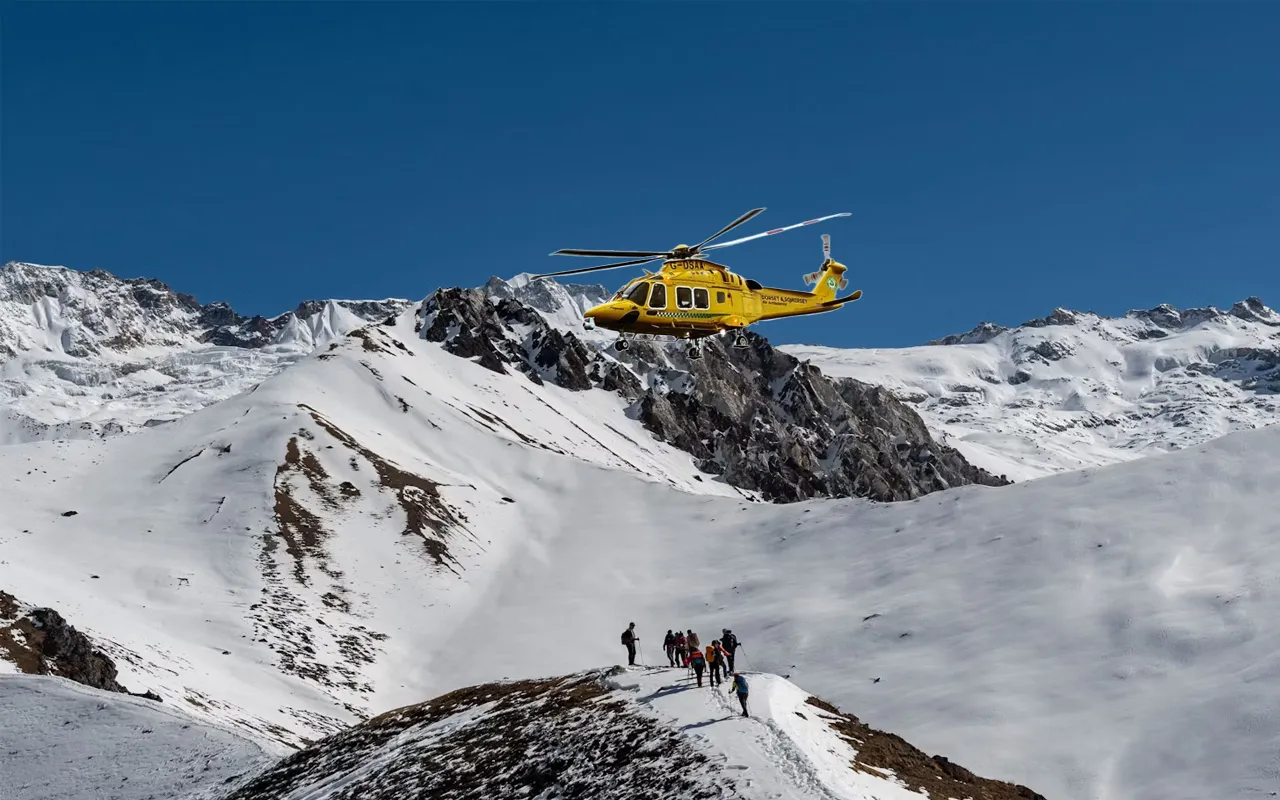
The helicopter sets down on flat ground beside Kyanjin Gompa. So you step out at 3,800 m into air that is thin, cold and very bright. Then you have about half an hour. Most people walk a short way toward the monastery, photograph Langtang Lirung standing directly above the village, and look up at Kyanjin Ri (4,850 m) and Tserko Ri (4,984 m) on the ridges either side. There is a yak cheese factory here too, run by the community. But move slowly and do not try to climb anything. After all, you have had no acclimatisation, and the stop is kept short for exactly that reason.
- Duration: About 30 min on the ground
- Max Altitude: 3,800 m
- Meals: None
- Accommodation: N/A
You board again and the helicopter drops back down the valley. So the light sits behind you now, which changes the whole view. In fact the peaks that were ahead on the way up now sit over your shoulder, and the valley reads completely differently. Then the forest returns, then the terraces, then the Kathmandu valley opens out below. So keep the camera out, because the return leg is not a repeat of the outbound one.
- Duration: About 30 min
- Max Altitude: down to 1,400 m
- Meals: None
- Accommodation: N/A
Your Spade Himalaya representative sees you back to your hotel. So you are usually back before nine, with the whole day still ahead of you. Many guests use the afternoon for Boudhanath, Patan Durbar Square or Swayambhunath, since none of them need an early start. However, if weather cancelled the flight, this is the point where we confirm the next clear morning instead, or arrange your refund if you have run out of days.
- Duration: About 20 min drive
- Max Altitude: 1,400 m
- Meals: None
- Accommodation: N/A
Trips Include
- Hotel pickup and drop-off in Kathmandu, in a private vehicle.
- The helicopter charter itself, both ways, with landing at Kyanjin Gompa.
- Langtang National Park entry permit and all local permits.
- A supplementary oxygen cylinder on board.
- An experienced mountain pilot and a pre-flight safety briefing.
- All government taxes, VAT and fuel surcharges.
- Flight insurance for the duration of the flight.
Trips Exclude
- International airfare to and from Nepal.
- Nepal entry visa (US$30 for 15 days, US$50 for 30 days, US$125 for 90 days).
- Personal travel and medical insurance (mandatory, and it must cover helicopter evacuation).
- Meals, drinks and anything bought at Kyanjin Gompa.
- Hotel accommodation in Kathmandu.
- Tips for the pilot and the ground team.
- Any cost arising from weather delays, such as an extra hotel night.
- Anything not listed under Cost Includes.
Packing List
General
This is a short day tour, so you need almost nothing. The one thing people underestimate is the cold at the landing site.
- A warm jacket, and a fleece or insulated layer
- Sunglasses with UV protection
- Sunscreen and lip balm
- A camera, with a spare battery, since cold drains them fast
- Any personal medication you take
- A hat and light gloves in winter
Good to Know
Kyanjin Gompa is the last settlement in the Langtang valley, at 3,800 m, with a monastery and a working yak cheese factory. Much of it was destroyed in the 2015 earthquake and rebuilt by the people who live there. The helicopter lands beside the village and you have about 30 minutes on the ground. That is enough to walk a short way and photograph the range, and deliberately not enough to start feeling the altitude.
The Langtang valley generates its own cloud as the day warms. A clear seven in the morning regularly becomes an unflyable eleven. So the flight leaves early, and an early start is not us being awkward, it is the only reliable window.
A glacial lake outburst flood came down the Bhote Koshi on 26 August 2026 and destroyed the road through Rasuwa district. That road served Langtang, Gosaikunda and the Tamang Heritage trail. The walking trails are largely intact, but vehicle access is gone, and rebuilding a mountain road takes seasons rather than weeks. We will say plainly when it reopens rather than quietly dropping this note.
The aircraft seats 5, but the binding limit is a combined passenger weight near 500 kg, so in practice it carries 4 to 5 people. At 3,800 m a helicopter has noticeably less lift than at sea level, so the figure is a safety margin rather than a guideline. We ask for rough weights at booking so the flight is planned properly. If the numbers do not work we fly two rotations and tell you the cost before you commit.
Very little. It is a day tour and you are never far from the aircraft. Bring a warm jacket, because 3,800 m is cold even in sunshine, plus sunglasses, sunscreen and a camera. Leave heavy luggage at your hotel, since every kilogram counts against the flight limit.
Trips Reviews
No reviews found.
Trips FAQs
Flight, weather and booking
About 2 to 3 hours door to door. That is roughly 25 to 30 minutes flying each way, about 30 minutes on the ground at Kyanjin Gompa, and the hotel transfers at either end.
Yes, by air. The glacial flood of 26 August 2026 destroyed the road through Rasuwa, which was the only vehicle access to the valley. The trails are largely intact but the road is gone, so a helicopter is one of the few ways in this season.
We move you to the next clear morning, or refund the flight in full if you have run out of days. Flights go early because the valley builds its own cloud by late morning. We do not fly marginal weather into a mountain valley.
Because the aircraft is chartered whole. It costs the same to fly whether one person boards or five, so the per-person price falls as the group grows. Capacity is 4 to 5 depending on combined weight. One passenger pays USD 2,750 and five pay USD 550 each.
Altitude, weight and suitability
There is a real one, and most pages do not mention it. You go from 1,400 m to 3,800 m in under half an hour, with no acclimatisation, where a trekker takes four days. The risk stays low because your time up high is short, but some people feel dizzy or headachy within minutes. We carry oxygen, keep the ground stop to about 30 minutes, and descend immediately if anyone feels unwell.
Yes. The helicopter seats 5, but weight decides it, not seats. The combined passenger limit is about 500 kg, near 100 kg each, so a heavier group of five becomes four. Helicopters lose lifting power as the air thins, so this is a flight-safety figure, not a formality. If your group is heavier we fly two rotations rather than pretend it fits.
Speak to your doctor first if you have a heart or lung condition, or if you are pregnant. Rapid ascent above 2,500 m is treated as a genuine exposure in published altitude guidance. Otherwise it suits nearly everyone, including children and older travellers, because there is no walking involved.
Yes. Langtang is a national park and the entry permit applies however you arrive. We arrange it. You do not need a TIMS card, because TIMS covers trekkers travelling on foot.
Where Langtang is, and what happened there
Langtang sits about 60 km north of Kathmandu, close to the Tibetan border in Rasuwa district. By helicopter that is roughly 25 to 30 minutes each way. On foot it is a 10-day round trip, and by road it was a long day of driving before the August 2026 flood destroyed that road.
The valley runs east to west in Rasuwa district, directly north of Kathmandu and along the border with Tibet. It sits inside Langtang National Park, which was the first Himalayan national park in Nepal. Kyanjin Gompa, where the helicopter lands, is the last settlement up the valley.
Yes. A landslide triggered by the 2015 earthquake destroyed the original Langtang village and killed a large part of its population. The village was rebuilt on a safer site nearby, and Kyanjin Gompa above it was rebuilt too. So what you land beside today is a working settlement, with a monastery and a yak cheese factory, put back by the people who live there.