Trip Facts
Country:
Nepal
Duration:
7 Days
Max Altitude:
1,400 m
Activities:
Sightseeing, jungle safari, and driving
Region:
Kathmandu Valley, Chitwan, and Pokhara
Starting Point:
Kathmandu
Ending Point:
Kathmandu
Grade:
Easy, no trekking
Group Size:
1 to 12 pax
Accomodation:
3-star hotels and a jungle lodge
Best Season:
Oct-Mar
Notice
This is the one-week version, and it involves no trekking at all. So it suits travellers who want Nepal’s culture and wildlife without walking days.
Chitwan National Park is the centrepiece, with two nights on the park boundary and a full day inside it.
You drive south and west, then fly back from Pokhara, so no day is spent repeating a road.
Overview of Nepal Itinerary 7 Days: Kathmandu, Chitwan and Pokhara Tour
Quick answer: This Nepal itinerary 7 days plan covers four of the seven UNESCO monument zones in the Kathmandu Valley, two nights at Chitwan National Park for a jungle safari, and a night in Pokhara with a Sarangkot sunrise. It involves no trekking. It is designed for travellers with one week who want culture and wildlife rather than mountains underfoot, and it is run privately by Spade Himalaya, a trekking and tour company based in Kathmandu.
One week is what a lot of people can actually get away for. Also, it is enough for Nepal, provided you accept one honest limit. In short, seven days does not fit a proper trek as well as the cities and the jungle. So this Nepal 7 day itinerary drops the walking entirely. Then it spends the time on three places you can reach comfortably by road and a short flight.
What you get instead is the part of Nepal most trekking itineraries skip. First, three days among the Newar temples and squares of the Kathmandu Valley. Then a full day tracking rhino in the country’s oldest national park, and a Himalayan sunrise above Phewa Lake.
If you would rather walk, our Nepal itinerary 10 days adds the four-day Poon Hill trek in place of Chitwan. Want both? Then the Nepal itinerary 14 days covers the culture, the trek and the safari together. For a wider comparison of lengths and costs, see our guide on how to plan a trip to Nepal.
Trips Highlights
- Visit four of the seven Kathmandu Valley monument zones inscribed by UNESCO in 1979.
- Look for one-horned rhinoceros on a jeep safari in Chitwan National Park.
- Drift the Rapti River by dugout canoe, past basking gharial and mugger crocodiles.
- Spot a few of the 643 bird species recorded inside the park.
- Stand at Boudhanath, one of the largest stupas anywhere, rebuilt by its own community after 2015.
- Watch sunrise over Dhaulagiri I (8,167 m) and Annapurna I (8,091 m) from Sarangkot.
- Walk into a Tharu village on the park boundary with a local guide.
- Fly back from Pokhara instead of losing a second day to the road.
- Travel with a licensed guide, private vehicles, and every park permit arranged.
- Cover the whole trip without a single day of trekking.
Kathmandu (1,400 m) → Chitwan National Park (Terai lowlands) → Pokhara (822 m) → fly to Kathmandu (1,400 m).
This is the classic Kathmandu Chitwan Pokhara tour, the circuit most first-time visitors take when they have one week. So you begin among the temples, drop south into the jungle, then climb back into the hills for the mountain views.
Trips Itinerary
You land at Tribhuvan International Airport, clear the visa desk, and find a Spade Himalaya representative holding a name board in arrivals. Then the hotel is in Thamel, about thirty minutes away depending on traffic. So today asks nothing of you beyond getting there.
Seven days is a short trip, so your guide calls by in the evening to confirm timings and answer anything before the first early start. Kathmandu sits at 1,400 m in a bowl of hills, which keeps it temperate all year. So sleep if you can, because tomorrow begins properly.
- Duration: 30 min drive
- Max Altitude: 1,400 m
- Accommodation: 3-Star Hotel
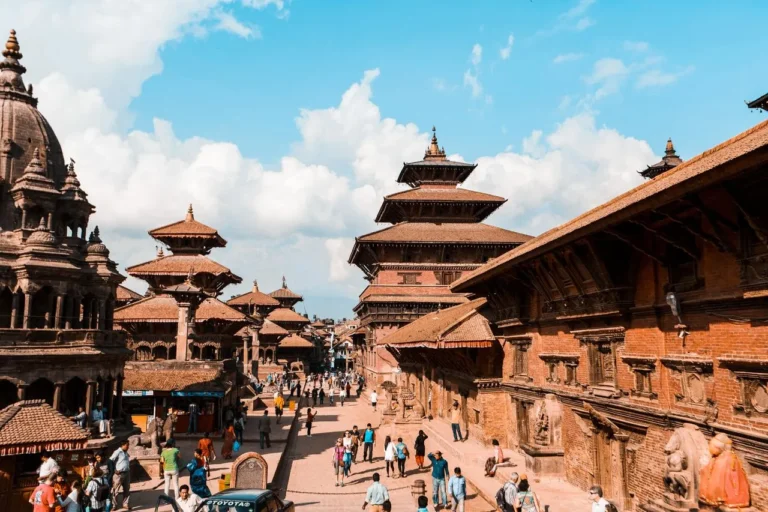
The Kathmandu Valley carries a single UNESCO inscription from 1979 that covers seven separate monument zones. Today you see four of them, with a guide and a private car, and every entrance fee is already paid.
First, Swayambhunath sits on a hill west of the city, up a long stairway that pilgrims still climb barefoot. The stupa’s origins reach back to the Licchavi period, which makes it one of the oldest religious sites in the valley. Also, its dome is ringed with prayer wheels turned by hand all day.
Then at Kathmandu Durbar Square you stand in the old royal seat of the Malla kings. The Kasthamandap, a wooden pavilion here, is what the city is named after, and it was rebuilt after collapsing in the 2015 earthquake. And the living goddess, the Kumari, still occupies a house on this square.
Next, Boudhanath fills the afternoon, a huge white stupa laid out as a mandala, rebuilt by the Tibetan community itself after 2015 and circled clockwise by pilgrims from dawn. After that you finish at Pashupatinath on the Bagmati, Nepal’s most important Shiva temple, where sadhus live among the shrines and cremations take place in the open.
- Duration: Full day sightseeing
- Max Altitude: 1,400 m
- Meals: Breakfast
- Accommodation: 3-Star Hotel
The road runs south out of the hills and down onto the Terai, the flat belt of land along the Indian border. Allow 5 to 6 hours. So you watch the country change through the window, from terraced hillside to sal forest and paddy fields.
Then your lodge is near Sauraha on the park boundary. You drop from 1,400 m in Kathmandu to under 300 m here, and the heat and the humidity arrive with it, so the lighter clothes come out of the bag on the first evening.
Then the afternoon is a guided walk into a Tharu village and out to the Rapti River for sunset. The Tharu have farmed this belt for centuries and carry a well-documented resistance to malaria, which is why they lived here when few others could.
- Duration: 5 to 6 hrs drive
- Max Altitude: 1,400 m
- Meals: Breakfast, Lunch & Dinner
- Accommodation: Jungle Lodge
Chitwan became Nepal’s first protected area in 1973 and was listed by UNESCO in November 1984. It covers 952.63 sq km of sal forest, elephant grass, and river. So today is the whole reason this itinerary comes so far south.
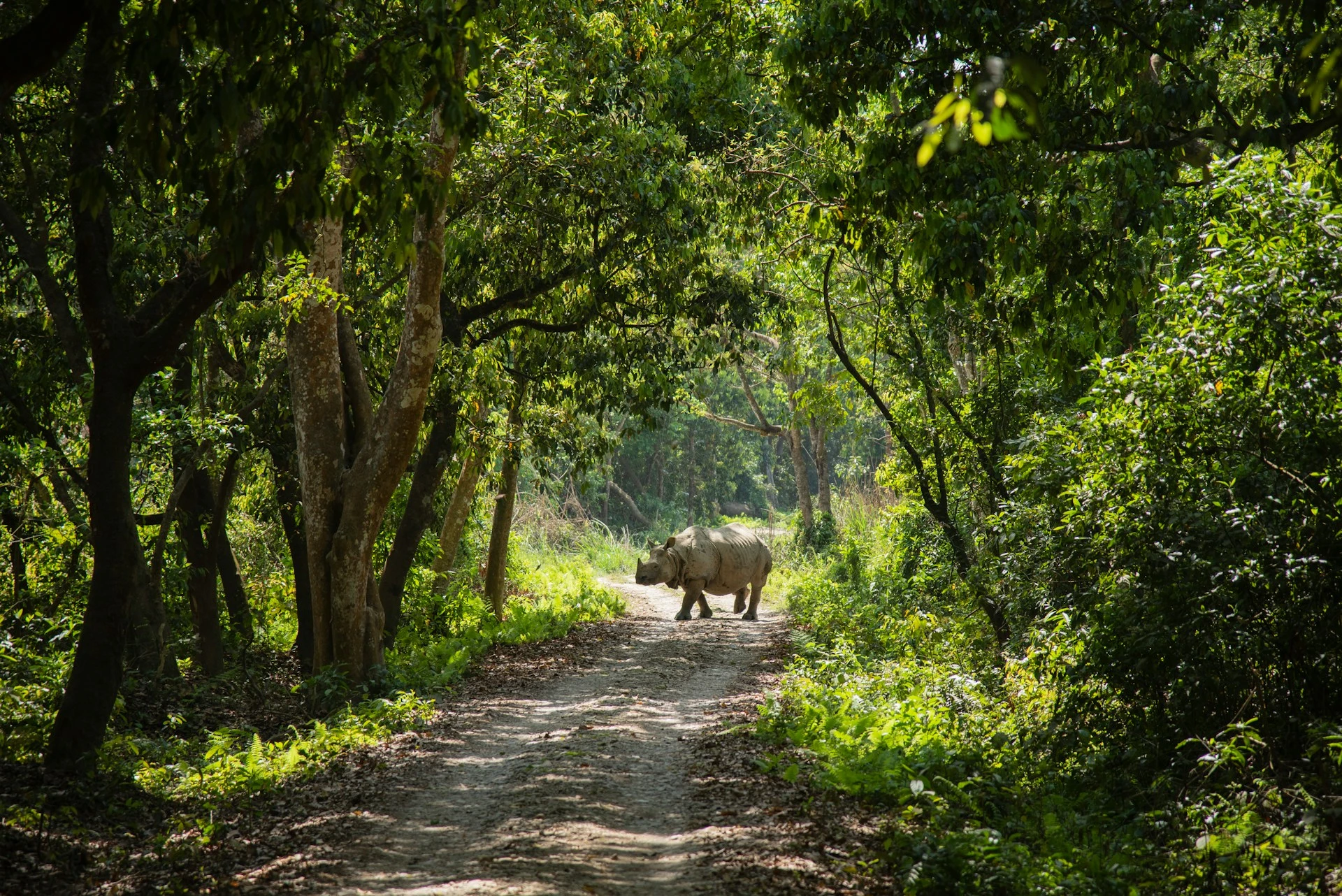
First, a jeep safari takes up the morning, running the forest tracks and the grassland near the water. One-horned rhinoceros are the animal you are most likely to see, and Chitwan is the stronghold of that species in Nepal. Still, Royal Bengal tiger are present in good numbers but are seldom seen by anybody.
Then after lunch you take a dugout canoe down the Rapti, which is slow and almost silent, past gharial and mugger crocodiles basking on the mud banks. 643 bird species have been recorded in the park, so this is the hour to have binoculars with you.
Finally, the elephant breeding centre is the last stop, where the government runs its breeding programme. Then in the evening the lodge hosts a Tharu stick dance. It is staged for visitors, and it is also a living tradition, which are not contradictory things.
- Duration: Full day safari
- Max Altitude: 286 m
- Meals: Breakfast, Lunch & Dinner
- Accommodation: Jungle Lodge
An early walk along the forest edge catches the best hour for birds, before the heat sets in properly. Here hornbills, kingfishers, and storks are all common. Then you eat breakfast and leave the Terai behind you.
The drive west to Pokhara takes about 5 hours, climbing gradually back into the hills. So you gain roughly 500 m and lose the humidity, which most people are glad of by this stage of the week.
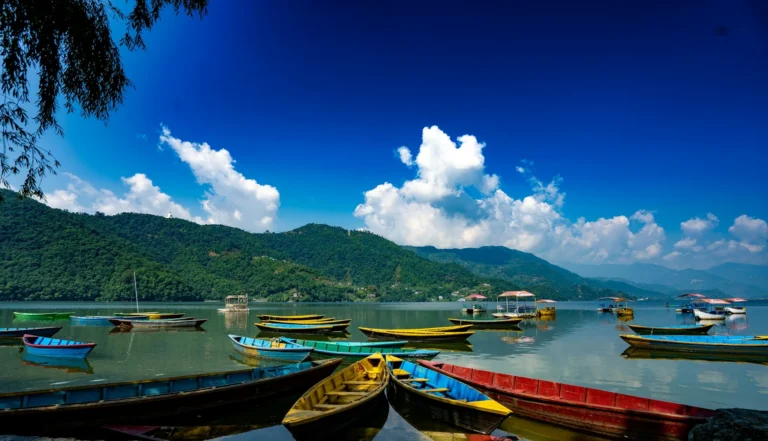
Now Pokhara sits at 822 m along the shore of Phewa Lake, with the Annapurnas standing behind it on a clear evening. Also, Lakeside is yours once you have checked in, and it runs to cafes, bookshops, and boats for hire until dusk.
- Duration: 5 hrs drive
- Max Altitude: 822 m
- Meals: Breakfast
- Accommodation: 3-Star Hotel
You leave in the dark for the Sarangkot viewpoint above the lake, which is the classic Pokhara sunrise. On a clear morning Dhaulagiri I (8,167 m), Annapurna I (8,091 m), and Machhapuchhre (6,993 m) line up along the skyline. Then the light reaches them one by one.
Then you come back down for breakfast and spend the rest of the morning at the lake. Here you can row out to the Tal Barahi temple on its island, or cross by boat and walk up to the World Peace Pagoda for the view back over the water.
Then the afternoon flight to Kathmandu takes 25 minutes and runs alongside the range in clear weather. So that leaves your last evening free in Thamel, which is the right time to buy anything you have been putting off all week.
- Duration: 25 min flight
- Max Altitude: 1,400 m
- Meals: Breakfast
- Accommodation: 3-Star Hotel
Finally, a Spade Himalaya vehicle takes you to the airport roughly three hours before your flight. Still, if you leave late in the day, the hotel will keep your bags so the morning is still usable. Extra nights are easy to add at either end of the trip.
- Duration: 30 min drive
- Max Altitude: 1,400 m
- Meals: Breakfast
Trips Include
What is included: Your package covers every hotel and lodge night, all transport including the flight back from Pokhara, guided sightseeing with entry fees, and every Chitwan activity and permit. So the only things left are your international flights, your visa, your insurance, and the meals named below.
- All airport transfers in a private vehicle.
- 3 nights in a 3-star hotel in Kathmandu, with breakfast.
- 1 night in a 3-star hotel in Pokhara, with breakfast.
- 2 nights at a jungle lodge in Chitwan, with all meals.
- Guided sightseeing in Kathmandu, with all entry fees.
- Kathmandu to Chitwan and Chitwan to Pokhara by tourist coach.
- Pokhara to Kathmandu by air, including domestic airport tax.
- All Chitwan National Park activities and entry permits.
- A private vehicle for the Sarangkot sunrise trip.
- A licensed, English-speaking Spade Himalaya guide throughout.
- Pay, food, lodging, and insurance for all staff.
- Safe drinking water using a filter or purification tablets.
- A first-aid kit with an oximeter to check oxygen levels.
- Spade Himalaya T-shirt, cap, and a trip-completion certificate.
- All local taxes and office costs.
Trips Exclude
What is not included: A few things sit outside the package. So please budget for these too.
- International flights and airport taxes.
- Nepal entry visa (US$30 for 15 days, US$50 for 30 days, US$125 for 90 days).
- Travel and medical insurance (this is a must).
- Lunches and dinners in Kathmandu and Pokhara (budget US$10 to US$20 per meal).
- Optional extras such as paragliding, the Everest mountain flight, and a Bhaktapur day trip.
- Extra nights from early arrival, late departure, or itinerary changes.
- All drinks, laundry, Wi-Fi, and snacks.
- Tips for your guide and drivers.
- Personal gear and any personal expenses.
- Anything not listed under Cost Includes.
Trips Altitude
Packing List
General
- Daypack (20 to 30 litres) for day trips
- Reusable water bottle, at least 1 litre
- Torch or headlamp for the early Sarangkot start
- Power bank for long road days
- Passport and several passport photos
- Sunglasses with UV protection
- Binoculars, which matter more here than on any trek
Upper Body
- A light-coloured long-sleeved shirt for Chitwan, which keeps insects off
- Quick-dry T-shirts (3 to 4)
- A warm fleece for the Sarangkot sunrise, cold before dawn
- A light rain jacket
- Sun hat for the Terai
- A shawl or scarf to cover your shoulders at temple sites
Lower Body
- Lightweight long trousers for Chitwan and the temple visits
- Comfortable trousers for travel days
- Shorts or a skirt for the Terai heat
Undergarments
- Quick-dry underwear (4 to 5)
- Comfortable socks (4 pairs)
Hands
- Light gloves for the Sarangkot start in winter
Feet
- Comfortable walking shoes or trainers, no boots needed
- Sandals for the lodge and warm evenings
- Closed shoes for the forest walk
First Aid Kits
- Personal medication, with a copy of the prescription
- Insect repellent containing DEET for Chitwan
- High-factor sun cream and lip balm
- Hand sanitiser
- Rehydration salts for the Terai heat
Optional
- Camera with a zoom lens for wildlife
- A book for the road days
- Neutral or muted colours for the safari, which help
Others
- Quick-dry towel
- Toiletries and toilet paper
- Snacks for the road days
- Cash in Nepali rupees, since Sauraha ATMs are unreliable
- Dry bags or zip-lock bags for the canoe trip
Good to Know
Before you go
You only need a few things ready. First, bring your passport, two passport photos, and a copy of your insurance, so Spade Himalaya can arrange your Chitwan National Park permits. Then carry some cash in Nepalese rupees, because the ATMs in Sauraha are not always reliable. Also, October to March is the season this trip is built around, and Chitwan lodges fill early in it, so confirm your dates as far ahead as you can.
This itinerary is built for travellers with one week in Nepal who want the country’s culture and its wildlife, and who would rather not spend days walking. So it suits:
- Non-walkers and anyone short on time. There is no trekking at all. The most you walk is temple steps, a village path, and a short forest walk in Chitwan.
- Families with young children. Jeep safaris, canoe trips and a lodge with all meals work far better for small children than teahouses and walking days.
- Older travellers and anyone with limited mobility. This is our most accessible itinerary. Tell us your limits and we will adjust what we can.
- Wildlife watchers and birders. Chitwan has 643 recorded bird species, and a full day inside the park covers jeep, canoe and foot.
- First-time visitors on a tight week. Three places, in a line, with a flight home from Pokhara instead of a second long drive.
This is the wrong trip if you came to Nepal to walk. Seven days cannot hold a worthwhile trek alongside the cities and the jungle, so if trekking matters, take the 10-day or the 14-day instead. Also, if seeing Everest is the point, this itinerary never goes near it.
Spade Himalaya runs three multi-region itineraries from our own office in Kathmandu. Use this table to pick the right one rather than guessing.
| Time you have | What you want | Trekking | Choose | From |
|---|---|---|---|---|
| 7 days | Culture and a jungle safari | None | This itinerary | USD 880 |
| 10 days | Culture and the Poon Hill trek | 4 days | Nepal Itinerary 10 Days | USD 1,100 |
| 14 days | Culture, the trek and the safari | 4 days | Nepal Itinerary 14 Days | USD 1,390 |
In short, the 7-day trades the trek for Chitwan. So the real question is whether you would rather walk in the Annapurnas or look for rhino in the Terai with the week you have.
Seven days is the most common amount of leave people can take. And Nepal rewards it, provided you are honest about what fits. Also, the three places on this route lie roughly in a line, so almost none of the week is spent backtracking. So the one compromise is the trek, and dropping it is what keeps the rest unhurried.
October to March is the window for this trip. That is because it is driven by Chitwan rather than by the mountains. Also, grass in the park is cut in late winter, which makes animals far easier to see. October and November add the clearest Sarangkot sunrises. April and May are hot in the Terai, and the monsoon closes many park activities.
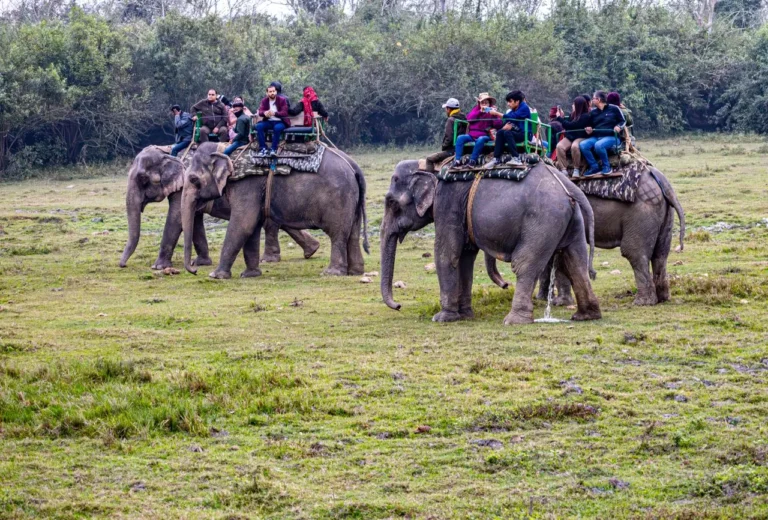
In short, jeep safaris, canoe trips, guided nature walks, and the elephant breeding centre. Elephant-back safaris are not included and we do not offer them. Still, sightings are never guaranteed, and a good naturalist guide matters more than luck. And mornings and late afternoons are when the park is most active.
Nepal runs largely on cash outside the bigger hotels. Still, there are ATMs in Kathmandu, Pokhara, and Sauraha. The Sauraha machines are not always reliable, so carry some rupees with you. Tipping is customary rather than compulsory, and guides and drivers are usually tipped at the end.
The 25-minute flight home is what keeps this trip to seven days. Still, domestic flights in Nepal are weather-dependent, and afternoon departures are less reliable than morning ones. If yours is cancelled, the road is always there, and your guide will move you onto it the same day.
Trips Reviews
No reviews found.

Trips FAQs
These are the questions travellers ask us most about this itinerary. They cover whether one week is enough, why there is no trek, what you can realistically expect to see in Chitwan, and how this compares with our longer trips. If yours is not answered here, write to us and someone in our Kathmandu office will reply.
Is One Week Enough
Yes, for culture and wildlife. In practice, 7 days in Nepal is enough for the cities and the jungle, but not for those and a trek as well. Overall, seven days covers the Kathmandu Valley, Chitwan, and Pokhara at a reasonable pace. But it does not fit a proper trek. The shortest worthwhile one needs four days, plus travel at each end. So if walking is why you are coming, look at the 10-day version instead.
Because a trek squeezed into seven days would be a bad version of both things. In practice you would get two rushed walking days and lose either Chitwan or the valley. We would rather give you three places properly than four badly. Our Ghorepani Poon Hill Trek can be added on either end if your dates stretch.
Chitwan and Wildlife
No, and anyone promising that is not being straight with you. Here one-horned rhinoceros are seen often, especially near the river in the cooler months. Still, tigers live in the park in good numbers but are rarely spotted. But birds are the sure thing, with 643 species recorded.
October to March is the window. Because the grass is cut low then, Chitwan animals are far easier to see. Also, October and November give the clearest mountain views from Sarangkot. But April and May get hot in the Terai. The monsoon, June to August, is wet and many park activities stop.
Comparing Our Itineraries
In short, the 7-day is culture plus wildlife, with no walking. The 10-day is culture plus the Poon Hill trek, with no safari. The 14-day is all three, at a slower pace. So the question is really whether you would rather walk or look for rhino in the time you have.
Suitability and Accommodation
Generally yes, and it is our most accessible itinerary because there is no trekking. Still, the demands are two road days of 5 to 6 hours and a few early starts. Also, temple sites do involve steps, and Swayambhunath has a long stairway. Tell us about any mobility limits and we will say honestly what can be adjusted.
First, three-star hotels in Kathmandu and Pokhara, twin-share with breakfast. Then a lodge on the Chitwan park boundary, where all meals are included. Nothing on this trip involves a teahouse or a shared bathroom. And single rooms are available, with no supplement on a private trip.
Visa, Packing and Cost
Most nationalities can get a visa on arrival at Tribhuvan International Airport. Also, it costs US$30 for 15 days, US$50 for 30 days, and US$125 for 90 days. So bring cash in US dollars and a passport photo. Our Nepal visa on arrival guide has the current process.
Light, neutral-coloured clothing for Chitwan, plus insect repellent and binoculars. Also, something that covers shoulders and knees for the temple sites. And a warm layer for the Sarangkot start, which is cold before dawn even when the day turns hot. No trekking gear is needed.
There are no fixed departure dates, so nobody joins a scheduled group. But if another traveller is looking at similar dates and you are both happy to share, we can combine you, which brings the per-person price down. Still, nobody is ever placed with strangers without agreeing first.