Trip Facts
Duration:
15 Days
Max Altitude:
Thorong La Pass, 5,416 m (17,769 ft)
Activities:
Trekking and cultural sightseeing
Region:
Annapurna (Annapurna Conservation Area)
Starting Point:
Kathmandu
Ending Point:
Kathmandu
Grade:
Strenuous
Group Size:
Min 1
Accomodation:
Teahouses on the trail, hotels in Kathmandu and Pokhara
Best Season:
March-May and September-November
Notice
- A licensed guide and a TIMS card are required in the Annapurna region. Solo trekking is not allowed, and the rule still stands in 2026 (Nepal Tourism Board, 2026). Spade Himalaya gives you the guide and both permits.
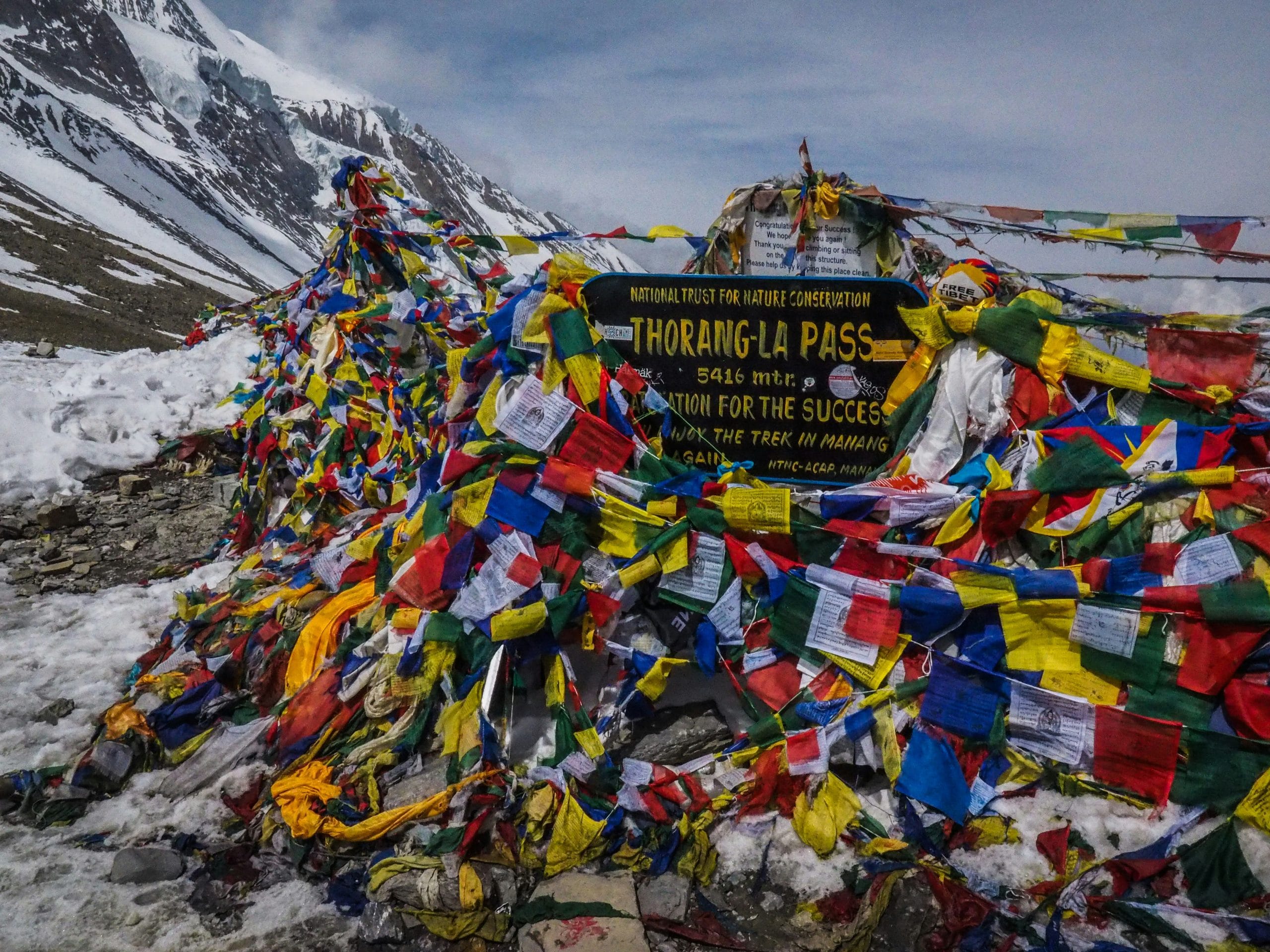
- The high point is Thorong La Pass (5,416 m). You cross it on Day 8 with a pre-dawn start. Then you drop into Mustang to the holy temple of Muktinath.
- This is the 15-day version, with extra rest and culture days. For the shorter trekking-only route, see the Annapurna Circuit Trek (12 Days).
Overview of Annapurna Circuit Trek via Thorong La Pass 15-Days
Quick answer: This 15-day Annapurna Circuit via Thorong La Pass (5,416 m) is a strenuous classic, crossing the high pass to Muktinath, Mustang, and the apple village of Marpha. It starts near Pokhara and is best in spring and autumn.
The Annapurna Circuit Trek via Thorong La Pass is a 15-day loop around the Annapurna massif. Many trekkers rate it one of the best treks in the world. The reason is variety. In two weeks, you walk from green farmland to high desert and back again.
First, the trail climbs the Marsyangdi valley through pine forest and old villages. Then it crosses the high pass of Thorong La (5,416 m). After that, it drops into the dry Mustang region and the famous Kali Gandaki valley. So each day looks different from the last.
The big moment is the dawn crossing of Thorong La at 5,416 m. The pass links Manang in the east with Muktinath in the west. On the far side, you reach Muktinath, a temple holy to both Hindus and Buddhists. It is known for its eternal flame and 108 water spouts. Then the trail follows the Kali Gandaki Gorge, one of the deepest gorges on earth. It runs between two 8,000 m giants: Dhaulagiri (8,167 m) and Annapurna I (8,091 m).
The whole route lies inside the Annapurna Conservation Area, the largest protected area in Nepal at 7,629 km2. Along the way, you rest in Manang, a high village ringed by glaciers. You also taste apple pie and cider in the Thakali village of Marpha. At the end, you enjoy culture days in Pokhara and Kathmandu. So it is a true grand tour of central Nepal.
Spade Himalaya runs this trek with licensed Nepali guides. So your guide sets a safe pace, watches the weather, and checks your health each day. Want a shorter loop? Try the 12-day Annapurna Circuit Trek. For a lower, shorter trip, see the Annapurna Base Camp Trek. The remote Manaslu Circuit Trek is a wilder cousin. In the Everest region, the Everest Base Camp Trek and the Everest Three Passes Trek are popular too. The crux of this route deserves respect. So read our Thorong La pass guide for crossing day advice, and the Circuit cost breakdown for budgeting.
Trips Highlights
- Cross Thorong La Pass (5,416 m), one of the highest passes on any popular trek.
- Visit Muktinath, a temple holy to Hindus and Buddhists, with its eternal flame and 108 water spouts.
- Walk the Kali Gandaki Gorge, one of the deepest gorges on earth, between Dhaulagiri and Annapurna.
- Watch the land change from green valleys to the high desert of Mustang.
- Rest in Manang, a high village of monasteries, glaciers, and lakes.
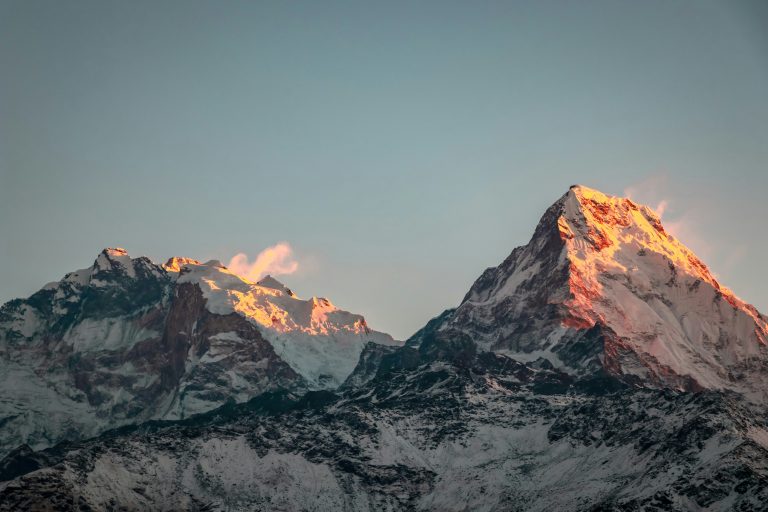
- See close views of Annapurna, Dhaulagiri, Gangapurna, Tilicho Peak, and Nilgiri.
- Walk through Tibetan-style villages like Pisang, Ghyaru, and Ngawal.
- Taste apple pie, cider, and dried apples in the Thakali village of Marpha.
- Relax in lakeside Pokhara, with the Peace Pagoda and Phewa Lake.
- Finish with UNESCO sightseeing in Patan, Kathmandu, and the great stupas.
Route Details
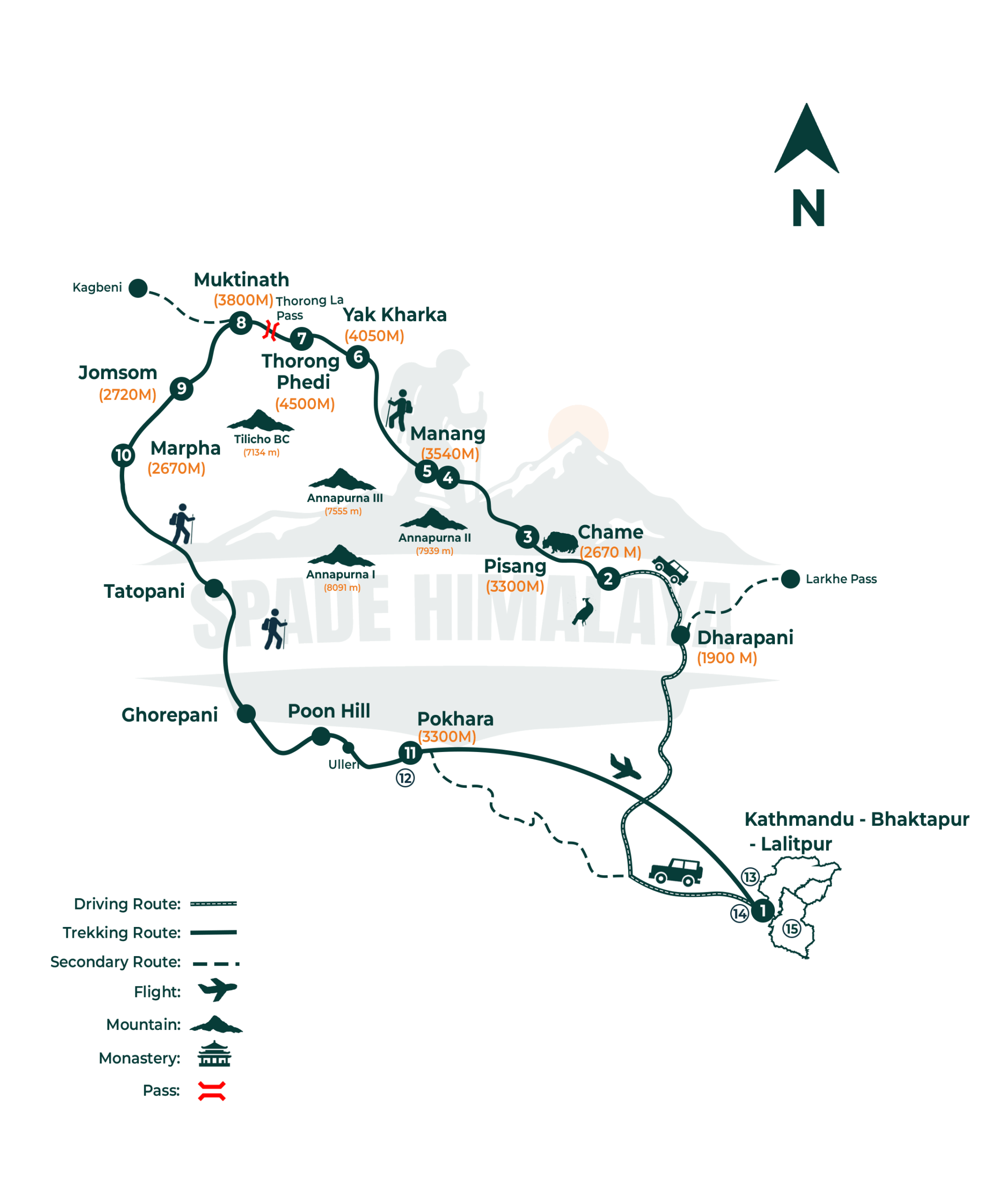
Kathmandu (1,400 m) → drive to Chame (2,710 m) → Pisang (3,200 m) → Manang (3,540 m) → acclimatization day → Yak Kharka (4,020 m) → Thorong Phedi (4,540 m) → Thorong La Pass (5,416 m) → Muktinath (3,800 m) → Jomsom (2,720 m) → Marpha (2,670 m) → drive to Pokhara (820 m) → fly to Kathmandu, with sightseeing in Pokhara, Patan, and Kathmandu.
In short, you climb the Marsyangdi valley through Chame, Pisang, and Manang. Then you go up via Yak Kharka and Thorong Phedi to cross Thorong La. After that, you drop to Muktinath and down the Kali Gandaki through Jomsom and Marpha. Finally, you return via Pokhara to Kathmandu.
Trips Itinerary
A Spade Himalaya representative meets you at Tribhuvan International Airport, helps with your bags and drives you to your hotel, roughly twenty minutes from the terminal.
Kathmandu sits at 1,400 m, so there is no height to manage yet. Your guide meets you in the evening for the briefing and a kit check, so bring your passport, two photographs and a copy of your insurance, because the trekking permits need all three.
- Duration: 20 min Drive
- Max Altitude: 1,400 m
- Meals: Welcome Soft Drinks
- Accommodation: Shared 3 Star Hotel
A long day in a jeep, first on the highway west out of Kathmandu and then on a rough mountain road that climbs the Marsyangdi valley all the way to Chame.
Chame is at 2,710 m, so you gain more than 1,300 m sitting down, and the drive takes eight to ten hours. Chame is the headquarters of Manang district and has a small hot spring by the river, with Lamjung Himal and Annapurna II standing above the town.
- Duration: Driving: 8 to 10 hrs
- Max Altitude: 2,710 m
- Meals: Breakfast, Lunch & Dinner
- Accommodation: Guest House
The walking starts today. You follow the Marsyangdi upstream through pine forest and apple orchards, under cliffs and waterfalls, to the village of Pisang.
Pisang is at 3,200 m after five or six hours, a gain of around 500 m. It is a sensible opening stage that lets your legs and your lungs find the pace they want.
The country dries out noticeably as you climb and the buildings change with it. Pisang is built in Tibetan style, and Annapurna II and Lamjung Himal are ahead of you for much of the day.
- Duration: Walking: 5 to 6 hrs
- Max Altitude: 3,200 m
- Meals: Breakfast, Lunch & Dinner
- Accommodation: Guest House
Today you take the high route through Upper Pisang, Ghyaru and Ngawal rather than the easier valley path, which costs you more effort and repays it in the views.
Manang is at 3,540 m and the day takes six or seven hours. The upper trail climbs well above the river before dropping back down, so you gain and lose more than the figures show.
You look across at Annapurna II, Annapurna IV, Gangapurna and Tilicho Peak for most of the way. Old monasteries and lines of prayer flags sit on the dry hillsides along the route.
- Duration: Walking: 6 to 7 hrs
- Max Altitude: 3,540 m
- Meals: Breakfast, Lunch & Dinner
- Accommodation: Guest House
You stay a second night in Manang and spend the day walking above the village, because an active rest day is what actually prepares your body for the pass.
Most groups hike up to the Gangapurna Lake viewpoint, gaining a few hundred metres across three or four hours, then come back down to sleep at 3,540 m in the village.
From the viewpoint you see the glacier, Annapurna III and IV and Tilicho Peak. Manang has bakeries, shops and a clinic, and the free altitude talk here is worth an hour.
- Duration: Walking: 3 to 4 hrs ·
- Max Altitude: 3,540 m
- Meals: Breakfast, Lunch & Dinner
- Accommodation: Guest House
You leave Manang and climb into dry open country today, passing the small teahouse stop at Gunsang and crossing wide yak pastures on the way up to Yak Kharka.
Yak Kharka is at 4,020 m, around 480 m of gain across four or five hours. The stages get shorter from here because height matters more than distance now. Annapurna III, Gangapurna and Tilicho Peak stay in view, and the afternoons turn cold quickly at this height.
- Duration: Walking: 4 to 5 hrs ·
- Max Altitude: 4,020 m
- Meals: Breakfast, Lunch & Dinner
- Accommodation: Guest House
A short day of three or four hours across open ground brings you to Thorong Phedi, the base camp for the pass, leaving the afternoon free for rest and food.
Thorong Phedi sits at 4,540 m. It is only about 520 m of gain, but at this height that is plenty, and the trail crosses a couple of loose slide prone sections that need care.
The lodges here are basic because everything has to be carried in. Some groups climb another 400 m to High Camp instead, and your guide decides based on conditions and how everyone is going.
- Duration: Walking: 3 to 4 hrs.
- Max Altitude: 4,540 m
- Meals: Breakfast, Lunch & Dinner
- Accommodation: Guest House
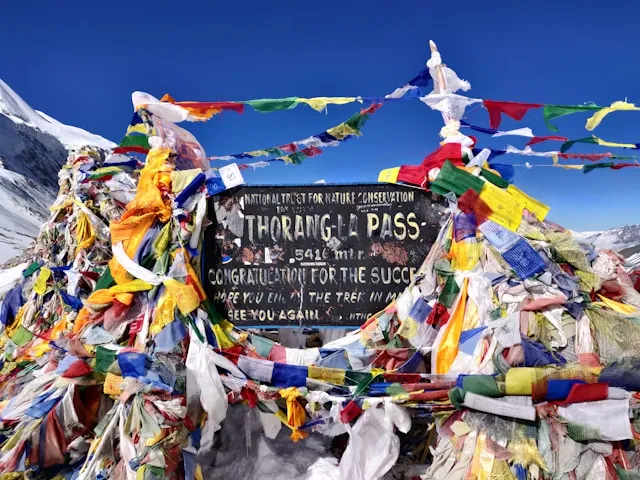
The biggest day of the trek. You leave between three and four in the morning, climb the steep rocky path to the prayer flags on Thorong La, then descend into Mustang.
The pass is 5,416 m and Muktinath is at 3,800 m, so it is around 900 m up and then 1,600 m down, across eight to ten hours of walking with no shelter on the way over.
You leave in the dark so that you cross before the wind rises, which it does across the top of the pass by the middle of most mornings at this time of year.
From the top you look across Annapurna, Dhaulagiri and out into Mustang. Muktinath below is sacred to Hindus and Buddhists alike and has 108 stone water spouts fed from the mountain.
- Duration: Walking: 8 to 10 hrs
- Max Altitude: 5,416 m
- Meals: Breakfast, Lunch & Dinner
- Accommodation: Guest House
A mostly downhill day takes you through the dry, windy country of Mustang, usually by way of the old village of Kagbeni, and finishes at the town of Jomsom.
Jomsom is at 2,720 m, so you lose over 1,000 m across five or six hours. The wind here reliably picks up by late morning, which is why walking days start early in this valley.
Kagbeni sits at the gateway to Upper Mustang and is worth the detour for its old alleys and monastery. Dhaulagiri and Nilgiri at 7,061 m stand over the Kali Gandaki the whole way down.
- Duration: Walking: 5 to 6 hrs
- Max Altitude: 2,720 m
- Meals: Breakfast, Lunch & Dinner
- Accommodation: Guest House
An easy three to four hour walk down the wide Kali Gandaki valley brings you to Marpha, and the flat ground makes this the gentlest walking day of the whole trek.
Marpha is at 2,670 m, barely below Jomsom, so there is almost no height to lose. It is a Thakali village of whitewashed houses and flagstone streets, known across Nepal for its apples, and the local pie, cider and apple brandy are all worth trying.
- Duration: Walking: 3 to 4 hrs
- Max Altitude: 2,670 m
- Meals: Breakfast, Lunch & Dinner
- Accommodation: Guest House
A long but scenic jeep day runs down the Kali Gandaki, through villages and orchards, as the high desert gradually turns back into the green middle hills.
Pokhara is at 820 m, so you lose nearly 1,900 m across seven to nine hours of driving, and the road surface improves steadily the further south you get. Your hotel is near Phewa Lake, so the evening is an easy one after the pass.
- Duration: Driving: 7 to 9 hrs
- Max Altitude: 820 m
- Meals: Breakfast, Lunch & Dinner
- Accommodation: Shared Star Hotel
A relaxed sightseeing day around Pokhara, taking in Davis Falls, the World Peace Pagoda on the ridge above the water, and Phewa Lake itself in the afternoon.
You stay at 820 m all day with no walking of any consequence. After eleven days on the trail this is a genuine rest rather than another item on the schedule.
Davis Falls is where a stream disappears underground. From the pagoda you look down on the lake, the city and the Annapurna range, and you can row out to the Tal Barahi temple on the island.
- Max Altitude: 820 m
- Meals: Breakfast Included
- Accommodation: Shared Star Hotel
A short morning flight takes you back to Kathmandu, and in the afternoon you visit Patan Durbar Square on the other side of the river from the city centre.
The flight takes about half an hour and returns you to 1,400 m, with a last look along the Himalayan range from the air on a clear morning. Patan is known for the stone built Krishna Mandir, and metalworkers and carvers still have workshops in the lanes around the square.
- Duration: 35 min flight
- Max Altitude: 1,400 m
- Meals: Breakfast Included
- Accommodation: Star Hotel (Shared)
A guided culture day around three more of the Kathmandu Valley World Heritage sites, with short drives between them and a fair amount of walking at each one.
You are at 1,400 m with no altitude to think about and nothing strenuous in the day at all. It is a good way to spend your last full day in Nepal before flying home.
Kathmandu Durbar Square holds the old palace and the Kumari house. Swayambhunath is a hilltop stupa with monkeys around it, and Boudhanath is one of the largest stupas anywhere.
- Max Altitude: 1,400 m
- Meals: Breakfast Included
- Accommodation: Star Hotel (Shared)
Your trip ends today. After a relaxed breakfast the morning is free, then a representative drives you to the airport, about thirty minutes from Thamel though traffic can stretch it. This is the end of the Annapurna Circuit via Thorong La.
- Max Altitude: 1,400 m
- Meals: Breakfast Included
Trips Include
- Airport meet and assist on arrival and departure, with all transfers by private vehicle.
- Non-alcoholic welcome drink on arrival.
- Hotel in Kathmandu and Pokhara (3-star, twin or double share) with breakfast.
- Kathmandu to Chame jeep transfer and Marpha to Pokhara jeep transfer.
- Annapurna Conservation Area Permit (ACAP) and TIMS card.
- Sightseeing in Pokhara, Patan, and the Kathmandu Valley with all monument entrance fees.
- All teahouse and lodge accommodation during the trek (twin or dormitory share).
- Three meals a day on the trek (breakfast, lunch, dinner).
- A government-licensed English-speaking trekking guide.
- Porter support, one porter per two trekkers (maximum 8 kg per trekker).
- Assistant guide for groups larger than 7.
Trips Exclude
- International airfare to and from Kathmandu.
- Excess baggage charges on domestic and international flights.
- Nepal entry visa (US$30 for 15 days, US$50 for 30 days, US$125 for 90 days).
- Lunches and dinners in Kathmandu and Pokhara, and any meals not listed.
- Personal trekking equipment such as sleeping bag and down jacket.
- Travel and medical insurance with helicopter evacuation.
- Hot showers, Wi-Fi, and device charging on the trek.
- Drinks, snacks, laundry, telephone, and personal expenses.
- Photography or video fees at monuments, if applicable.
- Tips for guides, porters, drivers, and staff.
- Costs from early return, trip extension, or unforeseen events (weather, landslides, strikes).
- Anything not listed under Cost Includes.
Trips Altitude
Trips Map
Trips Gallery
Packing List
General
- Four-season (zero degree) sleeping bag (personal; available to rent in Kathmandu for about US$35)
- Sleeping bag liner
- Puffy down jacket (personal; available to rent in Kathmandu for about US$35)
- Spade Himalaya duffel bag (provided, carried by the porter)
- Daypack, 30 to 45 litres, with a rain cover
Upper Body
- Sun hat or cap
- Knitted hat or beanie
- Neck gaiter, buff, or scarf
- Sunglasses (UV protection)
- Headlamp with spare batteries
- Technical base-layer tops (light for warm months, heavy for cold months)
- Short and long sleeve technical shirts
- Fleece jacket or pullover
- Waterproof, windproof shell jacket
Lower Body
- Technical base-layer trousers (weight to suit the season)
- Hiking trousers (2 pairs)
- Comfortable trousers for the teahouses
- Hiking shorts
- Waterproof, windproof shell trousers
Hands
- Wool or technical liner gloves
- Insulated hard-shell outer gloves (the pass morning is bitterly cold)
Feet
- Waterproof trekking boots (well broken in)
- Warm wool or technical socks, and hiking socks
- Liner socks (optional)
- Ice cleats or micro spikes (useful on Thorong La with snow)
- Gaiters (light for dust in Mustang, heavier for snow)
- Casual shoes for the evenings
Undergarments
- Quick-drying technical underwear
- Sports bras (women)
- Sleeping clothes or pyjamas
First Aid Kits
Your guide carries a kit and medication, but a personal kit is strongly recommended.
- Sunscreen and lip balm
- Antiseptic ointment and blister care
- Ibuprofen or other pain relief
- Personal medication and any altitude medication advised by your doctor
- Water purification tablets or a UV purifier
Others
- Passport and extra passport photos
- Reusable water bottle and a hydration bladder
- Toiletry kit, quick-dry towel, toilet paper
- High-protein snacks (bars, nuts)
- Waterproof or dry bags for documents and money
- Earplugs and trekking poles
Optional
- Power bank and spare batteries
- Camera or phone for photos
- Binoculars
- Thermos for hot water and a comb
Good to Know
Before you go
You only need a few things ready. First, bring your passport, two photos, and a copy of your insurance. Then Spade Himalaya can sort your ACAP and TIMS card. Also, carry enough cash in Nepalese rupees from Kathmandu or Pokhara. There are ATMs in Chame, Manang, and Jomsom, but they can be down. Last, train before you come, because the Thorong La day is long.
Since April 2023, Nepal requires foreign trekkers in the Annapurna region to walk with a licensed guide from a registered agency. One guide may lead up to seven trekkers, and the rule still holds in 2026 (Kathmandu Post, 2023). The goal is safety and faster help in an emergency. Spade Himalaya is a registered agency with licensed guides. So your permits, plans, and emergency cover are handled for you.
The pass is the crux of the trek. You start before dawn to cross before the wind picks up. Move slowly in the thin air, and wear your warmest layers, because the morning is bitterly cold. Micro spikes help if there is snow. Your guide checks the conditions first and will turn back if the pass is unsafe. The reward is a wide summit view over Annapurna, Dhaulagiri, and Mustang.
The plan follows the climb-high, sleep-low rule. So it adds a rest day in Manang and a slow approach to the pass. Drink 3 to 4 litres of water a day, walk slowly, and skip alcohol up high. Tell your guide early if you feel unwell. Carry altitude medicine if your doctor advises it. Going down is the best cure.
You sleep in teahouses with twin or shared rooms. They are good on this popular route, but more basic at Yak Kharka and Thorong Phedi. The food is simple and filling: dal bhat, noodles, potatoes, soup, and bread, with tea twice a day. Marpha is famous for apple dishes. Mustang and the Kali Gandaki get strong afternoon winds, so start early and carry a windproof layer. For water, refill and purify rather than buy bottles.
Trips Reviews
Crossing Thorong La Pass Was the Highlight of My Nepal Trip
Trips FAQs
Why Choose the Annapurna Circuit?
It is the full circuit. You cross Thorong La (5,416 m), the high point of the trek. Then you reach the holy temple of Muktinath. After that, you follow the Kali Gandaki Gorge through Mustang. This 15-day version also adds Marpha, Pokhara, and UNESCO sightseeing. So you get a big high pass and deep culture in one trip.
Pick the 12-day Annapurna Circuit Trek for a shorter, trek-focused route. Pick this 15-day version for more rest and full culture days in Pokhara, Patan, and Kathmandu. Both cross Thorong La Pass and reach Muktinath. The difference is pace and the sightseeing built around the trek.
The Circuit is a long loop over the high Thorong La Pass, with huge variety. The Annapurna Base Camp Trek is shorter, at 9 days, and tops out lower at 4,130 m. It walks into a glacial bowl below Annapurna I. So choose the Circuit for a big high-pass trip, and Base Camp for a shorter, lower first trek.
Guide Requirement & Trek Regulations
Yes. Since April 2023, every foreign trekker in the Annapurna region must hire a licensed guide and carry a TIMS card. The rule still holds in 2026 (Nepal Tourism Board, 2026). Solo trekking is not allowed here. So Spade Himalaya gives you a licensed guide and sorts your permits.
You need two. First, the Annapurna Conservation Area Permit (ACAP), about NPR 3,000 for foreign trekkers. Second, the TIMS card, about NPR 2,000 for non-SAARC trekkers. Spade Himalaya arranges both, and rangers check them along the trail. The ACAP helps fund Nepal’s largest protected area.
Trek Difficulty: Who Can Trek?
At 5,416 m, Thorong La is one of the highest passes on any popular trek. The crossing day is long and hard. You start at 3 to 4 AM, climb in thin, cold air, then descend to Muktinath. In all, it takes 8 to 10 hours. Safety comes from the rest day in Manang, a slow build-up, and your guide’s weather check before the climb.
Trekker's Well-Being & Safety
It is a real risk, because you sleep above 3,500 m for several nights and cross 5,416 m. So the plan adds a Manang rest day and a slow climb to the pass. Your guide also checks you each day with an oximeter. Drink 3 to 4 litres of water daily, walk slowly, and skip alcohol up high. Tell your guide early if you feel unwell.
Yes, it is a must. Your policy has to cover trekking up to at least 5,500 m and a helicopter rescue. Many normal policies do not, so check the wording first. Arrange it at home before you fly. Then leave a copy with Spade Himalaya at the briefing, so the team can act fast in an emergency.
Cultural and Spiritual Highlights
Muktinath is a temple at about 3,800 m in Mustang. It is holy to both Hindus and Buddhists. It is famous for an eternal natural flame and a row of 108 water spouts. Pilgrims come here to bathe and pray. You reach it just after the hardest day, the Thorong La crossing. So it is one of the most moving stops on the trek.
Best Time to Trek the Annapurna Circuit
Spring (March to May) and autumn (September to November) are best. In these months, the weather is stable and the pass is open. Winter is cold, and snow can block Thorong La. The summer monsoon brings rain to the low valleys, but Mustang stays drier in its rain shadow. For winter details, see our Annapurna Circuit winter guide.