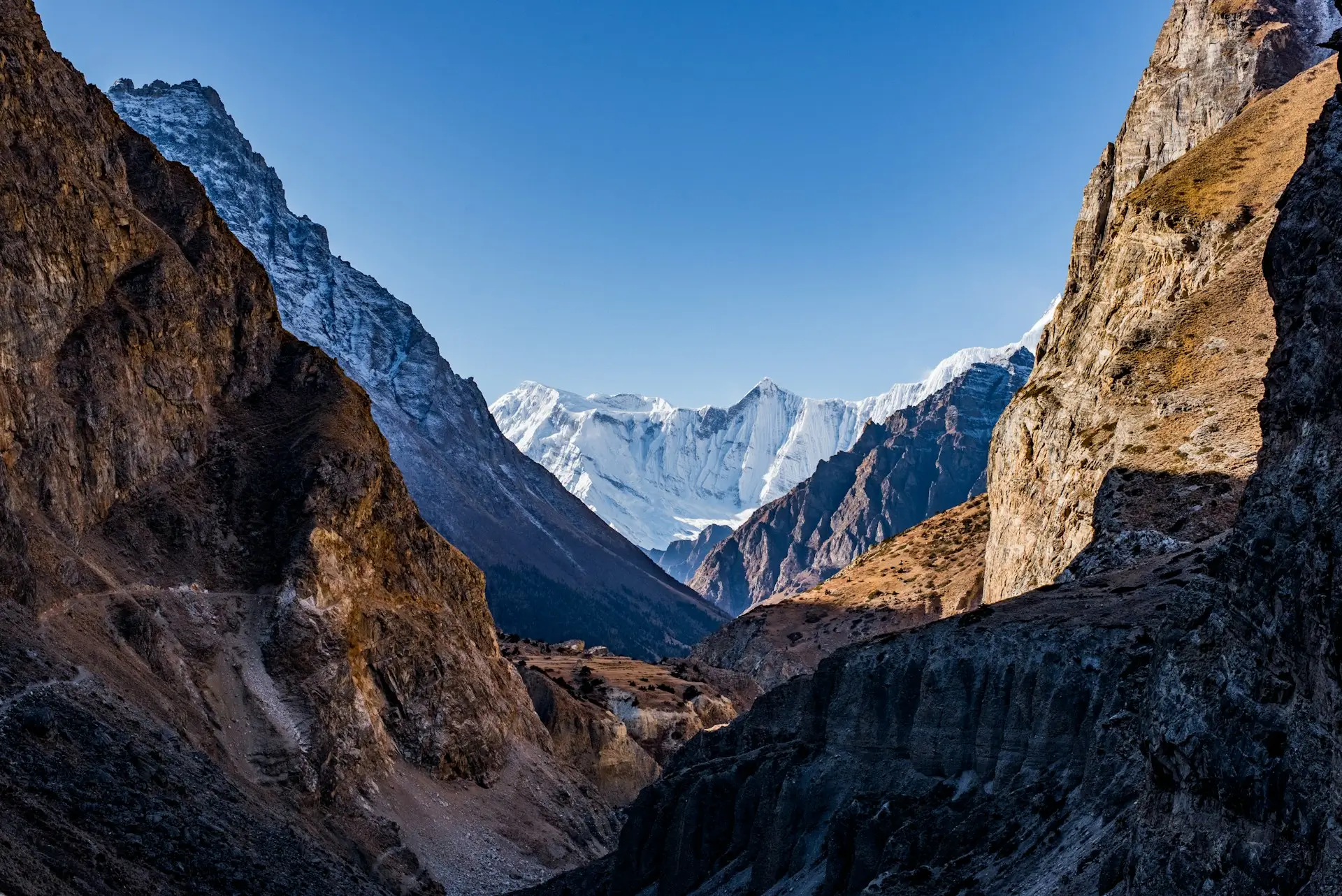
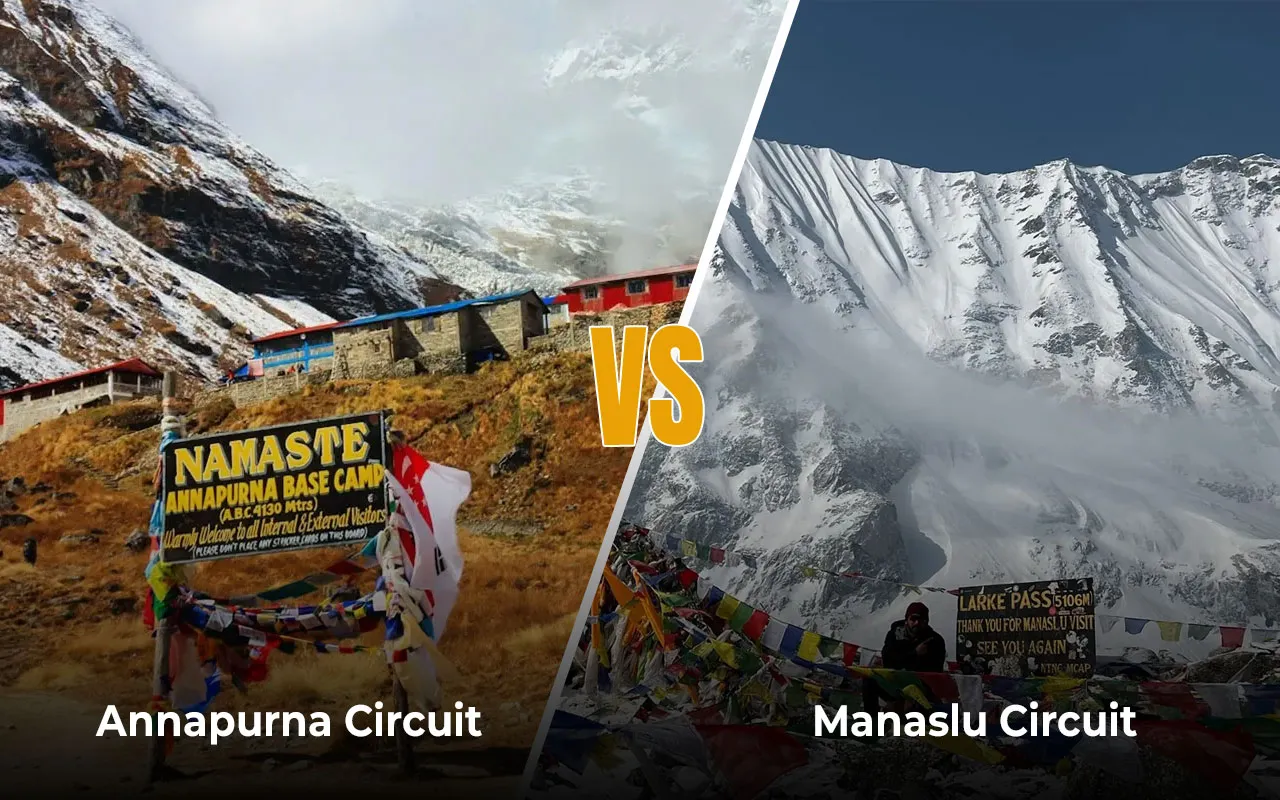
Quick answer: Choose the Manaslu Circuit for a wild, remote loop with the Larkya La pass (5,106 m) and far fewer people. Choose the Annapurna Circuit for better lodges, easier access, and more variety. Manaslu is a restricted area needing a guide and special permits; both cross a high pass.
Choose the Manaslu Circuit if you want a wild, quiet, remote trek; choose the Annapurna Circuit if you want more comfort, variety, and easier access. Both are great two-week loops with a high pass. However, they feel very different on the ground.
Key Takeaways
- Manaslu is more remote, quieter, and a little harder. It needs a restricted permit and a guide.
- Annapurna has better lodges, more variety, and easier rules. It is a touch cheaper.
- Both cross a high pass: Larkya La (5,106 m) on Manaslu, Thorong La (5,416 m) on Annapurna.
- Both now require a licensed guide for foreign trekkers.
- Pick Manaslu for wild and quiet, and Annapurna for comfort and variety.
This guide compares the two on difficulty, cost, permits, crowds, and scenery. For full details, see our Manaslu Circuit Trek guide and our Annapurna region guide.
Quick comparison
Here is the short version, side by side.
| Feature | Manaslu Circuit | Annapurna Circuit |
|---|---|---|
| Duration | about 14 days | about 12 to 15 days |
| High pass | Larkya La 5,106 m | Thorong La 5,416 m |
| Difficulty | Moderate to strenuous | Strenuous |
| Crowds | Very quiet, remote | Busier, well-travelled |
| Lodges | Simple, fewer | More, better quality |
| Permits | Restricted permit + MCAP + ACAP | ACAP + TIMS |
| Cost | about US$1,000 to US$1,600 | about US$900 to US$1,600 |
| Best for | Wild and quiet | Comfort and variety |
Difficulty: which is harder?
Manaslu is a little harder overall, mostly because it is so remote. The trails are rougher, the lodges are simpler, and help is further away. So you need to be more self-reliant.
The Annapurna Circuit has the higher pass, though. Thorong La sits at 5,416 m, while Larkya La is 5,106 m. Still, Annapurna feels safer at the top. That is because it has clearer paths, better lodges, and more acclimatization stops. In short, Manaslu is tougher because it is wild, not because its pass is higher.
Cost: which is cheaper?
The Annapurna Circuit is usually a bit cheaper, by about US$150 to US$300. The main reason is the permit. Annapurna only needs the ACAP and a TIMS card, which are cheap. Manaslu needs a Restricted Area Permit on top of two conservation permits.
Manaslu also has more remote logistics, which costs a little more. Neither trek needs an expensive mountain flight, though. So both stay good value. For full numbers, see our Manaslu cost guide and Annapurna Circuit cost guide.
How do the permits and rules compare?
Manaslu has stricter rules, because it is a restricted area. You need three permits, a licensed guide, and a registered agency. You cannot get the main permit on your own.
Annapurna is simpler. You need the ACAP and a TIMS card. Since 2023, you also need a licensed guide there, just like on most Nepal treks (Nepal Tourism Board, retrieved 2026-06-23). So both require a guide now. However, Manaslu’s permit process is more involved. For the detail, read our Manaslu permit guide.
How do crowds and scenery compare?
Manaslu is far quieter; Annapurna offers more variety. On Manaslu, you may walk for hours without seeing another group. The villages feel deeply Tibetan, and the route stays wild from start to finish.
The Annapurna Circuit is busier, especially in autumn. In return, it gives you more variety. For example, you pass green valleys, the Manang highlands, the sacred town of Muktinath, and the deep Kali Gandaki gorge. So Manaslu wins on solitude, while Annapurna wins on range.
Which trek should you choose?
Pick by what matters most to you: solitude or comfort. Here is a simple way to decide.
- Choose Manaslu if: you want a wild, remote, quiet trek, you have some experience, and you like the idea of an off-the-map route.
- Choose the Annapurna Circuit if: you want better lodges, more variety, easier access, and a slightly lower price.
- New to the Himalaya? Both are big treks. So you might start with the shorter Annapurna Base Camp Trek first.
There is no wrong answer here. Both are world-class. Your taste for solitude versus comfort should decide.
Ready to book? See our 14-day Manaslu Circuit Trek or our 12-day Annapurna Circuit Trek.
How do accommodation and food compare?
The lodges differ a lot between the two treks. On the Annapurna Circuit, the teahouses are bigger and better. Many have private rooms, hot showers, and wide menus. So Annapurna is the more comfortable trek.
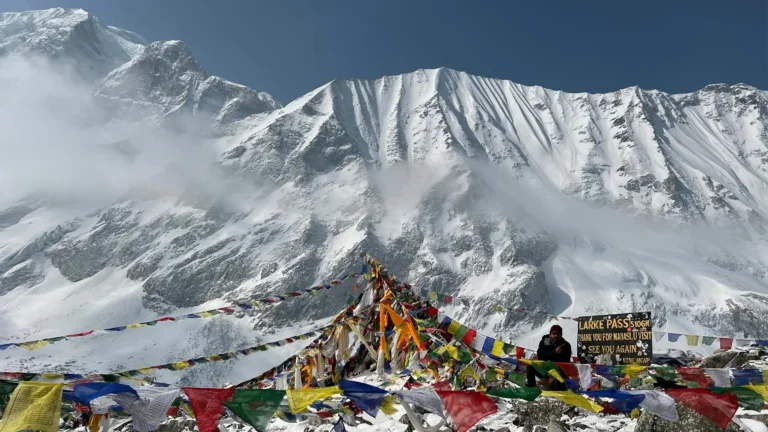
On Manaslu, the teahouses are simpler and fewer. Rooms are basic, especially up high. The food is still good, though. In fact, both treks serve dal bhat, noodles, potatoes, soups, and Tibetan bread. So you eat well on either route. In short, Annapurna wins on comfort, while Manaslu feels more rustic and remote.
How do getting there and logistics compare?
Both treks use road travel, not flights. The Annapurna Circuit starts with a drive to Besisahar and Chame. Then it ends through Pokhara. So it is easy to reach and easy to leave.
Manaslu is a little more involved. First, you drive a long way to Soti Khola or Machha Khola. Then, at the end, you reach Dharapani, where the trail joins the Annapurna road. Neither trek needs an expensive mountain flight, though. As a result, both avoid Lukla-style weather delays.
Which trek wins season by season?
Both treks share the same best seasons, but there are small differences. Here is a quick look.
- Spring (March to May): great for both. Also, Annapurna adds rhododendron blooms.
- Autumn (September to November): the peak season for both, with the clearest skies.
- Winter (December to February): both passes can close with snow. However, lower Annapurna treks stay open.
- Monsoon (June to August): wet for both. Still, Annapurna’s Mustang side stays drier in its rain shadow.
So for the high passes, both treks are best in spring and autumn.
Which trek suits which trekker?
Here is a simple way to choose, by trekker type. Find the one that sounds like you.
- First-time trekker: Annapurna. It is more forgiving and better supported.
- Solitude seeker: Manaslu. It is far quieter.
- Comfort seeker: Annapurna. The lodges are better.
- Experienced trekker wanting wild: Manaslu. It feels off the map.
- Photographer: both are stunning. Choose Manaslu for raw remoteness, or Annapurna for variety.
In short, pick Annapurna for comfort and ease, and Manaslu for solitude and adventure.
FAQs
Is the Manaslu Circuit harder than the Annapurna Circuit?
Yes, a little. Manaslu has rougher trails, fewer lodges, and more remote terrain, so it asks for more experience. Annapurna has the higher pass at 5,416 m, but it feels safer with better paths and lodges. So Manaslu is harder mainly because it is wild.
Which is cheaper, Manaslu or Annapurna Circuit?
The Annapurna Circuit is usually cheaper, by about US$150 to US$300. The main reason is the permit. Manaslu needs a Restricted Area Permit plus two conservation permits, while Annapurna only needs the ACAP and a TIMS card.
Do both treks need a guide?
Yes. Manaslu has required a licensed guide for years, because it is a restricted area. Since 2023, the Annapurna region also requires a licensed guide for foreign trekkers (Nepal Tourism Board, retrieved 2026-06-23). So both treks now need a guide booked through a registered agency.
Which has better scenery?
Both are stunning in different ways. Manaslu is wild and deeply Tibetan, with quiet trails. Annapurna offers more variety, from green valleys to Muktinath and the Kali Gandaki gorge. So choose Manaslu for solitude and Annapurna for range.
Which should a first-timer choose?
Both are demanding two-week treks. If you have some experience, Annapurna is the gentler of the two. If it is your first Himalayan trek, a shorter route like Annapurna Base Camp is a better start. Then you can step up to a circuit later.
Accuracy note: official fees, rules, and hard facts in this guide are cited inline from their sources; trail and price details are Spade Himalaya field research; route details reviewed by Yubaraj Katel, government-licensed trekking guide (Licence No. 19827) with 10 years of experience leading treks in the Annapurna region.

Still Deciding?
Updated: 6 Jul, 2026
7 min
Manaslu Circuit Trek Cost in 2026: Full Budget Breakdown
Quick answer: A guided Manaslu Circuit Trek costs about US$1,000 to US$1,600 per person in 2026....
Updated: 6 Jul, 2026
7 min
Annapurna Circuit Trek Cost in 2026: Full Breakdown
Quick answer: A guided Annapurna Circuit Trek is good value, with mandatory but cheap permits and...
Updated: 14 Sep, 2026
10 min
Manaslu Circuit Trek Guide and Route Map (2026)
Quick answer: The Manaslu Circuit Trek is a remote 14-day loop around Mount Manaslu (8,163 m),...