Quick answer: The Mardi Himal Trek is a short, quiet ridge trek in Nepal’s Annapurna region, climbing to Mardi Himal Base Camp (4,500 m) below the Fishtail peak. It runs 4 to 7 days, needs no flight, is graded moderate, and is best in spring and autumn.
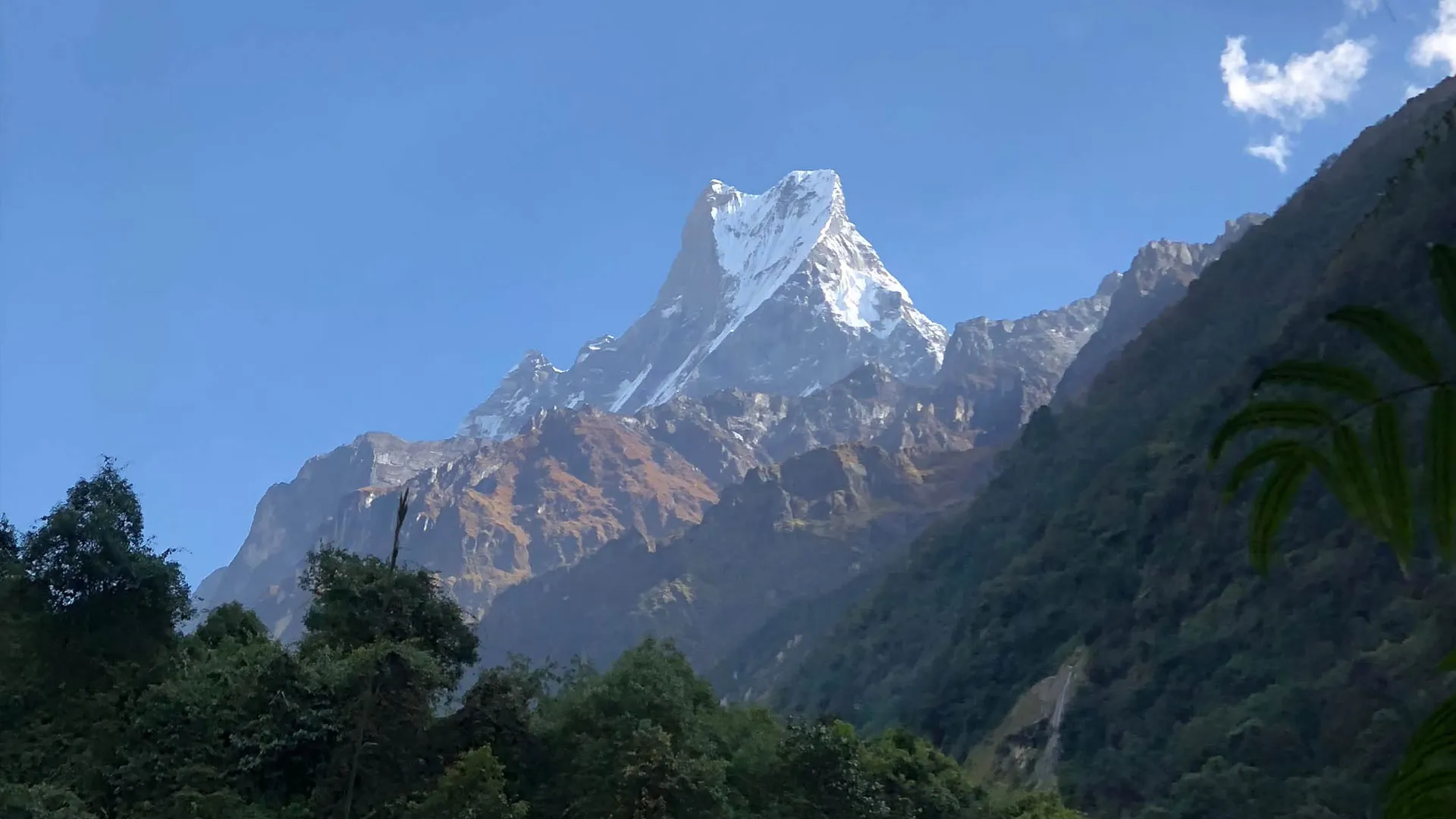
The Mardi Himal Trek is a short, quiet ridge trek in the Annapurna region, with huge close-up views of Machhapuchhre, the Fishtail peak. It climbs a hidden spur to Mardi Himal Base Camp (4,500 m). It needs no flight, just a short drive from Pokhara. So it is one of the best short treks in Nepal. This guide covers the route, days, cost, difficulty, permits, and best time, all in plain terms.
Key Takeaways
- The trek climbs a quiet ridge to Mardi Himal Base Camp (4,500 m), below Machhapuchhre (6,993 m).
- It runs from 4 to 7 days on the trail, or about 10 days with travel from Kathmandu.
- It is graded moderate, and it suits fit beginners.
- There is no flight. You start with a short drive from Pokhara.
- The best time is spring (March to May) and autumn (September to November).
- Budget roughly US$350 to US$750 for a guided trek, by length and group size.
This is the hub for everything we cover on Mardi Himal. First, use it to plan the big picture. Then follow the links to our deeper guides and the full trek itineraries.
What is the Mardi Himal Trek?
The Mardi Himal Trek is a high ridge walk in the Annapurna region, near Pokhara. It is one of Nepal’s newer official trails, so it stays quiet. You climb a forested spur that sits right below the Fishtail peak.
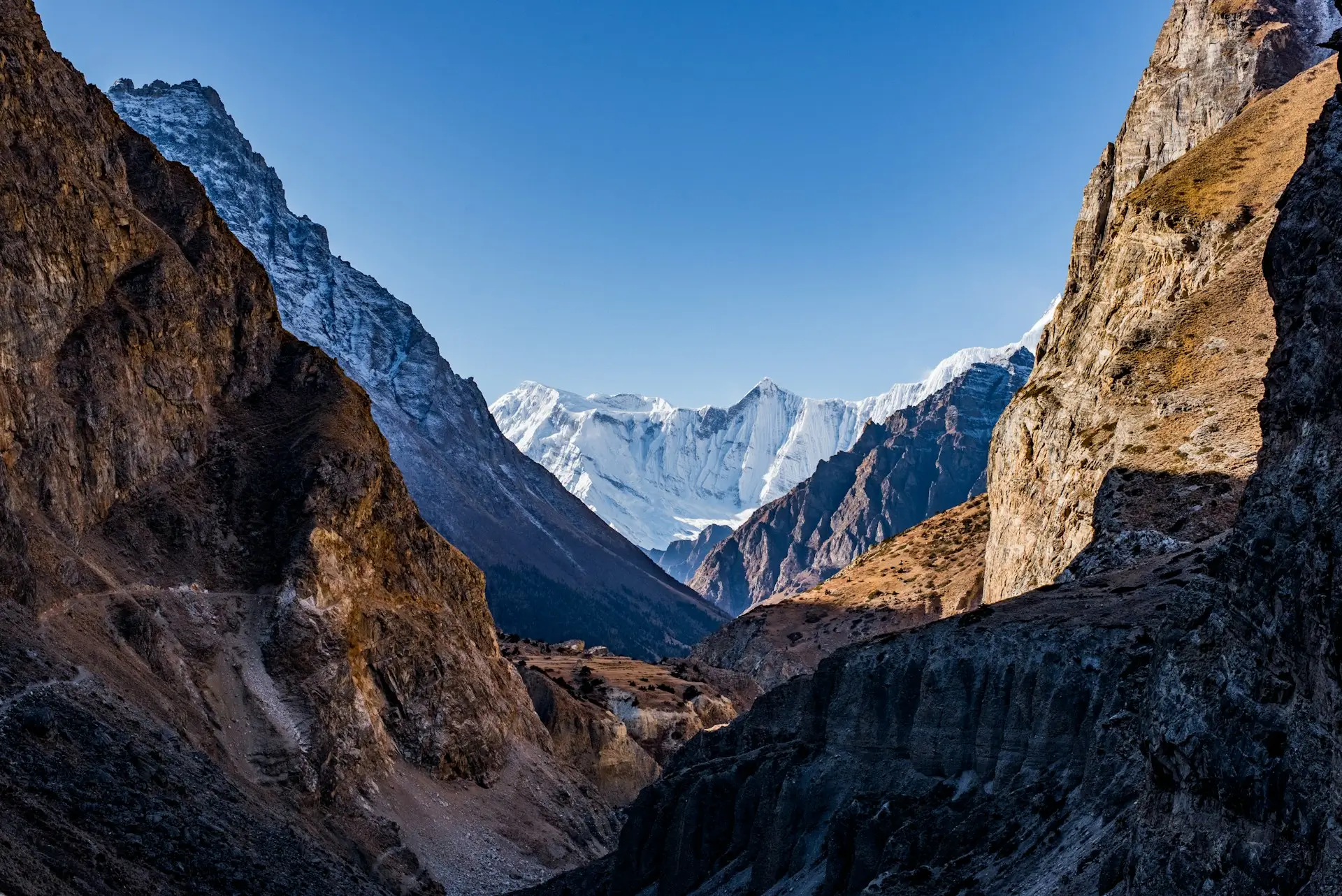
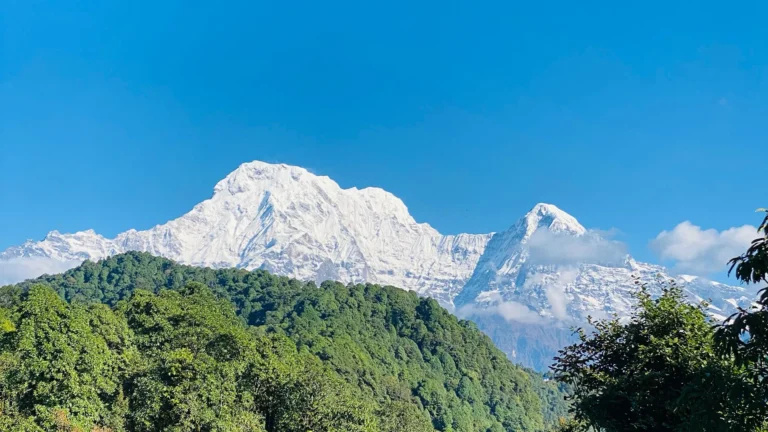
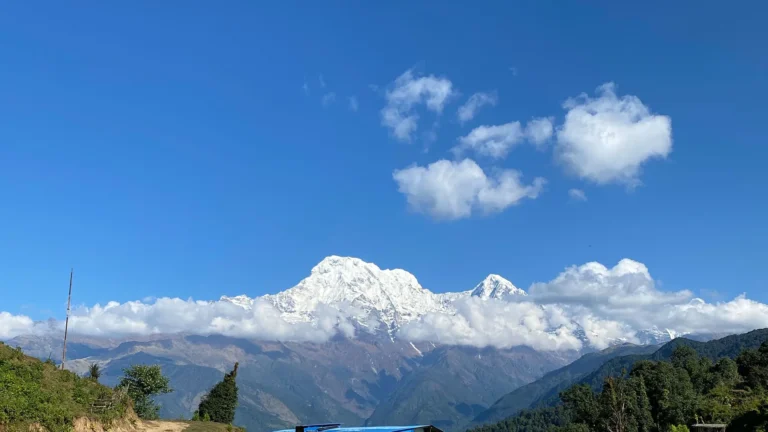
The trail starts low, in green rhododendron and oak forest. Then it climbs a narrow ridge to open alpine meadows. Higher up, a wall of peaks fills the sky. You see Machhapuchhre (6,993 m), Annapurna South (7,219 m), Hiunchuli (6,441 m), and Mardi Himal (5,587 m) itself.
The whole route sits inside the Annapurna Conservation Area, Nepal’s largest protected area. So a permit and a licensed guide are required. In short, Mardi gives you big Himalayan views without the crowds or a long trip.
For the full day-by-day plan, see our 10-day Mardi Himal Trek.
What is the route, and what are the camps?
The Mardi Himal Trek follows one ridge up and down, so it is simple to picture. You climb through a string of small camps, each higher than the last. Here is the route in short.
Pokhara to Kande to Forest Camp to Low Camp to High Camp to Mardi Himal Base Camp (4,500 m), then back down to Siding and on to Pokhara.
Here are the main stops by height:
| Stop | Height (m) | What it is |
|---|---|---|
| Kande | 1,770 | Road head, start of the walk |
| Forest Camp | 2,600 | Lodges in deep forest |
| Low Camp | 2,970 | First open mountain views |
| High Camp | 3,580 | The base for the summit push |
| Upper View Point | 4,200 | A closer viewpoint on the ridge |
| Mardi Himal Base Camp | 4,500 | The high point, below Fishtail |
So you climb the ridge over a few days, reach Base Camp, then return the same way. On the way out, you pass the village of Siding and its terraced farms.
Mardi Himal trek map
This is the ridge route from Kande through Forest Camp, Low Camp and High Camp to Mardi Himal Base Camp.
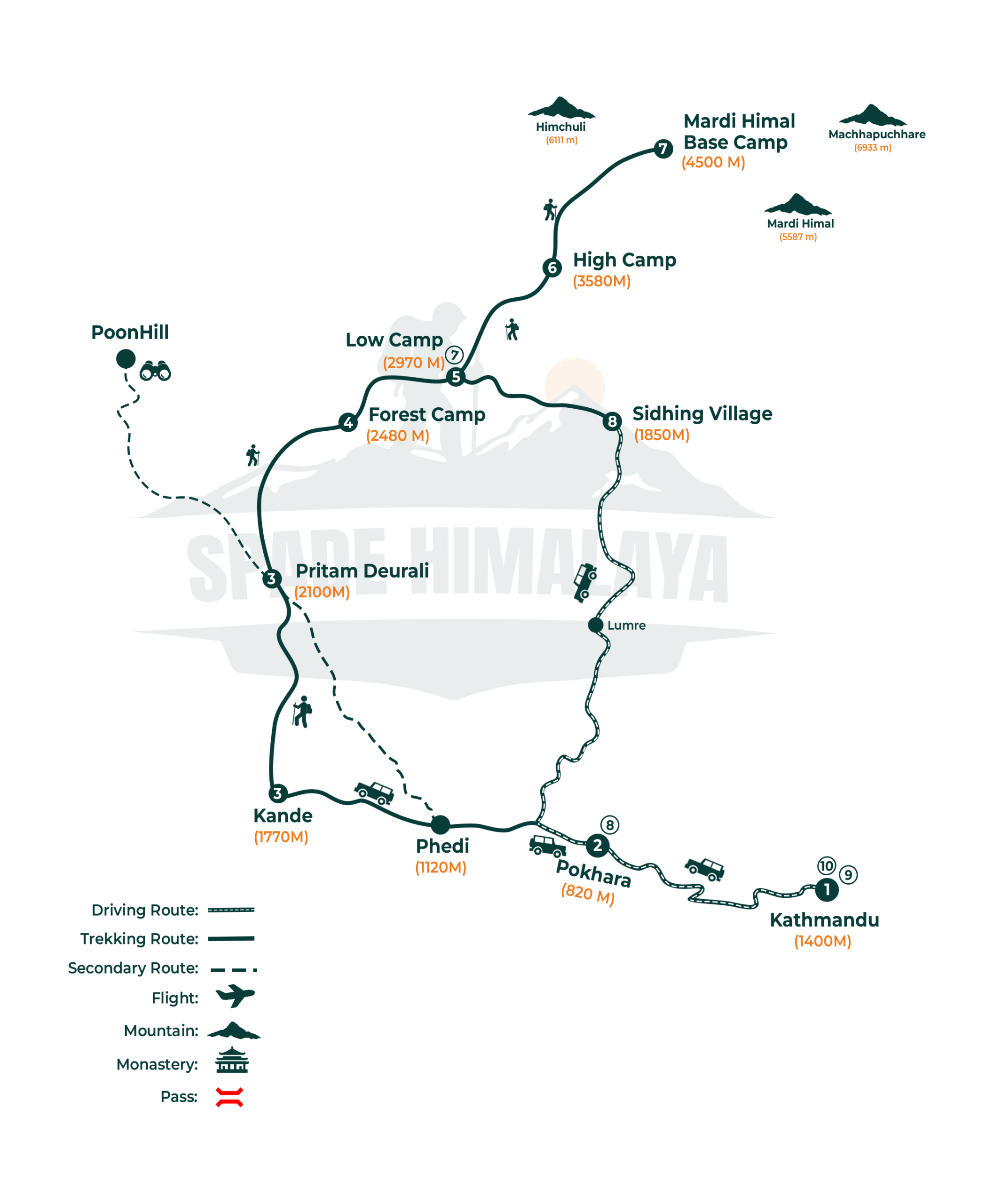
Our own Mardi Himal trek map. The route runs Kande (1,770 m), Pitam Deurali (2,100 m), Forest Camp (2,600 m), Low Camp (2,970 m) and High Camp (3,580 m) to Mardi Himal Base Camp (4,500 m), descending to Siding (1,750 m) for the drive back to Pokhara.
How many days do you need?
Most people trek Mardi Himal in 4 to 7 days on the trail, plus travel time. The right length depends on your fitness and your time. Here are the common options.
- 4-day trek. This is the fast version. It works for fit walkers who are short on time.
- 5-day trek. This adds a little breathing room. It is the best balance for most trekkers.
- 7-day trek. This is the most relaxed, with extra time to acclimatize and explore.
- 10-day trip. This adds travel and a night or two in Kathmandu and Pokhara.
We suggest at least 5 days, so you climb a touch slower and enjoy the ridge. For the short options from Pokhara, see our guide to the short Mardi Himal Trek. For the full plans, see the 5-day short trek and the 10-day trek.
What permits do you need for the Mardi Himal Trek?
You need two low-cost permits for the Mardi Himal Trek, plus a licensed guide. So the paperwork is simple, and Spade Himalaya handles it for you.
You need two papers:
- Annapurna Conservation Area Permit (ACAP). This costs NPR 3,000 (about US$25) for foreign trekkers (Nepal Tourism Board, retrieved 2026-06-24).
- TIMS card. This costs NPR 2,000 for foreign trekkers, or NPR 1,000 for SAARC nationals (Nepal Tourism Board, retrieved 2026-06-24).
Since 31 March 2023, foreign trekkers must use a licensed guide in Nepal’s national park and conservation areas, including the Annapurna region (Nepal Tourism Board, retrieved 2026-06-24). So a solo, guide-free Mardi trek is no longer allowed. Spade Himalaya is a registered agency, so we arrange the guide and both permits for you.
How much does the Mardi Himal Trek cost?
A guided Mardi Himal Trek usually costs about US$350 to US$750 per person in 2026. The price depends on the length, the group size, and the comfort level. The short 4 to 5 day trek sits at the lower end. The 10-day trip costs more.
Mardi is one of the cheapest treks in Nepal. The reason is simple. There is no flight, the trek is short, and the permits are low. So your money goes to the guide, the transport, the food, and the lodging.
For a full line-by-line breakdown, see our Mardi Himal Trek cost guide.
Trek difficulty: the Spade Himalaya Trek Difficulty Scale
We grade every trek from 1 to 5, so you can compare them fast. This is our own scale, based on altitude, length, remoteness, and lodging.
| Grade | Name | What it means | Example treks |
|---|---|---|---|
| 1 | Easy | Under 3,500 m, short, gentle days | Poon Hill |
| 2 | Moderate | Up to about 4,500 m, no high pass | Annapurna Base Camp, Mardi Himal |
| 3 | Strenuous | 5,000 to 5,550 m, a base camp or one high pass, good lodges | Everest Base Camp, Annapurna Circuit, Manaslu Circuit |
| 4 | Challenging | Remote, above 5,000 m, long rough days, simple lodges or some camping | Makalu, Everest Three Passes |
| 5 | Expedition | Very remote, full camping, or several high passes | Upper Dolpo |
On this scale, the Mardi Himal Trek is Grade 2 (Moderate). It has no high pass and no technical ground. The one catch is the fast altitude gain, which we cover below. For more detail, see our Mardi Himal Trek difficulty and best time guide.
What are the temperatures by season?
Here are rough temperatures by season, so you know what to pack. These are field-experience ranges from our guides, not exact figures, because mountain weather changes fast.
| Season | Lower ridge (day) | High Camp and Base Camp (night) | Verdict |
|---|---|---|---|
| Spring (Mar to May) | 12 to 20°C | -5 to -10°C | Excellent, rhododendrons bloom |
| Autumn (Sep to Nov) | 10 to 18°C | -7 to -12°C | Excellent, clearest views |
| Winter (Dec to Feb) | 4 to 12°C | -12 to -18°C | Cold, snow up high |
| Monsoon (Jun to Aug) | 15 to 22°C | -2 to -6°C | Wet, leeches, cloud |
When is the best time to trek Mardi Himal?
Spring (March to May) and autumn (September to November) are the best seasons. Both bring stable weather and clear skies. So the mountain views are at their best.
In spring, the rhododendron forests bloom red and pink along the ridge. In autumn, the air is crisp and clear after the rains. So autumn gives the sharpest, longest views of Fishtail and Annapurna South.
Winter is cold, and snow can cover the trail above High Camp. Still, clear days are common, and the trail is quiet. The summer monsoon brings rain, leeches, and cloud, so most trekkers skip it.
How do you stay safe at altitude?
Mardi climbs fast, so altitude is the main thing to respect, even though the trek is short. You go from about 1,770 m to 4,500 m in just a few days. That is quicker than the usual advice once you pass 3,000 m.
Altitude sickness (AMS) gets more likely the higher you go. In one study of Nepali Himalaya trekkers, AMS affected about 15% of people at 4,000 to 4,500 m (PubMed, retrieved 2026-06-24). So the push from High Camp (3,580 m) to Base Camp (4,500 m) is the part to take slowly.
The plan is simple. First, walk at an easy pace. Next, drink 3 to 4 litres of water a day, and skip alcohol up high. Also, choose a 5 to 7 day plan over a rushed 3-day one, so your body has more time. Your guide carries a pulse oximeter and checks you daily. If anyone feels unwell, going down is the best cure (CDC Yellow Book, retrieved 2026-06-24).
Mardi Himal or Annapurna Base Camp?
Choose Mardi Himal for a short, quiet ridge with close-up views; choose Annapurna Base Camp for a longer, grander walk into a ring of peaks. Both are classic Annapurna treks. However, they feel different.
Mardi is shorter, steeper, and far quieter. Annapurna Base Camp is longer, richer in culture, and more famous. Mardi gains height faster, so acclimatization matters more. In short, Mardi rewards trekkers who want big views in less time.
For a full head-to-head, read Mardi Himal vs Annapurna Base Camp. You can also combine both on our Mardi Himal and Annapurna Base Camp Trek.
What are accommodation and food like?
You sleep in simple teahouses, the small family lodges along the ridge. Lower down, rooms are basic but comfortable. Higher up, at High Camp, they get colder and plainer. So a warm sleeping bag matters near the top.
The food is filling and good for trekking. For example, you get dal bhat, noodles, soup, potatoes, and eggs. You can also get pancakes and Tibetan bread at many lodges. Vegetarian meals are easy to find too.
The ridge has no ATMs, and power can be scarce up high. So carry enough Nepalese rupees from Pokhara. Wi-Fi, charging, and hot showers all cost a small fee that rises with altitude.
What should you pack?
The key is layers, because the trek runs from warm forest to a cold, windy ridge. Here is a short list of essentials:
- Waterproof trekking boots, broken in, plus warm socks
- Base layers, a fleece or down mid-layer, and a waterproof shell
- A four-season sleeping bag and a down jacket (you can rent both in Pokhara)
- Warm hat, sun hat, sunglasses, buff, and gloves
- Headlamp, trekking poles, sunscreen, and a water bottle
- Micro spikes for the ridge above High Camp, in case of snow
Our trek pages list the full, season-by-season packing list.
Who should trek Mardi Himal?
Mardi suits fit beginners and anyone who wants big views in a short, quiet trek. You do not need climbing skills or past trekking experience. You just need decent fitness and a sensible pace for the altitude.
It is a great first Himalayan trek, and a great second trip for people who found the famous routes too busy. So if you have under a week and want the Annapurna peaks up close, Mardi is hard to beat.
If you are comparing nearby treks, see our Annapurna region guide. For other short options, look at the Ghorepani Poon Hill Trek or the quiet Khopra Danda Trek. For a straight comparison of the two most popular short options, see Mardi Himal vs Poon Hill.
FAQs
How many days is the Mardi Himal Trek?
Most people trek it in 4 to 7 days on the trail. The 4-day plan is the fast option, and 5 days is the best balance for most trekkers. With travel from Kathmandu, the full trip runs about 10 days.
How hard is the Mardi Himal Trek?
It is graded moderate, so it suits fit beginners. There is no climbing or technical ground. The main challenge is the fast altitude gain, since you reach 4,500 m in just a few days. So a steady pace matters.
Where does the Mardi Himal trek start?
At Kande, a short drive from Pokhara. From there the route climbs through Forest Camp and Low Camp to High Camp and Mardi Himal Base Camp, then descends to Siding and back to Pokhara.
Do you need a guide for the Mardi Himal Trek?
Yes. Since 31 March 2023, foreign trekkers must use a licensed guide in the Annapurna region. You also need an ACAP permit and a TIMS card. Spade Himalaya arranges the guide and both permits for you.
How high is Mardi Himal Base Camp?
Mardi Himal Base Camp sits at 4,500 m. High Camp, the last overnight stop, is at 3,580 m. So you climb nearly 1,000 m on the summit-push morning, which is why a slow pace helps.
Do you need a flight for the Mardi Himal trek?
No. Mardi Himal needs no domestic flight at all, just a short drive from Pokhara to the trailhead. That keeps the cost down and removes the risk of weather delays.
Accuracy note: official fees, rules, and hard facts in this guide are cited inline from their sources; trail and price details are Spade Himalaya field research; route details reviewed by Yubaraj Katel, government-licensed trekking guide (Licence No. 19827) with 10 years of experience leading treks in the Annapurna region.

Start Planning Your Trek
Updated: 16 Sep, 2026
6 min
Mardi Himal Trek Cost in 2026: A Full Price Breakdown
Quick answer: A guided Mardi Himal Trek costs US$395 to US$995 per person in 2026 on...
Updated: 6 Jul, 2026
6 min
Short Mardi Himal Trek from Pokhara (3, 4, and 5 Day Options)
Quick answer: The short Mardi Himal Trek runs from Pokhara in 3, 4, or 5 days...
Updated: 6 Jul, 2026
7 min
Mardi Himal Trek Difficulty and Best Time (2026 Guide)
Quick answer: The Mardi Himal Trek is graded moderate, so it suits fit beginners, with no...