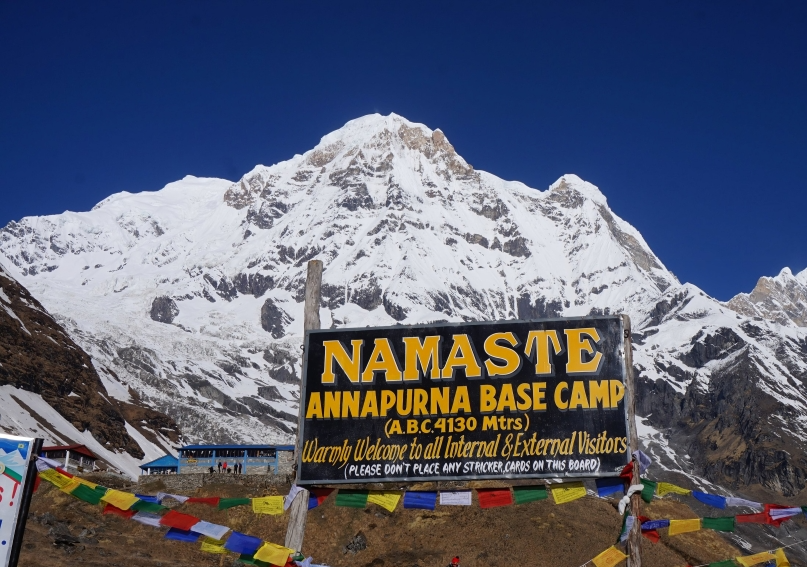
Quick answer: Annapurna Base Camp sits at 4,130 m (13,550 ft), which is your highest sleeping point on the trek. That is high enough to feel the thin air, but low enough that serious altitude sickness is uncommon if you pace yourself. The trek is graded moderate, and the real challenge is the long stone staircases, not the altitude.
Two questions hide inside “how high is Annapurna Base Camp,” and I want to answer both: the number, and what the number means for you. After all, people search the height because they are quietly asking whether they can handle it. So here is the full elevation profile, in metres and feet, and an honest read on how hard the trek actually feels.
Key Takeaways
- Annapurna Base Camp altitude is 4,130 m (13,550 ft), the trek’s highest point.
- You sleep highest at base camp; Machhapuchhre Base Camp below it is 3,700 m.
- At 4,130 m, altitude sickness is possible but uncommon with sensible pacing.
- ABC is much lower than Everest Base Camp (5,364 m), so the altitude risk is smaller.
- The trek is moderate, and the real effort is the stone staircases, not the air.
How high is Annapurna Base Camp?
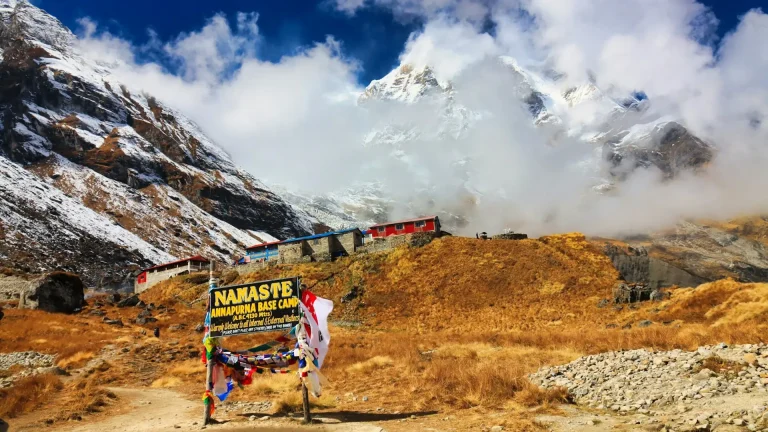
Annapurna Base Camp stands at 4,130 m, which is 13,550 feet. That is the top of the trek and your highest sleeping altitude. It is high enough that you will notice the thinner air on the final climb, where the oxygen is only about 60% of what you breathe at sea level. And it is cold enough at night to need a good sleeping bag. But it is not extreme by Himalayan standards.
For comparison, Everest Base Camp sits over 1,200 m higher, at 5,364 m. That gap matters more than it sounds, because altitude effects grow quickly with height. So ABC gives you a genuine high-mountain experience with a gentler ceiling. And that is a big part of why it suits first-timers.
The Annapurna Base Camp trek elevation profile
Here is how the height builds, stop by stop, in metres and feet. You climb steadily up one valley, which is kinder on the body than a sudden jump.
| Stop | Metres | Feet |
|---|---|---|
| Pokhara | 820 m | 2,690 ft |
| Nayapul | 1,050 m | 3,445 ft |
| Ghandruk | 1,940 m | 6,365 ft |
| Chhomrong | 2,170 m | 7,120 ft |
| Himalaya | 2,920 m | 9,580 ft |
| Machhapuchhre Base Camp | 3,700 m | 12,140 ft |
| Annapurna Base Camp | 4,130 m | 13,550 ft |
So most of your nights are spent well below 3,000 m, in comfortable villages. You only reach the real altitude on the final push to base camp. And that gradual profile is exactly the kind that keeps trekkers healthy.
Is the altitude at Annapurna Base Camp dangerous?
It deserves respect, not fear. At 4,130 m, altitude sickness is possible but not common when you climb sensibly. Mild altitude sickness can affect anyone above about 3,000 m, and ABC crosses that line on its last day or two. But you sleep low for most of the trek, and only reach 4,130 m briefly. So most trekkers feel fine.
Still, the rules that keep you safe are simple. Climb at a steady pace, drink plenty of water, and tell your guide at the first sign of a headache or nausea. Many trekkers swear by the garlic soup on the teahouse menus, a local staple said to help with the altitude. Our guides carry a pulse oximeter and check trekkers daily on the high section. And if symptoms grow, the cure is always the same. You go down, which is quick and easy here, because the valley drops away fast. For the full picture on how altitude works, see our altitude sickness guide.
How difficult is the Annapurna Base Camp trek?
Moderate, and the honest challenge is the staircases, not the thin air. Now, since the altitude stays manageable, the difficulty of ABC is really about the terrain and the daily effort. You walk roughly 5 to 7 hours a day, on real gradients, up and down.
The Annapurna trails are famous for their stone steps, and by some counts the route holds around 30,000 of them. And the climb in and out of Chhomrong is the leg-burner everyone remembers. There is no technical ground, though. No ropes, no ice, nothing that would frighten a hillwalker. So the trek asks for fitness and patience, not mountaineering skill.
How fit do you need to be for ABC?
Fit enough to climb stairs for hours and do it again the next day. Honestly, that is the whole test. You do not need to be an athlete, and you do not need altitude experience. But your legs and lungs will thank you for some preparation.
In our experience, the trekkers who enjoy ABC most have trained for six to eight weeks before they arrive. A simple plan works well:
- Build cardio with brisk walks, jogging, cycling, or stairs, three or four times a week.
- Do back-to-back hill walks with a daypack, to train your legs for consecutive days.
- Add some strength work for legs and core, and break in your boots early.
So do that, and a healthy adult of almost any age finishes this trek strong. The Sanctuary rewards preparation more than raw talent.
Annapurna Base Camp vs Everest Base Camp: the altitude difference
ABC tops out over 1,200 m lower than Everest Base Camp, which makes it the easier trek on altitude. In fact, this is the single biggest reason ABC suits beginners and shorter trips.
| Annapurna Base Camp | Everest Base Camp | |
|---|---|---|
| Highest point | 4,130 m (13,550 ft) | 5,364 m (17,598 ft) |
| Altitude risk | Lower | Higher |
| Acclimatization days | Usually none needed | Built into the route |
| Getting there | Drive from Pokhara | Flight to Lukla |
So does the altitude of Everest Base Camp worry you? Then ABC is the gentler door into the high Himalaya, and no less beautiful. Our Annapurna Base Camp guide covers the whole trek, and the day-by-day itinerary shows exactly where the height builds.
FAQs
What is the altitude of Annapurna Base Camp?
Annapurna Base Camp sits at 4,130 m, which is 13,550 feet. That is the highest point and the highest sleeping altitude on the trek. Machhapuchhre Base Camp, just below it, is 3,700 m.
How high is Annapurna Base Camp in feet?
Annapurna Base Camp is 13,550 feet (4,130 m) above sea level. It is high enough to feel the thin air on the final climb, but well below the extreme altitudes of the higher Himalayan treks.
Is Annapurna Base Camp high enough for altitude sickness?
Yes, mild altitude sickness is possible above about 3,000 m, and ABC reaches 4,130 m. But because you sleep low for most of the trek and only briefly reach the top, serious cases are uncommon with sensible pacing.
How much oxygen is there at Annapurna Base Camp?
At 4,130 m the air holds only about 60% of the oxygen you breathe at sea level. That is why the final climb feels slow even for fit trekkers. It is not low enough to need supplementary oxygen, but it is low enough to demand a steady pace.
Is Annapurna Base Camp higher than Everest Base Camp?
No. Annapurna Base Camp is 4,130 m, while Everest Base Camp is 5,364 m, over 1,200 m higher. That lower ceiling makes ABC the easier of the two on altitude, and a better first trek for most people.
Do you need to acclimatize on the ABC trek?
Usually no separate acclimatization day is needed, because the route climbs gradually and tops out at a moderate 4,130 m. A steady pace and good hydration are normally enough, and a guide watches for any symptoms.
Accuracy note: Annapurna Base Camp altitude (4,130 m, about 13,550 ft) and the elevation profile reflect Spade Himalaya’s own Annapurna Base Camp Trek route (retrieved 2026-07-14); feet conversions are rounded from the metre figures; Everest Base Camp comparison altitude (5,364 m) matches our Everest guides; altitude-health guidance is general and reflects standard acclimatization practice, not medical advice; reviewed by Yubaraj Katel, government-licensed trekking guide (Licence No. 19827) with 10 years of experience across Nepal’s regions.

Keep Planning Your Trek
Updated: 14 Sep, 2026
8 min
Annapurna Base Camp Trek Itinerary, Route and Map
The Annapurna Base Camp trek route and itinerary, village by village, with 5-day, 7-day, and 9-day...
Updated: 20 Jul, 2026
9 min
Annapurna Base Camp Trek Cost (2026): A Full Breakdown
What the Annapurna Base Camp trek really costs in 2026: permits, guide, food, transport, and package...
Updated: 15 Jul, 2026
13 min
Annapurna Base Camp Trek: The Complete Guide (2026)
The Annapurna Base Camp trek, explained by a Nepal operator: difficulty, itinerary, cost, best time, and...