Trip Facts
Country:
Nepal
Duration:
14 Days
Max Altitude:
3,210 m
Activities:
Sightseeing, trekking, jungle safari, and driving
Region:
Kathmandu Valley, Annapurna, and Chitwan
Starting Point:
Kathmandu
Ending Point:
Kathmandu
Grade:
Easy
Group Size:
1 to 12 pax
Accomodation:
3-star hotels, teahouses, jungle lodge
Best Season:
Oct-Nov & Mar-Apr
Notice
This trip crosses three very different parts of Nepal in two weeks: the medieval cities of the Kathmandu Valley, the Annapurna foothills, and the subtropical Terai.
The trek is short and low. It tops out at Poon Hill (3,210 m), so altitude sickness is rare and no previous trekking experience is needed.
Three days in the plan are deliberately free. Two weeks in Nepal goes wrong when every hour is booked.
Overview of Nepal Itinerary 14 Days: Culture, Poon Hill and Chitwan Tour
Quick answer: This 14-day Nepal itinerary covers six of the seven UNESCO monument zones in the Kathmandu Valley, three nights in Pokhara, a four-day teahouse trek to Poon Hill (3,210 m), and two nights of wildlife viewing in Chitwan National Park. It is graded easy and needs no previous trekking experience. It is designed for first-time visitors to Nepal with a full fortnight who want culture, mountains and wildlife in one trip, and it is run privately by Spade Himalaya, a trekking and tour company based in Kathmandu. If you have 2 weeks in Nepal and want more than one region, this is the route that works.
Most people have one or two weeks for Nepal and no clear idea how to split them. So 14 days in Nepal is the shortest window that fits all three of the things the country is known for without rushing any of them. In short, this Nepal travel itinerary gives four days to the Kathmandu Valley and its temples, four days to walking in the Annapurnas, and three to the lowland forest, with travel time and rest days built in around them.
The trek is the part people worry about. It should not be. The Ghorepani Poon Hill route is the gentlest well-known trek in Nepal, it never crosses 3,210 m, and you sleep in heated teahouses rather than tents. If you can walk for five hours on consecutive days, you can do it. Our separate Ghorepani Poon Hill Trek package covers the same route on its own if you would rather skip the rest.
For a wider view of how long to stay and what a trip to Nepal actually costs, read our guide on how to plan a trip to Nepal, which compares 7, 10, and 14-day plans side by side.
Trips Highlights
- Visit six of the seven Kathmandu Valley monument zones inscribed by UNESCO in 1979.
- Watch sunrise over Dhaulagiri I (8,167 m) and Annapurna I (8,091 m) from Poon Hill (3,210 m).
- Walk a four-day teahouse trek that never climbs above 3,210 m, so altitude sickness is rare.
- Look for one-horned rhinoceros and Royal Bengal tiger in Chitwan National Park.
- Spot a few of the 643 bird species recorded inside the park.
- Stay three nights beside Phewa Lake in Pokhara, with a full free day built in.
- Walk into the Gurung village of Ghandruk (1,940 m) and its heritage museum.
- Drop from 3,210 m in the Annapurnas to under 300 m in the Terai in three days.
- Travel with a licensed guide, private vehicles, and every permit arranged for you.
- Keep three unscheduled days, so the trip never feels like a checklist.
Kathmandu (1,400 m) → Bhaktapur and Patan → Pokhara (822 m) → drive to Nayapul (1,050 m) → Ulleri (2,050 m) → Ghorepani (2,874 m) → Poon Hill (3,210 m) → Tadapani (2,610 m) → Ghandruk (1,940 m) → Pokhara (822 m) → Chitwan (Terai lowlands) → Kathmandu (1,400 m).
This is the classic Kathmandu Pokhara Chitwan tour, with a four-day Annapurna trek added in the middle. So you start in the old cities of the valley, move west to the lakes, climb into the Annapurna foothills for four days on foot, then drop south into the jungle before returning to Kathmandu.
Trips Itinerary
A Spade Himalaya representative meets you in the arrivals hall at Tribhuvan International Airport and drives you to your hotel in Thamel. So the transfer takes about 30 minutes in normal traffic. After that, you have the rest of the day free to sleep off the flight.
Your guide comes to the hotel in the evening for the trip briefing. Then you go through the route, check your trek kit, and hand over passport copies and photos for the permits. Kathmandu sits at 1,400 m in a bowl ringed by hills, so the air stays mild even in late autumn.
- Duration: 30 min drive
- Max Altitude: 1,400 m
- Accommodation: 3-Star Hotel
Today covers four of the seven monument zones that together make up the Kathmandu Valley World Heritage Site, inscribed in 1979. Also, a private vehicle and your guide are with you all day, and every entry fee is already paid.
First, you start at Swayambhunath, the hilltop stupa reached by a long stone stairway on the western side of the valley. Here, the painted eyes on the tower look out over the whole city. Macaques live in the trees around it, which is where the nickname Monkey Temple comes from.
Next, Kathmandu Durbar Square follows, the old royal complex at Hanuman Dhoka. Much of it was damaged in the 2015 earthquake and the rebuilding is still going on, which is part of the story rather than a reason to skip it. Also, the Kumari Ghar here houses the living goddess.
The afternoon belongs to Boudhanath, one of the largest stupas in the world and the centre of Tibetan Buddhist life in Nepal, and then to Pashupatinath on the Bagmati River. Pashupatinath is an active cremation site, not a museum, so your guide will tell you where photography is and is not welcome.
- Duration: Full day sightseeing
- Max Altitude: 1,400 m
- Meals: Breakfast
- Accommodation: 3-Star Hotel
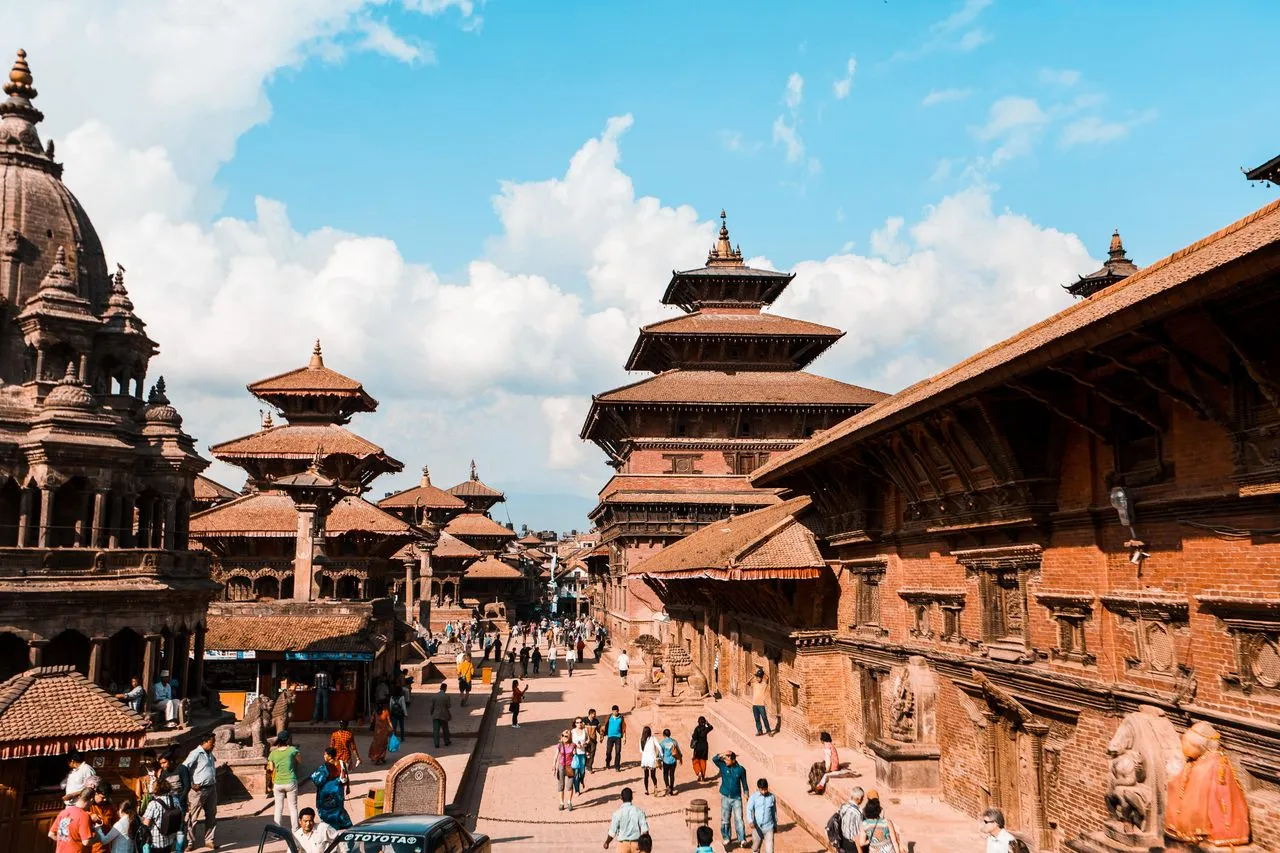
Today you visit two more monument zones, and they are the best preserved of the seven. First, Bhaktapur is about 45 minutes east of Thamel by road. After lunch you cross the valley to Patan, which sits just south of the Bagmati River.
Bhaktapur is a working medieval town rather than a single square. Here, its brick lanes open onto Taumadhi Square and the five-tiered Nyatapola temple, the tallest in Nepal. Also, potters still throw and dry clay in the open at Pottery Square, much as they have for generations.
Patan Durbar Square is smaller and denser, and the stone and metalwork there is the finest in the valley. Also, the Patan Museum inside the old palace is genuinely good, because it explains the iconography you have been looking at for two days. Plus, Newar craft workshops fill the lanes behind it.
- Duration: Full day sightseeing
- Max Altitude: 1,400 m
- Meals: Breakfast
- Accommodation: 3-Star Hotel
A tourist coach leaves Kathmandu in the morning and follows the Trishuli River west, then climbs into the Pokhara valley. So the drive takes 6 to 7 hours with stops. If you would rather fly, the 25-minute flight is a paid upgrade and it buys you most of a day.
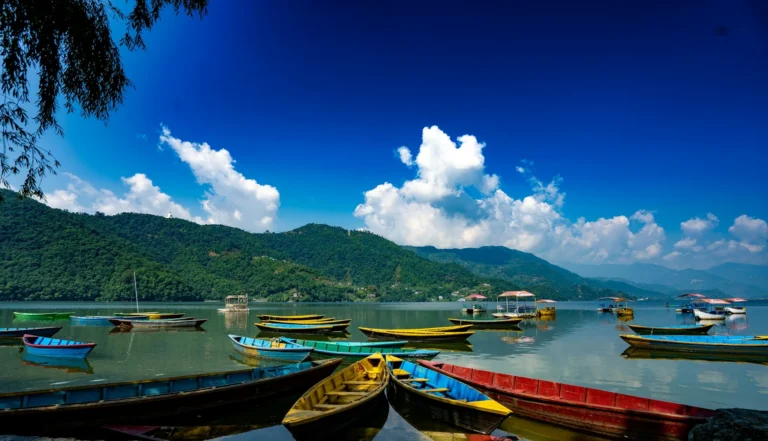
Pokhara sits at 822 m beside Phewa Lake, with the Annapurna range standing up behind it in clear weather. Then the evening is yours on Lakeside, a strip of cafes, bookshops, and boat hire. Your guide checks the trek permits tonight so nothing holds you up in the morning.
- Duration: 6 to 7 hrs drive
- Max Altitude: 1,400 m
- Meals: Breakfast
- Accommodation: 3-Star Hotel
A private vehicle takes you from Pokhara to Nayapul at 1,050 m, about 1.5 hours on a winding road. Then the walking starts at Birethanti, where the trail follows the Bhurungdi Khola upstream through farmland and scattered settlements.
The day ends on the stone staircase to Ulleri, which is the part everyone remembers. In fact, it climbs roughly 3,000 steps in one go. So take it slowly, drink often, and let your porter carry the weight, because there is no prize for arriving first.
Ulleri is a Magar village at 2,050 m looking across at Annapurna South. Here you sleep in a teahouse with twin beds and a shared bathroom, and dinner is cooked to order. Also, dal bhat comes with free refills, which is why most trekkers end up ordering it.
- Duration: 1.5 hrs drive, 5 hrs walk
- Max Altitude: 2,050 m
- Meals: Breakfast, Lunch & Dinner
- Accommodation: Teahouse
The trail leaves the terraces behind and enters rhododendron forest. In spring the canopy turns red and pink, because this tree, the lali gurans, is Nepal’s national flower. Overall, today is 5 to 6 hours of steady climbing with no steep sections.
Then you pass Banthanti and Nangethanti, both small clusters of lodges where the trail crosses streams. Here the forest is mossy and damp, and langur monkeys move through it early in the morning. Also, birdlife is heavy, especially pheasants near the treeline.
Ghorepani is a ridge village at 2,874 m and the night is genuinely cold. So most teahouses light a stove in the dining room after dark, which is where everyone ends up sitting. Before bed, your guide will agree a start time for the morning, usually around 4.30 am.
- Duration: 5 to 6 hrs walk
- Max Altitude: 2,874 m
- Meals: Breakfast, Lunch & Dinner
- Accommodation: Teahouse
You leave in the dark with a headlamp for the 45-minute climb to Poon Hill at 3,210 m. In fact, it is the high point of the whole trip. Also, the viewing tower gets busy in October, so arriving early is worth the cold start.
Sunrise lights Dhaulagiri I at 8,167 m and Annapurna I at 8,091 m, two of the world’s fourteen peaks above 8,000 m, standing on either side of the Kali Gandaki gorge. Annapurna South (7,219 m), Hiunchuli (6,441 m), Nilgiri (7,061 m), and Machhapuchhre (6,993 m) fill the gap between them.
Then you walk back down to Ghorepani for breakfast, then head east through the forest towards Tadapani. First the trail climbs to Deurali, then drops steeply through old rhododendron trees. So allow 5 to 6 hours for this leg, and expect mud underfoot after rain.
Tadapani means “far water”, and it sits at 2,610 m in a clearing with Machhapuchhre framed straight ahead. Yet that mountain has never been climbed to its summit, because it is closed to climbing on religious grounds. It makes for a short, quiet evening after a long day.
- Duration: 6 to 7 hrs walk
- Max Altitude: 3,210 m
- Meals: Breakfast, Lunch & Dinner
- Accommodation: Teahouse
A short descent through forest brings you to Ghandruk, one of the largest Gurung villages in Nepal at 1,940 m. Here, stone houses stack up the hillside under slate roofs, with the Annapurnas directly behind them. So the walking today is only about 3 hours.
Many Gurung families here have a long connection to the Gurkha regiments, and the small village museum sets out traditional dress, tools, and house interiors. Also, it costs very little and takes twenty minutes. Ghandruk is where the trek ends.
A jeep meets you at Kimche below the village and drives you back to Pokhara in roughly 2 hours. So you are back down at 822 m by mid-afternoon, with a hot shower and a proper bed. Your guide settles the permits and says goodbye over dinner.
- Duration: 3 hrs walk, 2 hrs drive
- Max Altitude: 2,610 m
- Meals: Breakfast & Lunch
- Accommodation: 3-Star Hotel
Nothing is scheduled today, and that is deliberate after four days of walking. Still, most people take an early taxi up to Sarangkot for sunrise over the Annapurnas, then come back down for a late breakfast.
Phewa Lake fills the rest of the day. Here you can row out to the Tal Barahi temple on its island, or take the boat across and walk up to the World Peace Pagoda for the view back over the water. Also, paragliding runs from Sarangkot and is booked locally.
- Duration: Free day
- Max Altitude: 822 m
- Meals: Breakfast
- Accommodation: 3-Star Hotel
The road leaves the hills and drops south into the Terai, the flat belt of land along the Indian border. In total, the drive takes about 5 hours. You feel the change as you go, because the air thickens, the temperature climbs, and the vegetation turns tropical.
Then you check into a lodge near Sauraha on the edge of Chitwan National Park. The altitude falls from 2,874 m at Ghorepani to under 300 m here, which is the biggest single change of the trip and the reason a fresh shirt is worth packing near the top of your bag.
The afternoon is a guided walk through a Tharu village and out to the Rapti River for sunset. Here, the Tharu are the indigenous people of the Terai and have lived alongside this forest for centuries. Also, fireflies come out along the river after dark.
- Duration: 5 hrs drive
- Max Altitude: 822 m
- Meals: Breakfast, Lunch & Dinner
- Accommodation: Jungle Lodge
Chitwan was established in 1973 as Nepal’s first protected area, and it was listed as a UNESCO World Heritage Site in November 1984. In total, it covers 952.63 sq km of sal forest, grassland, and river. Today is the reason you came south.
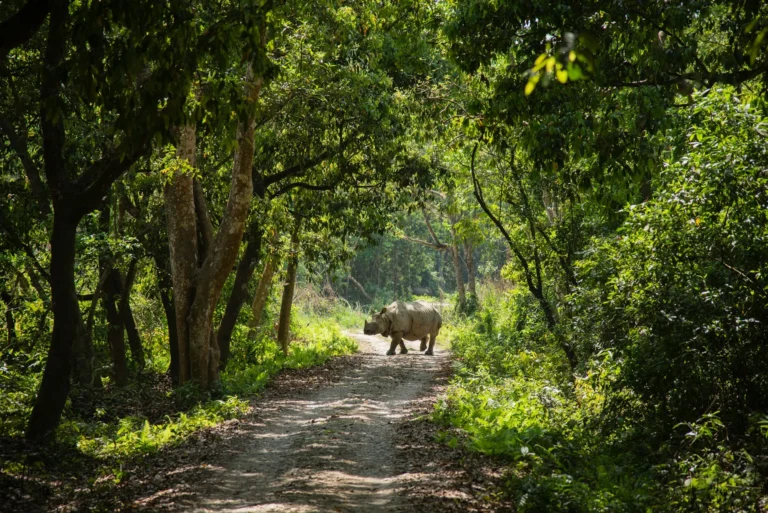
The morning is a jeep safari or a guided nature walk, depending on conditions and on what you would rather do. The park holds one-horned rhinoceros, Royal Bengal tiger, and Asian elephant, and rhino sightings in the riverside grassland are common. Still, tigers are there but rarely seen.
A dugout canoe trip on the Rapti River comes next, drifting past gharial and mugger crocodiles on the banks. 643 bird species have been recorded in the park, so bring binoculars if you own a pair. Also, the canoe is quiet, which is exactly why it works so well.
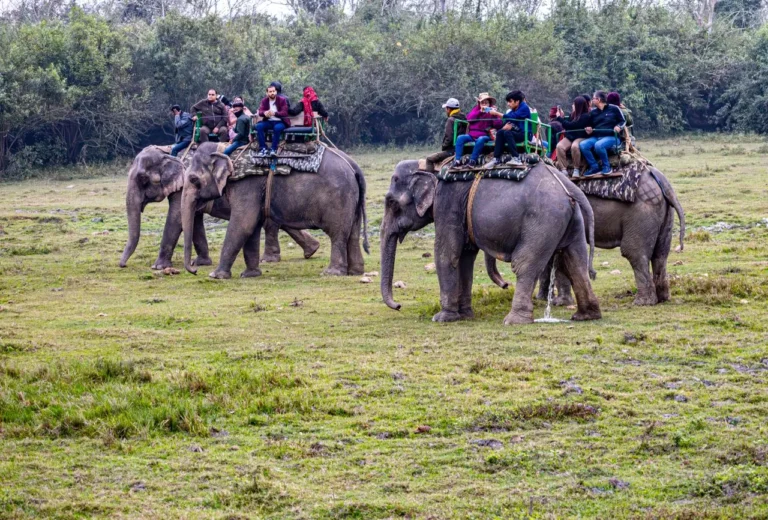
You also visit the elephant breeding centre, which runs the government breeding programme. Then the evening is a Tharu cultural show with stick dancing at the lodge. It is put on for visitors, and it is also a genuine local tradition rather than an invention.
- Duration: Full day safari
- Max Altitude: 286 m
- Meals: Breakfast, Lunch & Dinner
- Accommodation: Jungle Lodge
An early bird walk along the forest edge catches the best hour of the day, before the heat builds. Here, hornbills, kingfishers, and storks are all regular sightings. After that, you are back at the lodge in time for breakfast.
The drive to Kathmandu takes 5 to 6 hours and climbs back out of the Terai into the hills, following the Trishuli for part of the way. So you reach Thamel in the late afternoon, with the evening free for a shower and a quiet dinner.
- Duration: 5 to 6 hrs drive
- Max Altitude: 1,400 m
- Meals: Breakfast
- Accommodation: 3-Star Hotel
The day is open. Thamel is the obvious place for gear, pashmina, tea, and singing bowls, and your guide can come along if you would like help with prices. Also, bargaining is expected here, and it stays friendly.
If you would rather leave the city, Nagarkot on the eastern rim gives a long Himalayan skyline on a clear morning, and Kirtipur is a quiet Newar hill town with almost no traffic. Both are half-day trips and can be arranged the night before.
- Duration: Free day
- Max Altitude: 1,400 m
- Meals: Breakfast
- Accommodation: 3-Star Hotel
A Spade Himalaya vehicle takes you to Tribhuvan International Airport about three hours before your flight. If you have a late departure, we can hold your bags at the hotel so you can spend the morning in the city. Extra nights are easy to add.
- Duration: 30 min drive
- Max Altitude: 1,400 m
- Meals: Breakfast
Trips Include
What is included: Your package covers every hotel and lodge night, all internal transport, guided sightseeing with entry fees, the full trek with permits and staff, and all Chitwan activities. In short, the only things left are your flights, your visa, your insurance, and the meals we name below.
- All airport transfers in a private vehicle.
- 5 nights in a 3-star hotel in Kathmandu, with breakfast.
- 3 nights in a 3-star hotel in Pokhara, with breakfast.
- 2 nights at a jungle lodge in Chitwan, with all meals.
- 3 nights in teahouses on the Poon Hill trek.
- All meals on the trek (breakfast, lunch, and dinner).
- Guided sightseeing in Kathmandu, Bhaktapur, and Patan, with all entry fees.
- Kathmandu to Pokhara, Pokhara to Chitwan, and Chitwan to Kathmandu by tourist coach.
- Private vehicle from Pokhara to the trek start and back from Kimche.
- All Chitwan National Park activities and entry permits.
- A licensed, English-speaking, first-aid trained Spade Himalaya guide.
- A porter on the trek (1 porter for every 2 trekkers), plus pay, food, lodging, gear, and insurance for all staff.
- Annapurna Conservation Area Permit (ACAP) and TIMS card.
- Safe drinking water using a filter or purification tablets.
- A first-aid kit with an oximeter to check oxygen levels.
- Spade Himalaya T-shirt, cap, and a trip-completion certificate.
- All local taxes and office costs.
Trips Exclude
What is not included: A few things sit outside the package. So please budget for these too.
- International flights and airport taxes.
- Nepal entry visa (US$30 for 15 days, US$50 for 30 days, US$125 for 90 days).
- Travel and medical insurance with helicopter rescue cover (this is a must).
- Lunches and dinners in Kathmandu and Pokhara (budget US$10 to US$20 per meal).
- Flying Kathmandu to Pokhara instead of taking the coach (a paid upgrade).
- Optional extras such as paragliding, the Everest mountain flight, and Nagarkot day trips.
- Extra nights from early arrival, late departure, or itinerary changes.
- All drinks, hot showers, Wi-Fi, charging, and snacks.
- Tips for your guide, porter, and driver.
- Personal gear and any personal expenses.
- Anything not listed under Cost Includes.
Trips Altitude
Packing List
General
- Daypack (25 to 35 litres) with a rain cover
- Duffel or suitcase for the hotel nights, left in Kathmandu during the trek
- Sleeping bag rated for around freezing, for the three teahouse nights
- Reusable water bottle, at least 1 litre
- Headlamp with spare batteries
- Power bank, because charging costs a fee on the trail
- Passport and several passport photos for the permits
- Sunglasses with UV protection
Upper Body
- Quick-dry T-shirts (3 to 4), rather than cotton
- A warm fleece or light down jacket for the Ghorepani night
- A waterproof, windproof rain jacket
- A light-coloured long-sleeved shirt for Chitwan, which keeps insects off
- Sun hat, plus a warm hat for the early Poon Hill start
- Buff or neck scarf, useful against road dust
- A shawl or scarf to cover your shoulders at temple sites
Lower Body
- Trekking trousers (2 pairs)
- Lightweight long trousers for Chitwan and for temple visits
- Shorts or a skirt for Pokhara and the Terai heat
- Waterproof over-trousers
Undergarments
- Quick-dry underwear (4 to 5)
- Trekking socks (4 pairs), wool or synthetic
- Sports bra or similar support for the walking days
Hands
- Light gloves for the cold start at Poon Hill
- Hand warmers if you feel the cold
Feet
- Broken-in trekking boots with ankle support
- Trainers or sandals for the cities and the jungle lodge
- Flip-flops for teahouse bathrooms
First Aid Kits
- Personal medication, with a copy of the prescription
- Blister plasters and tape
- Rehydration salts
- Insect repellent containing DEET for Chitwan
- High-factor sun cream and lip balm
- Hand sanitiser and water purification tablets
Optional
- Trekking poles, genuinely useful on the Ulleri steps
- Binoculars for Chitwan, where they make a real difference
- Camera with spare batteries
- A book or cards for teahouse evenings
- Earplugs, because teahouse walls are thin
Others
- Quick-dry towel
- Toiletries and toilet paper
- Snacks such as nuts or energy bars
- Cash in Nepali rupees, since the trail has no ATMs
- Dry bags or zip-lock bags to keep electronics dry
Good to Know
Before you go
You only need a few things ready. First, bring your passport, four passport photos, and a copy of your insurance, so Spade Himalaya can arrange your ACAP, your TIMS card, and the Chitwan National Park permits. Then carry enough cash in Nepalese rupees from Kathmandu or Pokhara, because there are no ATMs on the trek. Also, your insurance should cover helicopter evacuation, even though this trip stays below 3,210 m. Last, October to November and March to April book out early, so confirm your dates as far ahead as you can.
This itinerary is built for first-time visitors to Nepal who have a full fortnight and want the country’s three signature experiences, its medieval cities, its mountains and its jungle, in one trip. So it suits:
- Complete beginners. No trekking background is needed. The walking is four days, never above 3,210 m, with a teahouse bed every night.
- Couples, honeymooners and small groups. Every trip is private, so there is no fixed departure and no strangers in your group.
- Families and older travellers. The grade is easy and there is no camping. Chitwan is done by jeep, canoe and short walks rather than hard days.
- Wildlife and birdwatchers. Chitwan has 643 recorded bird species, and two nights there is enough for a jeep safari, a canoe trip and a dawn bird walk.
- Travellers who want pace, not a checklist. Three days in this plan are deliberately unscheduled, so nothing has to be rushed.
This is the wrong trip if you are an experienced trekker chasing altitude, in which case Everest Base Camp or the Annapurna Circuit is a better fit. Also, if you have ten days rather than fourteen, the 10-day version below covers the same route without Chitwan.
Spade Himalaya runs three versions of this route from our own office in Kathmandu. Use this table to pick the right one rather than guessing.
| Time you have | What you want | Choose | From |
|---|---|---|---|
| 4 days | The trek only, starting in Pokhara | Ghorepani Poon Hill Trek 4 Days | USD 390 |
| 10 days | Kathmandu Valley culture plus the trek | Nepal Itinerary 10 Days | USD 1,100 |
| 14 days | Culture, the trek, and a Chitwan jungle safari | This itinerary | USD 1,390 |
In short, the difference between the 14-day and the 10-day is Chitwan, a free day in Pokhara, and one extra day in Kathmandu. Everything else is the same route.
Nepal gets compressed into “trekking” by most visitors, and that misses two thirds of the country. Instead, this plan gives you the Newar cities, which are among the densest concentrations of surviving medieval architecture anywhere, then the mountains, then subtropical jungle. Also, the three parts sit in a natural line, so you never double back.
October and November are the clearest months and the busiest. Also, March and April are nearly as good, with the added draw of rhododendron in flower on the trek. Then December and January are cold at Ghorepani but perfectly walkable, and Chitwan is at its best then. The monsoon, June to August, is wet, leeches are active on the trail, and mountain views are unreliable.
You need the Annapurna Conservation Area Permit and a TIMS card for the trek, plus park entry permits for Chitwan. Also, foreigners must trek with a licensed guide in the Annapurna region. Spade Himalaya arranges all of it, so you only need your passport and photos.
Nepal runs largely on cash outside the big hotels. Still, there are ATMs in Kathmandu and Pokhara but none on the trail, so draw what you need before you walk. Also, tipping is customary rather than compulsory, and guides and porters are usually tipped at the end of the trek.
This trip is low by Nepali standards, and the deliberate shape of it is a gradual climb followed by a gradual drop. Overall, you go from 1,400 m to 3,210 m over six days, then descend to the Terai lowlands, under 300 m. That is comfortable for almost everyone.
You walk 3 to 6 hours a day on stone paths and staircases, not wilderness trail. Also, villages appear every hour or two, so tea and food are never far. Overall, teahouses are simple: a twin room, a shared bathroom, a dining room with a stove. So bring a torch and expect the power to come and go.
Trips Reviews
No reviews found.
Trips FAQs
These are the questions travellers ask us most about this itinerary. They cover trip length, fitness, the best months to come, visas, and what you can realistically expect to see in Chitwan. If yours is not answered here, write to us and someone in our Kathmandu office will reply.
Planning and Trip Length
Yes, and it is close to ideal for a first visit. In practice, fourteen days lets you see the Kathmandu Valley properly, walk a short trek, and reach the lowland parks, with travel time between them. But under 10 days you have to drop one of those three. Over three weeks you can add a longer trek such as Annapurna Base Camp or Everest Base Camp.
We build these privately, so the length is adjustable. For example, a 10-day version drops the Pokhara free day and one Kathmandu day. Our Nepal itinerary 7 days drops the trek altogether and covers Kathmandu, Chitwan and Pokhara instead. Tell us your dates and we will map it.
Fitness, Altitude and Suitability
No. Here the trek is four days, tops out at 3,210 m, and you sleep in teahouses rather than tents. If you can walk 5 to 6 hours on consecutive days, you will manage it. Still, a few weeks of walking or stair climbing beforehand makes it more enjoyable.
It is unlikely. Poon Hill at 3,210 m sits below the altitude where sickness usually begins, and you only spend one night above 2,800 m. Still, drink plenty of water and tell your guide if you feel unwell. Our altitude sickness guide explains the warning signs.
Generally yes. Overall, the grade is easy, the trek is short, and there is no camping. The main things to weigh are the Ulleri staircase and the long road transfers. Tell us the ages and any mobility limits and we will say honestly whether it fits.
Season and Timing
October to November gives the clearest skies of the year, and March to April brings the rhododendron bloom on the trek. Also, Chitwan is best from October to March, when the grass is cut low and wildlife is easier to see. Our guide to the best time to visit Nepal breaks it down month by month.
Chitwan and Wildlife
No, and anyone promising that is not being straight with you. Still, one-horned rhinoceros are commonly seen, especially near the river in the cooler months. Tigers are present in good numbers but are rarely spotted. But birds are the sure thing, with 643 species recorded.
Logistics, Visa and Cost
Most nationalities can get a visa on arrival at Tribhuvan International Airport. Also, it costs US$30 for 15 days, US$50 for 30 days, and US$125 for 90 days. So bring cash in US dollars and a passport photo. See our Nepal visa on arrival guide for the current process.
Yes. The flight takes about 25 minutes against 6 to 7 hours by road, and it is a paid upgrade on this package. So it is worth considering if you are short on energy rather than short on time, since the coach day is not otherwise wasted.
There are no fixed departure dates, so nobody joins a scheduled group. But if another traveller is looking at similar dates and you are both happy to share, we can combine you, which brings the per-person price down. Still, nobody is ever placed with strangers without agreeing first.
For the trek you need boots, warm layers, and a rain jacket. For Chitwan you need light, neutral-coloured clothing and insect repellent. For the cities, anything comfortable that covers shoulders and knees at temple sites. Our Nepal trekking packing list covers the trek half in detail.