Quick answer: The Everest Base Camp Trek is about 130 km round trip from Lukla, or roughly 65 km each way. Most trekkers walk it in 12 to 14 days, averaging 10 to 15 km a day. The trek also climbs about 2,500 m, so altitude is the real challenge, not distance.
The Everest Base Camp Trek covers about 130 km round trip from Lukla, or roughly 65 km each way. You walk it over 12 to 14 days, with two rest days built in. So the daily distance is modest, about 10 to 15 km. The climb of around 2,500 m matters far more than the distance does.
Key Takeaways
- The trek is about 130 km round trip from Lukla, or roughly 65 km each way.
- Most people walk it in 12 to 14 days, including two rest days.
- The daily distance is 10 to 15 km, which is 5 to 7 hours of walking.
- The route climbs about 2,500 m, from Lukla (2,846 m) to Kala Patthar (5,545 m).
- Altitude, not distance, is the challenge. So the pace stays slow on purpose.
This guide breaks down the distance, day by day. For the full plan, see our 14-day Everest Base Camp Trek. To judge the effort, see our Everest Base Camp trek difficulty guide, and for the whole region, our Everest region trekking guide.
How far is the Everest Base Camp Trek?
The Everest Base Camp Trek is about 130 km round trip from Lukla. That is roughly 65 km in each direction, on the classic out-and-back route. So the total is less than many trekkers expect.

The distance alone makes the trek sound easy. However, the numbers hide the real test. You start at Lukla (2,846 m) and reach Kala Patthar at 5,545 m. So you climb about 2,500 m over the trip, and you do it on thinning air.
In short, this is not a flat 130 km. It is a slow, high climb with a lot of up and down. So the altitude shapes the trek far more than the distance.
Everest Base Camp trek map
This is the full route from Lukla to Kala Patthar, with every overnight stop and its altitude.
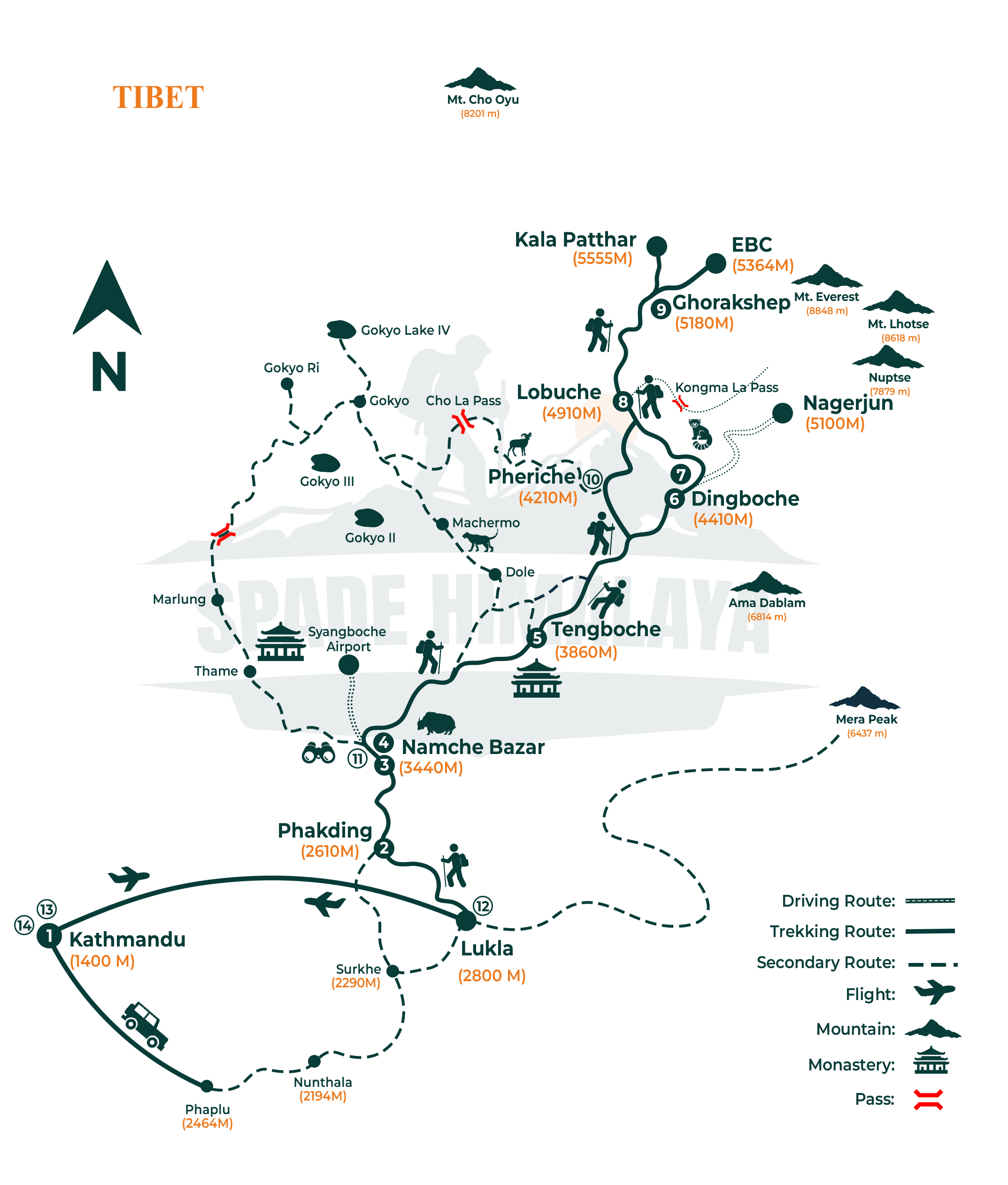
Our own Everest Base Camp trek map. The route runs Lukla (2,846 m), Phakding (2,610 m), Namche Bazaar (3,440 m), Tengboche (3,860 m), Dingboche, Lobuche and Gorak Shep to Everest Base Camp, with the viewpoint climb to Kala Patthar, then back the same way to Lukla.
How long is the Everest Base Camp Trek?
Most trekkers complete the Everest Base Camp Trek in 12 to 14 days. So how long is Everest Base Camp Trek walking, start to finish? It is about two weeks. Our classic plan takes 14 days from Kathmandu to Kathmandu. That includes two flights, two rest days, and the walk both ways.
The extra days are not padding. They are there to help you adjust to the altitude. So the 16-day Kala Patthar route adds an extra acclimatization hike and a culture day in Kathmandu. The 19-day Gokyo route is longer still, because it adds the Gokyo Lakes and a high pass.
Shorter plans exist, but they cut the rest days. So they raise the altitude risk. For that reason, we do not recommend rushing this trek.
How many days does the Everest Base Camp Trek take?
Plan for 12 to 14 trekking days, plus a spare day for the Lukla flight. People often search Everest Base Camp Trek how many days, and the honest answer is 12 to 14. The Lukla flight can also face weather delays. So a buffer day before your flight home is wise.
Here is how the days split on our 14-day plan:
- Days 1 to 8: the climb up to base camp, with rest days at Namche and Dingboche.
- Days 9 to 10: base camp, then Kala Patthar at dawn for the best Everest view.
- Days 11 to 13: the walk back down to Lukla and the flight to Kathmandu.
So the climb up is slow, and the descent is quick. This shape gives your body the time it needs at altitude. In short, the days are built around safety, not speed.
What is the day-by-day distance breakdown?
Here is the approximate distance for each day on the classic route. These figures are trail measurements from our guiding experience, so they are close, not exact.
| Day | Route | Distance | Walking time |
|---|---|---|---|
| Lukla to Phakding | gentle descent | about 6 km | 3 to 4 hrs |
| Phakding to Namche Bazaar | big climb | about 7 km | 5 to 6 hrs |
| Namche rest day | hike to Everest View | about 5 km | 3 to 4 hrs |
| Namche to Tengboche | up and down | about 9 km | 5 to 6 hrs |
| Tengboche to Dingboche | steady climb | about 12 km | 5 to 6 hrs |
| Dingboche rest day | Nangkartshang hike | about 5 km | 3 to 4 hrs |
| Dingboche to Lobuche | open valley | about 8 km | 5 hrs |
| Lobuche to Gorak Shep to base camp | rocky moraine | about 13 km | 7 to 8 hrs |
| Gorak Shep to Kala Patthar to Pheriche | dawn climb, long descent | about 16 km | 7 to 8 hrs |
So the longest days come near base camp and on the descent. The shortest are the rest days. After Pheriche, you retrace your steps to Namche and Lukla over two more days.
How many km do you walk per day?
You walk about 10 to 15 km on a normal day, which takes 5 to 7 hours. The pace is steady, with plenty of breaks for tea, photos, and rest. So it is not a race.
So the Everest Base Camp Trek km per day figure sits around 10 to 15 on most days. The rest days are short, around 3 to 5 km, with a climb to help you adjust. The longest days sit near base camp and on the descent, at about 13 to 16 km. So your daily distance changes with the terrain and the plan.
In short, the per-day distance is manageable for most fit walkers. The challenge is doing it day after day, on less oxygen. So training helps you enjoy each day more.
What does the Everest Base Camp route map look like?
The route follows the Dudh Koshi valley up to base camp, then returns the same way. Here is the Everest Base Camp trek map as a simple list of stops, with altitudes.
Lukla (2,846 m) to Phakding (2,610 m) to Namche Bazaar (3,440 m) to Tengboche (3,860 m) to Dingboche (4,410 m) to Lobuche (4,910 m) to Gorak Shep (5,190 m) to Everest Base Camp (5,364 m) and Kala Patthar (5,545 m), then back down to Pheriche, Namche, and Lukla.
So you can see the steady climb, valley by valley. A full route map with the daily stages sits on our 14-day Everest Base Camp Trek page. For the wider region, see our Everest region trekking guide.
Is the Everest Base Camp distance hard?
The distance is not hard, but the altitude makes the same distance feel harder. At sea level, 12 km is an easy day. At 5,000 m, the same 12 km takes more effort, because the air holds about half the oxygen.
So the trek is graded strenuous, even though the daily distance is modest. The slow pace is on purpose, to keep you safe. For a full look at the challenge, see our Everest Base Camp trek difficulty guide.
In short, train for the hours, not the kilometres. Then the distance becomes the easy part.
FAQs
Is the walk back from Everest Base Camp the same distance?
Yes, roughly. The trek is about 130 km round trip, so around 65 km each way. You retrace the same trail down to Namche and Lukla, but it takes fewer days because you are descending and no longer need acclimatization stops.
How long does the Everest Base Camp Trek take?
Most trekkers take 12 to 14 days, including two rest days for acclimatization. Our classic plan is 14 days from Kathmandu to Kathmandu. Add a spare day for the Lukla flight, which can face weather delays.
How many km do you walk per day on the trek?
About 10 to 15 km on a normal day, which is 5 to 7 hours of walking. Rest days are shorter, around 3 to 5 km. The longest days, near base camp and on the descent, reach about 13 to 16 km.
Why does the Everest Base Camp Trek take so many days for only 130 km?
Because of the altitude. The extra days are rest days that help your body adjust to the thin air. A faster trek raises the risk of altitude sickness. So the slow pace is a safety choice, not padding.
How many days do I need to acclimatize on the trek?
Two rest days are standard, at Namche (3,440 m) and Dingboche (4,410 m). On each, you hike higher and sleep lower, which helps your body adjust. The 16-day route adds a third rest hike for extra safety.
Accuracy note: prices, durations, and trail details in this guide are Spade Himalaya’s 2026 field research and typical market ranges; route details reviewed by Yubaraj Katel, government-licensed trekking guide (Licence No. 19827) with 10 years of experience leading treks in the Everest region.

Keep Planning Your Trek
Updated: 6 Jul, 2026
8 min
Everest Base Camp Trek Difficulty and Training (2026 Guide)
Quick answer: The Everest Base Camp Trek is graded strenuous, so it is hard but needs...
Updated: 6 Jul, 2026
9 min
Everest Base Camp Trek Cost in 2026: Full Breakdown
Quick answer: A guided Everest Base Camp Trek’s biggest single cost is the round-trip Lukla flight,...
Updated: 20 Jul, 2026
15 min
Everest Region Treks: Routes, Cost & Best Time (2026 Guide)
Quick answer: The Everest region, or Khumbu, is home to Everest Base Camp, the Gokyo Lakes,...