Quick answer: The Manaslu Circuit Trek is graded strenuous (Grade 3): remote, with long days and the Larkya La pass (5,106 m), its high point. It is harder than the Annapurna Circuit, with no climbing. It suits fit trekkers with some experience. The best seasons are spring and autumn.
The Manaslu Circuit Trek is graded moderate to strenuous, and it is harder than the Annapurna Circuit. There is no climbing and no technical ground. However, the trails are rough, the days are long, and you cross a high pass. So good fitness and some trekking experience really help.
Key Takeaways
- The trek is moderate to strenuous, and harder than Annapurna because it is more remote.
- The hardest day is the Larkya La pass (5,106 m), a long, early-morning crossing.
- Altitude is the main risk, not the terrain. So a slow pace matters most.
- You walk about 6 to 7 hours on most days.
- The best time to go is spring (March to May) and autumn (September to November).
This guide explains the difficulty, the pass, the altitude risk, and the best time. For the full plan, see the Manaslu Circuit Trek guide and our 14-day Manaslu Circuit Trek.
How hard is the Manaslu Circuit Trek?
It is a real challenge, but a fit, prepared trekker can do it without climbing skills. The walking itself is not technical. Still, several things make it tough.
First, the trail is rough and remote. Second, you walk long days, often 6 to 7 hours. Third, the teahouses are simpler than on busier routes. Finally, you cross a pass above 5,000 m. So the trek asks for stamina and a calm, steady mindset.
In short, it is harder than Annapurna but easier than a true climbing expedition. Most people who train and pace themselves finish it well.
What is the Larkya La pass like?
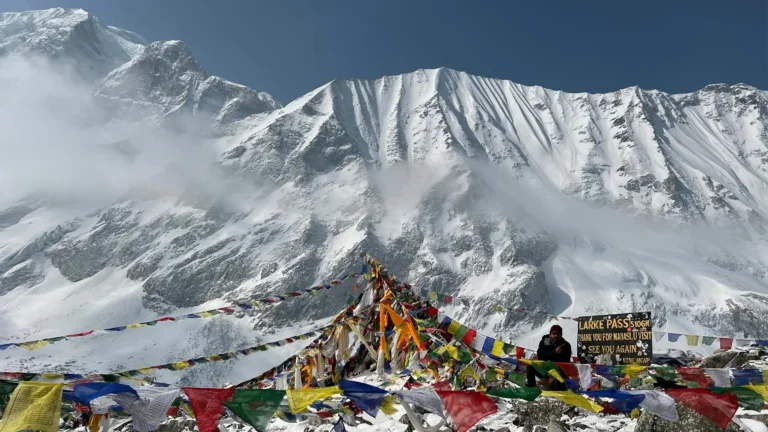
The Larkya La pass at 5,106 m is the crux of the whole trek. It is one of the longest passes in Nepal. You start before dawn from Dharmasala. Then you climb slowly over snow and loose rock to the top.
The air is thin, so you move slowly and breathe hard. After the prayer flags at the summit, a long, steep descent drops you down to Bimtang. In total, pass day takes about 7 to 9 hours. Your guide checks the weather first, because fresh snow can make the pass risky.
Why is altitude the real challenge?
Altitude is the biggest risk on this trek, far more than the trail itself. Altitude sickness (AMS) gets more likely the higher you sleep. In one study of Nepali Himalaya trekkers, AMS affected about 15% of people at 4,000 to 4,500 m and 51% at 4,500 to 5,000 m (PubMed, retrieved 2026-06-20).
So the plan is built to manage it. First, you climb gradually. Next, you take an acclimatization day at Samagaun (3,530 m). Also, you drink plenty of water and skip alcohol up high. Your guide carries a pulse oximeter and checks you every day.
Two rare problems need fast action. HACE affects the brain, and HAPE affects the lungs. For both, the safest treatment is to descend quickly (CDC Yellow Book, retrieved 2026-06-20). So tell your guide early if you feel unwell.
How fit do you need to be?
You need good general fitness, not athletic ability. If you can hike 6 to 7 hours with a daypack on back-to-back days, you are on the right track. Some past trekking experience also helps a lot.
Here is a simple way to prepare:
- Start 8 to 12 weeks before the trek. Build cardio with walking, jogging, cycling, or stairs.
- Do long hikes on hills, ideally on consecutive days, with a daypack.
- Add some leg and core strength to protect your knees on the long descents.
- Break in your boots well before you fly.
In short, the better you prepare, the more you will enjoy the high days.
When is the best time to trek Manaslu?
Spring (March to May) and autumn (September to November) are the best seasons. Both give stable weather, clear skies, and an open pass. Autumn is the most popular. Spring adds rhododendron blooms at lower heights.
The other seasons are harder. In winter (December to February), snow can block the Larkya La. In the summer monsoon (June to August), rain and leeches hit the lower trail. So most trekkers pick spring or autumn for the safest crossing.
| Season | Conditions | Verdict |
|---|---|---|
| Spring (Mar to May) | Warmer, blooms, clear | Excellent |
| Autumn (Sep to Nov) | Stable, clearest skies | Excellent (peak) |
| Winter (Dec to Feb) | Cold, snow can close the pass | For experts only |
| Monsoon (Jun to Aug) | Rain, leeches lower down | Avoid |
What are the tips to make the trek easier?
A few simple habits make a big difference on Manaslu. Here are the ones our guides repeat most.
- Walk slowly, especially above 3,000 m. Speed causes altitude sickness.
- Drink 3 to 4 litres of water a day. Cold weather hides dehydration.
- Do not skip the acclimatization day at Samagaun. It really helps.
- Layer up, because the pass morning is bitterly cold.
- Listen to your guide. They read the weather and your health every day.
Is the Manaslu Circuit right for you?
Manaslu suits fit trekkers who want a wild, quiet route and have some experience. It is not the best first trek, because it is remote and crosses a high pass. So if you are new to the Himalaya, start smaller, then return for Manaslu.
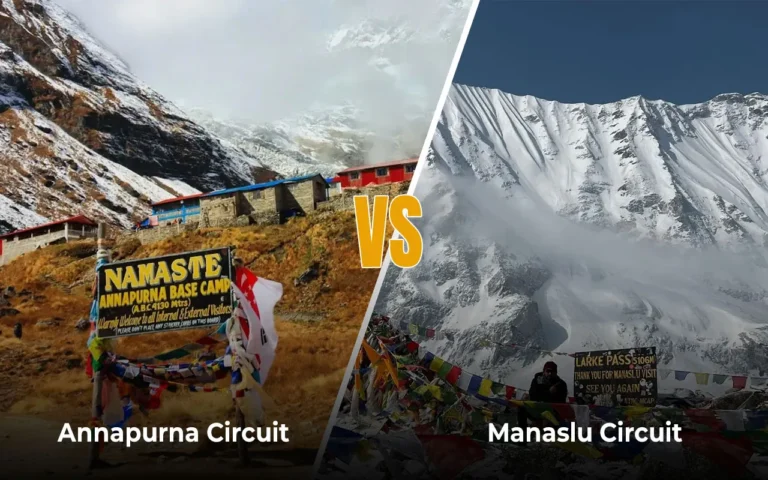
For a gentler first trek, look at the Annapurna Base Camp Trek. To compare Manaslu with a similar two-week loop, read Manaslu vs the Annapurna Circuit.
What is a typical day on the Manaslu trail?
Most days follow a simple rhythm, so you soon settle into it. Here is how a normal day looks.
You wake early, around 6 to 7 am. Then you eat breakfast and start walking by about 8 am. You walk for 3 to 4 hours, with short breaks, and stop for lunch near midday. After lunch, you walk another 2 to 3 hours to the next village. So you usually arrive by mid-afternoon.
The evenings are calm. First, you rest and drink tea. Then you eat an early dinner. Finally, you sleep early, because the next day starts again at dawn. Pass day is different, though. On that day, you start in the dark, often before sunrise.
How does Manaslu compare to Everest and Annapurna?
It helps to compare Manaslu with the treks people already know. So here is a quick guide.
- Easier than Manaslu: the Annapurna Base Camp Trek. It is shorter, lower, and has no high pass.
- Similar to Manaslu: the Annapurna Circuit and the Everest Base Camp Trek. All of them reach or cross above 5,000 m.
- Harder than Manaslu: the Everest Three Passes Trek. It crosses three high passes.
In short, Manaslu is a serious trek, but not the hardest in Nepal. Instead, it sits alongside the other classic two-week routes.
Who finds it hardest, and how do you cope?
Some people find Manaslu harder than others, so it helps to know the common struggles. Luckily, each one has a simple fix.
- Going too fast. Speed is the main cause of altitude sickness. So slow down.
- Skipping training. The long days hit the unprepared hard. So train for 8 to 12 weeks.
- Not drinking enough. Cold weather hides thirst. So drink 3 to 4 litres a day.
- Ignoring early symptoms. A small headache can grow fast. So tell your guide early.
The fix for all of them is the same. In short, go slow, prepare well, drink water, and listen to your guide.
FAQs
Is the Manaslu Circuit harder than Everest Base Camp?
They are close, and both grade 3, Strenuous. Manaslu is more remote with fewer lodges and one big pass at Larkya La (5,106 m). Everest Base Camp climbs higher but is far better supported. Most trekkers find Manaslu the tougher of the two logistically.
How high is the Larkya La pass?
Larkya La is 5,106 m (16,752 ft). It is the high point of the trek and one of the longest passes in Nepal. You cross it on a long day, starting before dawn from Dharmasala and descending to Bimtang.
Do you need experience for the Manaslu Circuit?
It helps a lot. You do not need climbing skills, but you do need good fitness and ideally some multi-day trekking behind you. The remoteness and the high pass make it a poor choice for a first-ever trek. So beginners should start with an easier route.
Can you trek the Manaslu Circuit in winter?
It is possible but not advisable for most trekkers. Larkya La at 5,106 m can be blocked by deep snow in winter, and some teahouses close for the season. Spring and autumn are the reliable windows.
How many hours a day do you walk on Manaslu?
About 6 to 7 hours on most days. Pass day is longer, around 7 to 9 hours, with an early start. Some days are shorter, especially around the acclimatization stop. Your guide sets a steady pace to protect your acclimatization.
Accuracy note: official fees, rules, and hard facts in this guide are cited inline from their sources; trail and price details are Spade Himalaya field research; route details reviewed by Yubaraj Katel, government-licensed trekking guide (Licence No. 19827) with 10 years of experience leading treks in the Manaslu region.

Keep Planning Your Trek
Updated: 6 Jul, 2026
7 min
Manaslu Circuit Trek Cost in 2026: Full Budget Breakdown
Quick answer: A guided Manaslu Circuit Trek costs about US$1,000 to US$1,600 per person in 2026....
Updated: 14 Sep, 2026
10 min
Manaslu Circuit Trek Guide and Route Map (2026)
Quick answer: The Manaslu Circuit Trek is a remote 14-day loop around Mount Manaslu (8,163 m),...
Updated: 6 Jul, 2026
6 min
Manaslu Circuit vs Annapurna Circuit: Which Trek to Choose?
Quick answer: Choose the Manaslu Circuit for a wild, remote loop with the Larkya La pass...