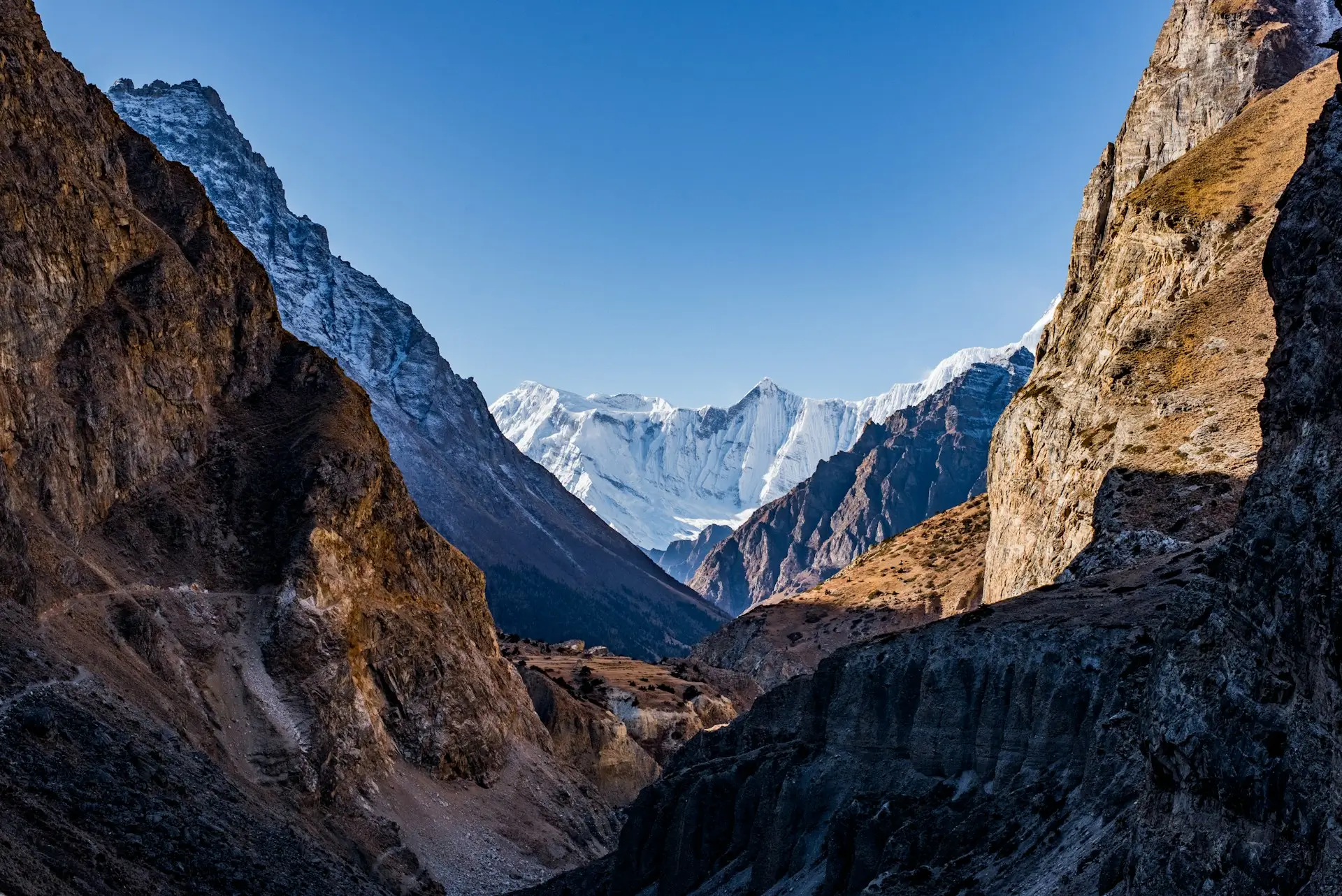
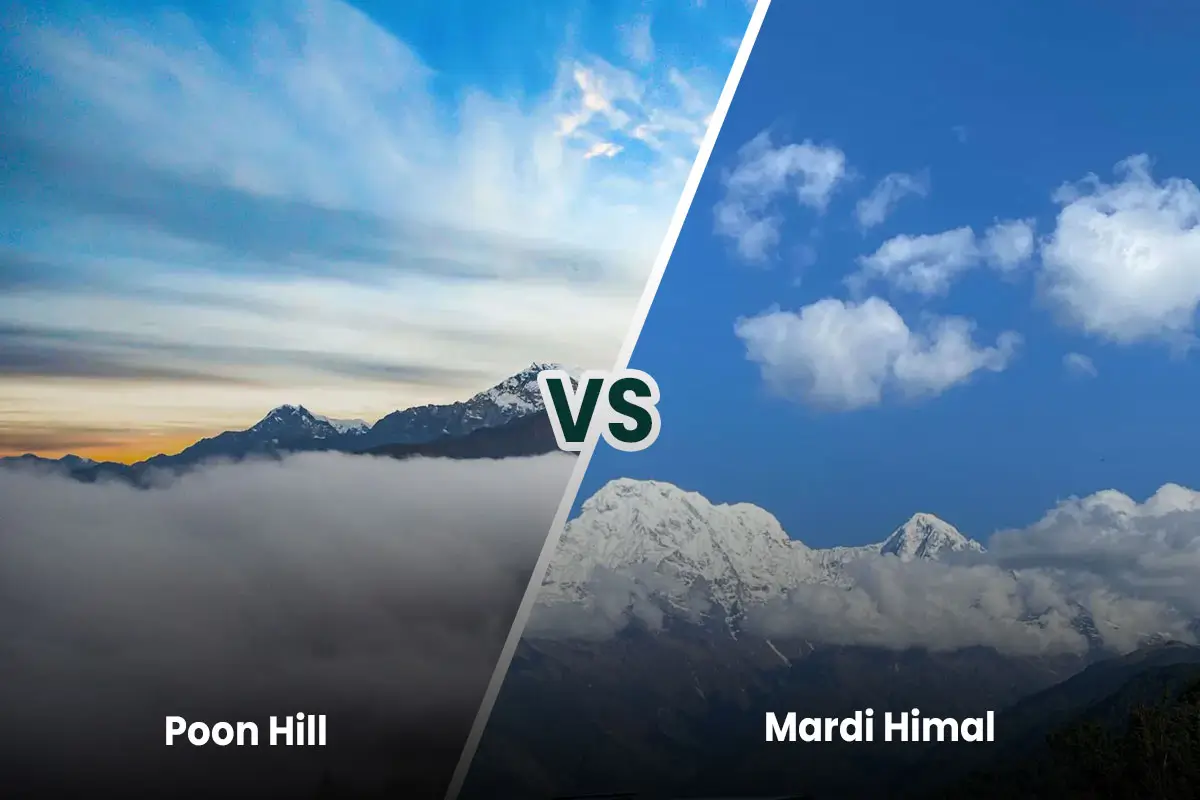
Quick answer: Pick the Ghorepani Poon Hill Trek if you have four days, want warm nights, and have never slept at altitude. Pick the Mardi Himal Trek if you have five to seven days and want to stand at 4,500 m. Poon Hill tops out at 3,210 m. Mardi climbs 1,290 m higher, and it does so quickly.
The choice is usually framed as beginner against adventurer. In practice the question is narrower: how much altitude do you want, and how many nights of real cold will you accept, in the days you actually have? Answer those two, and the choice makes itself.
Key Takeaways
- Poon Hill is Grade 1 (Easy) on the Spade Himalaya Trek Difficulty Scale. Its high point is 3,210 m.
- Mardi Himal is Grade 2 (Moderate). Its high point is Mardi Himal Base Camp at 4,500 m.
- The permits are identical. Both sit inside the Annapurna Conservation Area, so both cost NRs. 3,000 plus a TIMS card (Nepal Tourism Board, retrieved 2026-08-10).
- Both need a licensed guide. Both are named on Nepal’s mandatory-guide list (Nepal Tourism Board, retrieved 2026-08-10).
- The real gap is night temperature. In autumn, dawn on Poon Hill runs 0 to 6°C. A High Camp night on Mardi runs -7 to -12°C.
- With only five days from Pokhara, Poon Hill is the safer buy. Mardi in five days is possible, but it is rushed.
- Price is not the tiebreaker. At 4 to 5 days the two cost about the same with us, US$390 to US$550 depending on group size.
What do these two treks actually share?
More than you would expect: the permits, the guide rule, the transport and the seasons are the same. Before the differences, here is the common ground, because it removes four things people often treat as deciding factors.
First, both start from Pokhara by road. Neither needs a flight. Second, both sit inside the Annapurna Conservation Area, so the permits and the paperwork are the same. Third, both sleep in teahouses the whole way, so neither needs a tent. Finally, both share the same best seasons: spring and autumn.
So permits, transport, lodging and season do not separate these treks. Altitude, cold and days do. In short, ignore the rest and focus on those three.

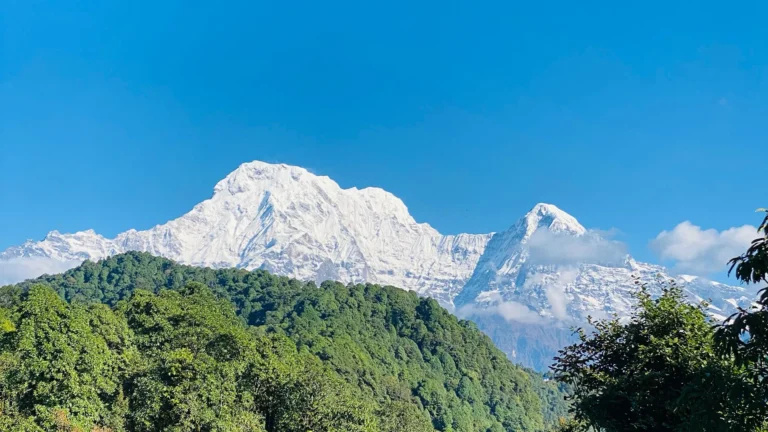
Mardi Himal vs Poon Hill: the side-by-side numbers
Here are the two treks side by side.
| Ghorepani Poon Hill | Mardi Himal | |
|---|---|---|
| Highest point | Poon Hill, 3,210 m | Mardi Himal Base Camp, 4,500 m |
| Highest sleep | Ghorepani | High Camp, 3,580 m |
| Difficulty (Spade Himalaya Trek Difficulty Scale) | Grade 1, Easy | Grade 2, Moderate |
| Days on trail | 4 typical | 4 to 7 |
| Trailhead | Nayapul or Ulleri, by road | Kande, 1,770 m, by road |
| Autumn dawn or night temp | 0 to 6°C | -7 to -12°C |
| Our guided price (2026) | US$390 to US$470, 4 days | US$395 to US$550, 5 days |
| Permits | NRs. 3,000 + TIMS | Identical |
| Guide required | Yes | Yes |
| Best for | first altitude, warm nights | a real high point, fast |
How high does each trek go, and does it matter?
This is the whole comparison in one number. Poon Hill tops out at 3,210 m. Mardi Himal Base Camp sits at 4,500 m.
That gap matters because of where it falls. Altitude sickness rarely troubles people below about 3,000 m. Above that, it becomes a genuine consideration for everyone, fit or not. So Poon Hill stays under the line for its whole route. Mardi crosses it, sleeps above it, and then climbs well past it.
The speed matters too. Mardi starts at Kande, 1,770 m, and reaches 4,500 m within a few days. That is a gain of 2,730 m. As our own Mardi Himal guide puts it, that is quicker than the usual advice once you pass 3,000 m. Because of that, we push people toward a 5 to 7 day plan rather than a rushed 3-day one.
None of this makes Mardi dangerous. However, it does make Mardi a trek where the itinerary you choose changes your odds of feeling well. Poon Hill is not like that. On Poon Hill, a short itinerary is simply a short itinerary.
How cold does it get at night on each trek?
Poon Hill dawns sit around freezing. Mardi’s High Camp nights drop far below it. Here are the figures for both treks, season by season.
| Season | Poon Hill: day / dawn | Mardi: lower ridge day / High Camp night |
|---|---|---|
| Spring, Mar to May | 14 to 22°C / 2 to 8°C | 12 to 20°C / -5 to -10°C |
| Autumn, Sep to Nov | 12 to 20°C / 0 to 6°C | 10 to 18°C / -7 to -12°C |
| Winter, Dec to Feb | 8 to 16°C / -5 to 2°C | 4 to 12°C / -12 to -18°C |
| Monsoon, Jun to Aug | 16 to 24°C / 6 to 12°C | 15 to 22°C / -2 to -6°C |
Look at the autumn row. Both treks give you a pleasant day. Then the night splits them by roughly 15°C. So the daytime experience is similar, and the night is not.
For that reason, your kit list changes. Poon Hill works with a light sleeping bag and one warm layer. Mardi needs a proper bag, gloves, a hat and a down jacket, even in the best season. Overall, people who dislike being cold at night are much happier on Poon Hill, and they usually do not discover this until night two.
How difficult is each one on the Spade Himalaya Trek Difficulty Scale?
Poon Hill is Grade 1, Easy. Mardi Himal is Grade 2, Moderate. Here is our full scale, so those two grades mean something next to the rest of what we run.
| Grade | Name | What it means | Example treks |
|---|---|---|---|
| 1 | Easy | Under 3,500 m, short, gentle days | Poon Hill |
| 2 | Moderate | Up to about 4,500 m, no high pass | Mardi Himal, Annapurna Base Camp, Kori |
| 3 | Strenuous | 5,000 to 5,550 m, a base camp or one high pass, good lodges | Everest Base Camp, Annapurna Circuit |
| 4 | Challenging | Remote, above 5,000 m, long rough days, simple lodges or some camping | Makalu, Everest Three Passes |
| 5 | Expedition | Very remote, full camping, or several high passes | Upper Dolpo |
Neither trek involves climbing, technical ground or a high pass. So the grade difference is not about skill. Instead, it is about altitude and about how long you walk each day. Mardi is one grade harder purely because it goes higher, faster. For the full breakdown, see our Poon Hill difficulty guide and our Mardi Himal difficulty guide.
How many days do you need for each?
Poon Hill needs four. Mardi wants five to seven. That single line settles most bookings.
A typical Poon Hill route runs from Nayapul or Ulleri up to Ghorepani, then the dawn hike up Poon Hill, then on to Tadapani and Ghandruk, and back to Pokhara. Four days covers it comfortably.
Mardi runs Pokhara to Kande, then Forest Camp at 2,600 m, Low Camp at 2,970 m, High Camp at 3,580 m, and Base Camp at 4,500 m, before dropping to Siding and back to Pokhara. Four days is the compressed version. Five to seven is the version we recommend, and our short Mardi Himal trek from Pokhara explains what gets cut when you squeeze it.
So if you have exactly five days out of Pokhara, both fit on paper. Yet they fit differently. Poon Hill fits with a spare day. Mardi fits with nothing spare, on the trek where altitude actually matters. Given that, we point five-day travellers at Poon Hill unless reaching 4,500 m is the point of the trip.
What do the permits cost, and do you need a guide?
The permits are identical, and both treks legally require a licensed guide. This surprises people who assume the easier trek has lighter rules.
Both routes lie inside the Annapurna Conservation Area. So both need the conservation area entry permit, which is NRs. 3,000 per person per entry for foreign nationals, NRs. 1,000 for SAARC nationals, and free for children under 10 (Nepal Tourism Board, retrieved 2026-08-10).
Both also need a TIMS card. That is NPR 2,000 for non-SAARC trekkers and NPR 1,000 for SAARC trekkers (Nepal Tourism Board, retrieved 2026-08-10). Together, the permits come to roughly US$40 per person on either trek.
On guides, Nepal’s rule took effect on 31 March 2023. Trekkers on the listed routes must be accompanied by a licensed trekking guide and carry an agency-issued TIMS card. Both of these treks are named individually on that list, as “Poon Hill-ABC Trek” and “Mardi Himal Trek” (Nepal Tourism Board, retrieved 2026-08-10). Therefore neither one is a legal solo trek, whatever older blog posts still say.
What does each trek cost in total?
A short trip costs about the same either way, US$390 to US$550 per person. The gap only opens if you take the longer 10-day Mardi route.
| What you pay | Ghorepani Poon Hill | Mardi Himal |
|---|---|---|
| Short trip, guided | US$390 to US$470 (4 days) | US$395 to US$550 (5 days) |
| Longer trip, guided | not offered, 4 days is the route | US$750 to US$995 (10 days) |
| ACAP permit and TIMS card | included | included |
| Licensed guide and porter | included | included |
| Teahouses and all meals on trek | included | included |
Group size sets the price, not comfort. A solo trekker pays the top of each range, and larger groups pay the bottom, because the guide, the transport and the logistics are shared. So the two treks start within US$5 of each other, and separate only when you add days.
Budget separately for trail extras. Drinks, hot showers, Wi-Fi, charging and snacks are paid at the teahouse, not in the package. They also get dearer the higher you sleep, so Mardi’s upper camps are the priciest stops on either route. Tips, travel insurance and your Nepal visa sit outside the price too.
So price will not decide this for you. Altitude, night cold and spare days will. For a fuller breakdown, see our Poon Hill cost guide and our Mardi Himal cost guide.
Which trek works in winter?
Poon Hill works. Mardi is for the committed only. Winter is where these two treks separate hardest, and it is also where most guides give a vague answer.
On Poon Hill, winter days run 8 to 16°C and dawns run -5 to 2°C. Snow is possible, and the dawn is genuinely cold. Still, days stay fine, the trail stays low, and the views are often at their clearest. So a December or January Poon Hill trip is a real option.
On Mardi, winter nights at High Camp run -12 to -18°C. That is a different proposition. It is doable with the right kit and the right guide. Yet it stops being a casual short trek. So if your trip falls between December and February, Poon Hill is the sensible pick, and Mardi becomes a spring or autumn plan.
Which trek suits which trekker?
Here is the short version, by traveller type.
- Never slept above 3,000 m: Poon Hill. It stays under the line entirely.
- Only five days out of Pokhara: Poon Hill. Mardi fits, but with nothing spare.
- Want to stand at 4,500 m: Mardi Himal. That is the whole reason to choose it.
- Trekking in December, January or February: Poon Hill.
- Hate being cold at night: Poon Hill, by roughly 15°C in autumn.
- Trekking with children or older parents: Poon Hill.
- Already done a Grade 1 trek and want the next step: Mardi Himal.
- Want quiet trails: Mardi Himal, or look at Kori and Khopra Danda.
Ready to plan? See our 4-day Ghorepani Poon Hill Trek, our 5-day Short Mardi Himal Trek or our 10-day Mardi Himal Trek. If you are also weighing a longer route, compare Poon Hill against Annapurna Base Camp and Mardi Himal against Annapurna Base Camp.
FAQs
Is Mardi Himal harder than Poon Hill?
Yes. On the Spade Himalaya Trek Difficulty Scale, Poon Hill is Grade 1 (Easy) and Mardi Himal is Grade 2 (Moderate). Neither involves climbing or technical ground. However, Mardi reaches 4,500 m while Poon Hill tops out at 3,210 m, and Mardi gains that height quickly. So the extra difficulty is altitude, not skill.
Which is better for a first-time trekker in Nepal?
Poon Hill, in most cases. It stays under 3,500 m, the nights are far warmer, and four days is enough. Mardi is still beginner-friendly for fit walkers. Yet it asks you to sleep at 3,580 m and walk to 4,500 m, which is a lot to meet on a first trek.
How high is Mardi Himal Base Camp, and how high is Poon Hill?
Mardi Himal Base Camp sits at 4,500 m. Poon Hill sits at 3,210 m. On Mardi you also sleep at High Camp, 3,580 m, which is higher than the Poon Hill summit. Low Camp is 2,970 m and Forest Camp is 2,600 m.
Do I need a guide for Mardi Himal or Poon Hill?
Yes, for both. Nepal’s rule, effective 31 March 2023, requires a licensed guide and an agency-issued TIMS card on the listed routes. Both treks appear on that list by name, as “Mardi Himal Trek” and “Poon Hill-ABC Trek” (Nepal Tourism Board, retrieved 2026-08-10).
Are the permits different for the two treks?
No. Both lie inside the Annapurna Conservation Area, so both need the same entry permit at NRs. 3,000 for foreign nationals and NRs. 1,000 for SAARC nationals, plus a TIMS card at NPR 2,000 or NPR 1,000 (Nepal Tourism Board, retrieved 2026-08-10). Permits come to about US$40 either way.
Can I do Mardi Himal in 5 days from Pokhara?
Yes, and many people do. Still, five days leaves no spare day on the trek where altitude actually matters. Because of that, we suggest five to seven days, and we suggest Poon Hill instead if your five days are fixed and cannot slip.
Which trek is better in winter?
Poon Hill. Winter days there run 8 to 16°C with dawns of -5 to 2°C, so it stays a real option. Mardi’s High Camp nights run -12 to -18°C in winter, which turns a short trek into a serious cold-weather trip. So book Mardi for spring or autumn instead.
Which one has better mountain views?
They are different rather than ranked. Poon Hill gives a wide dawn panorama from a single famous viewpoint at 3,210 m. Mardi puts you on a high ridge for several days, much closer under Machhapuchhre and the Annapurna wall. So Poon Hill is one great morning, and Mardi is sustained close-up scenery.
Accuracy note: permit fees and the guide requirement were checked against the Nepal Tourism Board on 10 August 2026, on its park entry fees and TIMS card pages. Altitude and seasonal temperature figures come from Spade Himalaya’s own published guides for both treks. Prices are Spade Himalaya’s own 2026 trip-page prices, read on 10 August 2026, and vary by group size. Teahouse prices move between seasons, so we are collecting dated price-board photographs on both routes in autumn 2026 and will republish the cost table from measured data. Route details reviewed by Yubaraj Katel, government-licensed trekking guide (Licence No. 19827) with 10 years of experience leading treks in the Annapurna region.

Still Deciding?
Updated: 10 Aug, 2026
6 min
Ghorepani Poon Hill Trek Cost in 2026: A Full Price Breakdown
Quick answer: A guided Ghorepani Poon Hill Trek costs US$390 to US$470 per person in 2026...
Updated: 16 Sep, 2026
6 min
Mardi Himal Trek Cost in 2026: A Full Price Breakdown
Quick answer: A guided Mardi Himal Trek costs US$395 to US$995 per person in 2026 on...
Updated: 15 Jul, 2026
12 min
Annapurna Region Treks: Routes, Cost & Best Time (2026 Guide)
Quick answer: The Annapurna region, near Pokhara, has Nepal’s widest range of treks: from the easy Poon...