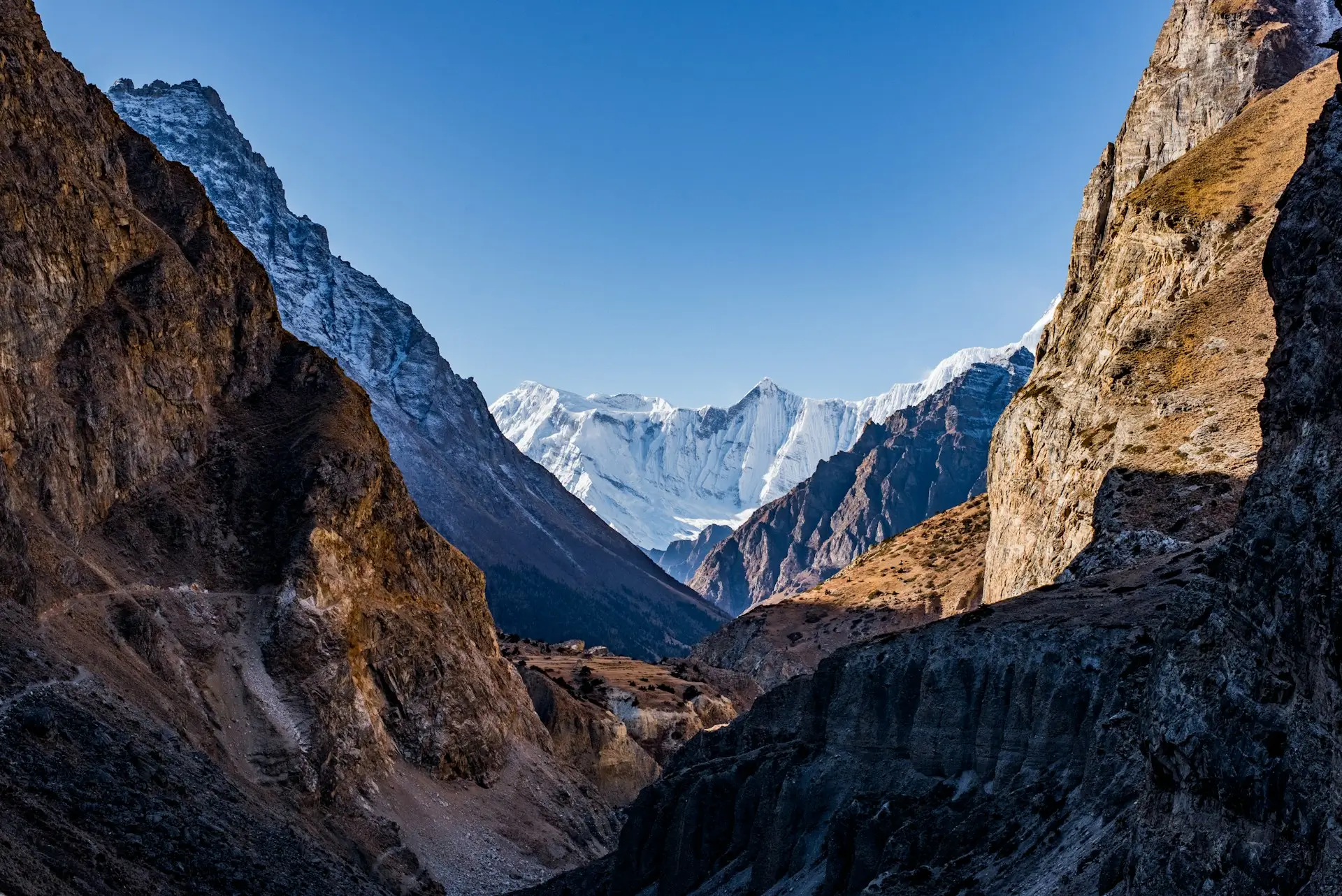
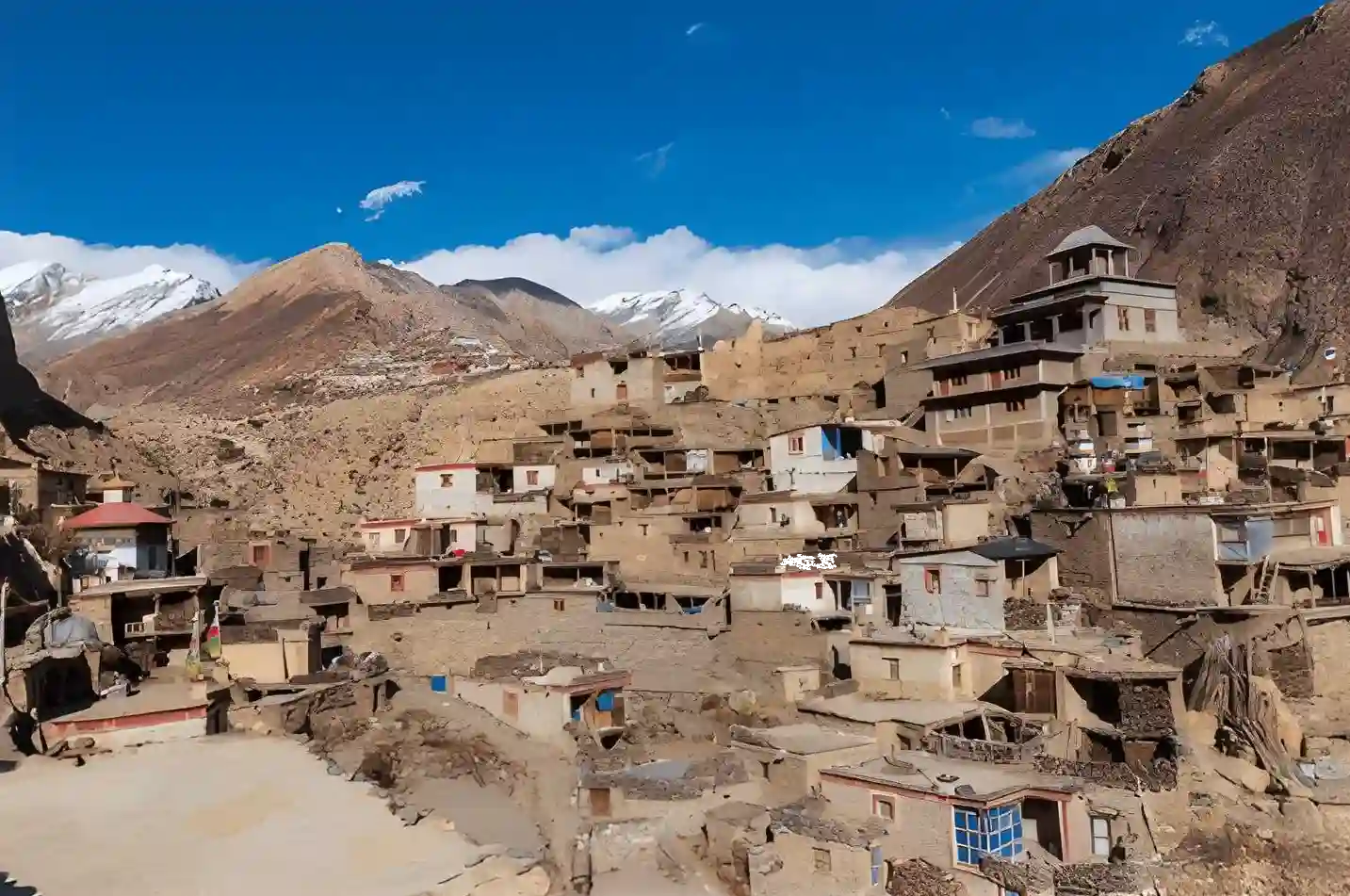
Quick answer: Nar Phu is a restricted valley in the Annapurna region, closed to foreigners until 2003 and still tightly controlled. You cannot walk it without a licensed guide. Nepal requires a Restricted Area Permit and a guide booked through a registered agency, and since March 2026 you no longer need a second trekker to get that permit. The trek takes about 14 days, tops out on the Kang La pass at 5,320 m, and reaches two Tibetan villages that see a fraction of the traffic of the nearby Annapurna Circuit.
Key takeaways
- This is a restricted area. Independent trekking without a guide is not permitted. You need a licensed guide and a registered agency. As of March 2026, you no longer need a second trekker to get the permit.
- Two permits, not one. A Restricted Area Permit plus an Annapurna Conservation Area Permit. TIMS is not required on top of these for a route that stays inside the restricted area.
- Kang La (5,320 m) is the crux, and it is the part every other guide skips. We explain what the crossing actually involves.
- Graded Strenuous on our scale. This is not a first Himalayan trek.
- Two seasons only: March to May, and September to November.
- You sleep high for several nights. Nar and Phu both sit above 4,000 m, which makes acclimatization the real planning problem.
Nar and Phu are two villages at the head of a side valley off the Annapurna Circuit. In fact, they were closed to outsiders until 2003. Tibetan in culture, built in stone, and still reached only on foot.
So most people who trek Nepal have never heard of them, which is the appeal. But the restricted status brings rules that catch people out, and the Kang La pass is harder than the marketing suggests. So this guide covers both honestly.
Where is the Nar Phu valley?
Geographically, the valley branches north from Koto, on the Annapurna Circuit trail, in the Manang district. So you walk in from the Circuit, spend several days in the side valley, then cross the Kang La pass to rejoin the Circuit near Ngawal or Manang.
And that geography matters for two reasons. First, it means the trek combines naturally with the Annapurna Circuit. And it means you are never on a separate trail system, so the exit over Kang La is what makes it a loop rather than an out and back.
Do you need a permit for Nar Phu?
Yes, and more than one. This is the part to get right before you book anything.
To be clear, Nar Phu is a designated restricted area. In practice that means two things are non negotiable:
- A Restricted Area Permit (RAP), which only a registered trekking agency can obtain for you. You cannot buy one yourself.
- A licensed guide. This is separate from Nepal’s general 2023 guide rule and predates it. Our Nepal trekking permits guide explains how the wider system works.
One rule changed recently. Until March 2026, a restricted area permit required a minimum of two trekkers, so solo travellers had to find a partner or book onto a group departure. The Department of Immigration dropped that requirement on March 22, 2026. A single trekker can now get a Nar Phu permit alone. The guide and agency rules above still apply. Some older sites and agency pages have not caught up, so if you read a two-trekker minimum elsewhere, treat this as the current rule.
On top of that, you will also need an Annapurna Conservation Area Permit (ACAP), because the valley sits inside the conservation area.
On the fees, be careful. The figures published across trekking sites agree with each other but are not always current. One of the two most detailed guides online omits costs entirely. Generally, the quoted structure is a RAP of around US$100 per person for the first seven days from September to November. From December to August it is around US$75 for the same period, with a per day charge after that. ACAP is usually quoted at NPR 3,000 for foreign nationals and NPR 1,000 for SAARC nationals.
However, treat those as indicative. Permit fees in Nepal change, and restricted area rules change more often than most. So confirm the current figures with your agency before you budget, and ask for them in writing.
One more detail matters for group treks. A single licensed guide can legally look after up to seven trekkers. From eight, a second guide is required. So if you book as a larger group and the price looks unusually low, query it.
What is the Kang La pass actually like?
This is the section every other Nar Phu guide leaves out, and it is the part that decides your trek.
To begin with, Kang La sits at 5,320 m. And it is the highest point of the route and the exit from the valley.
In short, it is a long, steep, non technical climb on loose ground. Then a steep descent on the Ngawal side. Importantly, you do not need ropes or climbing skill. But you do need to be comfortable on scree and to start very early, because the pass gets wind through the middle of the day.
So three things make it harder than the altitude alone suggests:
You cross it late in the trek, after several nights above 4,000 m. And that cuts both ways. You are acclimatized, but you are also tired.
Second, the descent is longer than the climb. The drop from 5,320 m to Ngawal at around 3,660 m happens in one day. So knees notice.
Finally, snow closes it. Outside the two main seasons, and occasionally within them, fresh snow makes Kang La impassable. Therefore a good itinerary has an alternative, which is to return the way you came and rejoin the Circuit at Koto. Ask your operator what their plan is if the pass is shut. If they do not have one, that tells you something.
The route, stage by stage
In practice, our 14 day Nar Phu Valley Trek runs in from Koto and exits over Kang La. Here is the shape of it.
| Stage | Place | Altitude | What happens |
|---|---|---|---|
| Drive | Kathmandu to Besisahar, then Chame | 2,670 m | Long road days on the Circuit |
| Trek | Meta | 3,560 m | Leave the Circuit, enter the side valley |
| Trek | Phu village | around 4,080 m | First Tibetan village, rest day here |
| Trek | Nar Phedi | valley floor | Monastery stop between the two villages |
| Trek | Nar village | around 4,110 m | Second village, acclimatization day |
| Pass | Kang La | 5,320 m | The crux. Early start |
| Trek | Ngawal or Manang | around 3,660 m | Rejoin the Annapurna Circuit |
| Drive | Kathmandu | 1,400 m | Out by road |
So note the shape rather than the exact numbers. Broadly, you climb steadily for about a week, sit high for two or three nights, then cross the pass and drop fast.
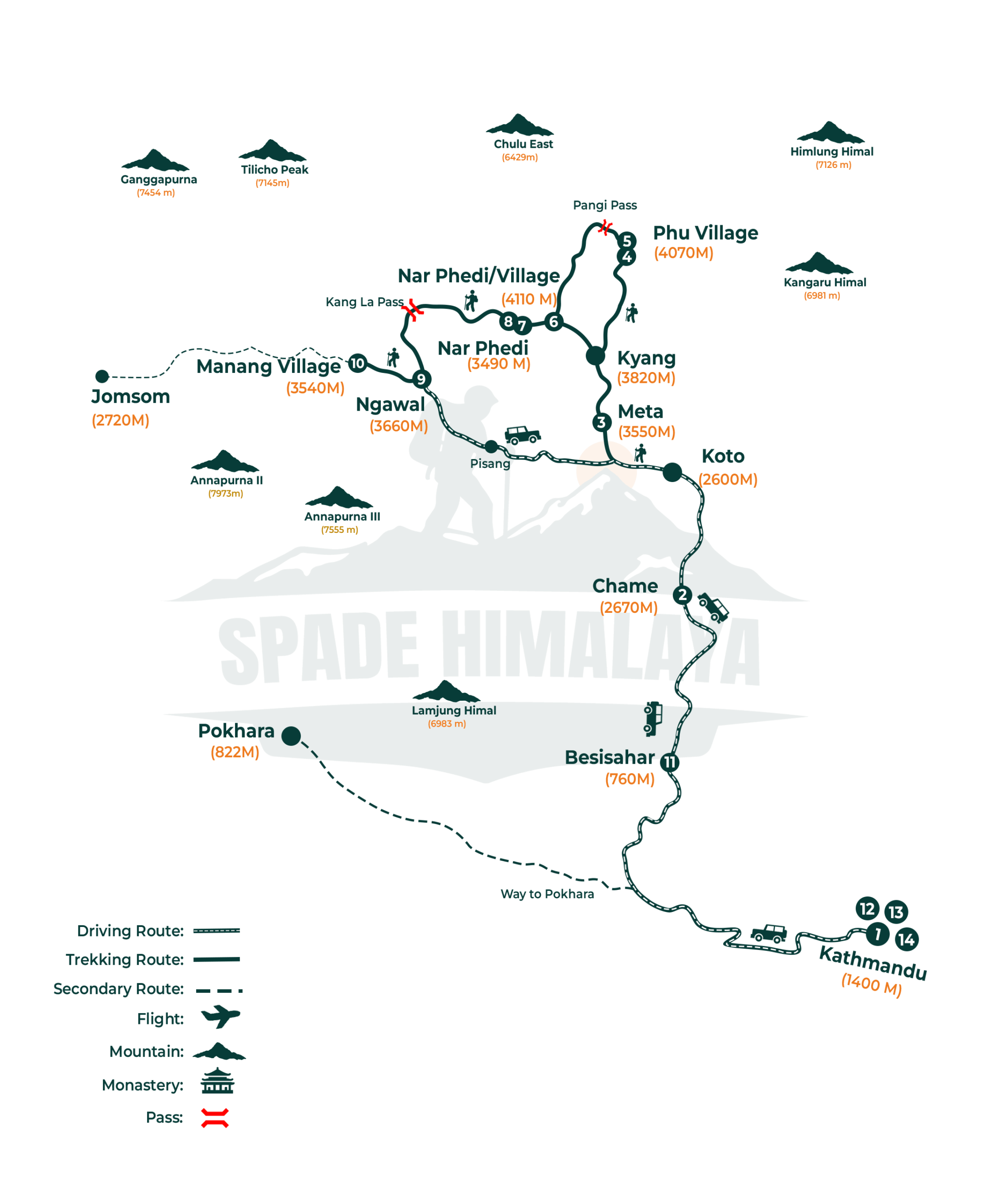
Our own Nar Phu Valley trek map. The route runs Chame (2,670 m), Koto (2,610 m), Meta (3,560 m), Phu village (4,250 m), Nar Phedi (3,490 m) and Nar village (4,110 m), crossing the Kang La at 5,320 m to Ngawal (3,660 m) and Manang (3,540 m).
How difficult is the Nar Phu valley trek?
We grade it Strenuous. Here is what that means against the rest of what we run.
| Grade | Name | What it means | Example treks |
|---|---|---|---|
| 1 | Easy | Under 3,500 m, short, gentle days | Poon Hill |
| 2 | Moderate | Up to about 4,500 m, no high pass | Annapurna Base Camp, Mardi Himal, Kori |
| 3 | Strenuous | 5,000 to 5,550 m, a base camp or one high pass, good lodges | Everest Base Camp, Annapurna Circuit, Nar Phu Valley |
| 4 | Challenging | Remote, above 5,000 m, long rough days, simple lodges or some camping | Makalu, Everest Three Passes |
| 5 | Expedition | Very remote, full camping, or several high passes | Upper Dolpo |
A realistic fitness benchmark, since no other guide gives one. You should be able to walk six to seven hours on consecutive days with a daypack. You should also have done at least one multi day trek before. Meanwhile, previous altitude experience is not required, but it helps.
Realistically, this is not a suitable first Himalayan trek. So if Nar Phu is your first, do a shorter one first.
How do you acclimatize properly here?
The altitude profile is the real difficulty, not the walking.
Specifically, Nar and Phu both sit above 4,000 m, and you sleep there for several consecutive nights before crossing a 5,320 m pass. Overall, that is a demanding profile, and it is why the rest days in the villages are not optional padding.
So here is what our guides actually do:
- A full rest day at Phu. Not a lie in. A short walk to higher ground and back down, because climbing high and sleeping low is what drives acclimatization.
- A second acclimatization day at Nar before the pass.
- A slow pass day, starting before dawn so that any problem happens with a full day of light left.
- Daily symptom checks against the signs of altitude sickness. Headache, appetite, sleep quality. Reported honestly rather than hidden, because trekkers who conceal symptoms are the ones who get into trouble.
If an itinerary you are quoted runs Nar Phu in nine or ten days with no rest days, that is the corner being cut.
What about emergencies?
Another gap in most guides worth closing.
Firstly, this valley is remote. Moreover, there is no road, no hospital, and mobile coverage is patchy to absent for much of the route. Meanwhile, helicopter evacuation is possible in daylight and reasonable weather, and it is expensive.
So two practical points. Travel insurance covering helicopter evacuation above 4,000 m is essential. Many standard policies do not. Check the altitude limit in your policy wording rather than assuming. And carry enough cash, because there are no ATMs once you leave the road.
Food, water and accommodation
Generally, accommodation is simple. Teahouses and homestays run by local families, usually twin rooms, basic but clean. This is not the Annapurna Circuit teahouse scene. There are far fewer beds, so in peak season your guide books ahead.
Water is the detail nobody mentions. Unfortunately, bottled water is scarce and expensive this far in, and buying it creates a plastic problem in a valley with no waste collection. So bring purification, whether tablets, a filter, or a UV pen. Boiled water is available at teahouses for a small charge.
Meanwhile, food is Nepali and Tibetan staples, heavier on the Tibetan side than elsewhere in Annapurna. Dal bhat, thukpa, tsampa. Fortunately, vegetarian is straightforward. Specific allergies are harder this remote, so bring what you cannot do without.
When is the best time to go?
Two windows, and they are genuinely the only two.
March to May. Firstly, warming, clearer as the season goes on, and the pass usually open from around late March.
September to November. This is the most reliable window. Stable air after the monsoon, the sharpest views, and the highest chance Kang La is crossable. October is the peak.
By contrast, December to February is cold enough that the villages empty out and the pass is often closed by snow. June to August is monsoon, though the valley sits partly in the rain shadow, so it is less wet than the southern Annapurna trails. Neither is what we would recommend.
FAQs
Can you trek Nar Phu without a guide?
No. Nar Phu is a restricted area, and a licensed guide is mandatory. So is a minimum of two trekkers and a permit obtained through a registered agency. This is not a rule that gets quietly ignored, because permits are checked.
How much does the Nar Phu valley trek cost?
Published package prices generally run from around US$950 to US$1,300 per person for a standard 12 to 14 day trip. Budget and comfort tiers sit either side. Permits, the guide, food and accommodation are the main components. Confirm exactly what is included, particularly permits and transport.
How high is the Kang La pass?
Kang La is 5,320 m, or 17,454 feet. It is the highest point of the trek.
Do you need TIMS for Nar Phu?
Sources disagree. Some list a TIMS card alongside the restricted permit. Others say the RAP replaces it. Ask your agency to confirm for your specific itinerary, since the answer can depend on where you enter and exit.
Can you combine Nar Phu with the Annapurna Circuit?
Yes, and it is a natural pairing, because the valley branches off the Circuit at Koto and rejoins it after Kang La. Adding the full Circuit with Thorong La turns it into a three week trip.
Is Nar Phu harder than the Annapurna Circuit?
In some ways yes. Kang La at 5,320 m is slightly lower than Thorong La, but Nar Phu is more remote, has fewer facilities, and requires more consecutive nights above 4,000 m.
What is at Phu village?
A small Tibetan settlement at around 4,250 m, with a monastery, old stone houses, and a landscape that looks more like Tibet than Nepal. Most itineraries include a rest day here, which is also the acclimatization day.
How many days do you need?
Around 14 including road travel and acclimatization days. Shorter versions exist. They work by cutting rest days, which is the wrong thing to cut on this particular profile.
Route stages and grading in this guide reflect the Nar Phu departures we run. Restricted area permit fees and rules in Nepal change, and published figures online are not always current, so confirm the position with your agency or the Department of Immigration before you budget. Route detail reviewed by Yubaraj Katel, senior licensed trekking guide, Nepal licence 19827.
