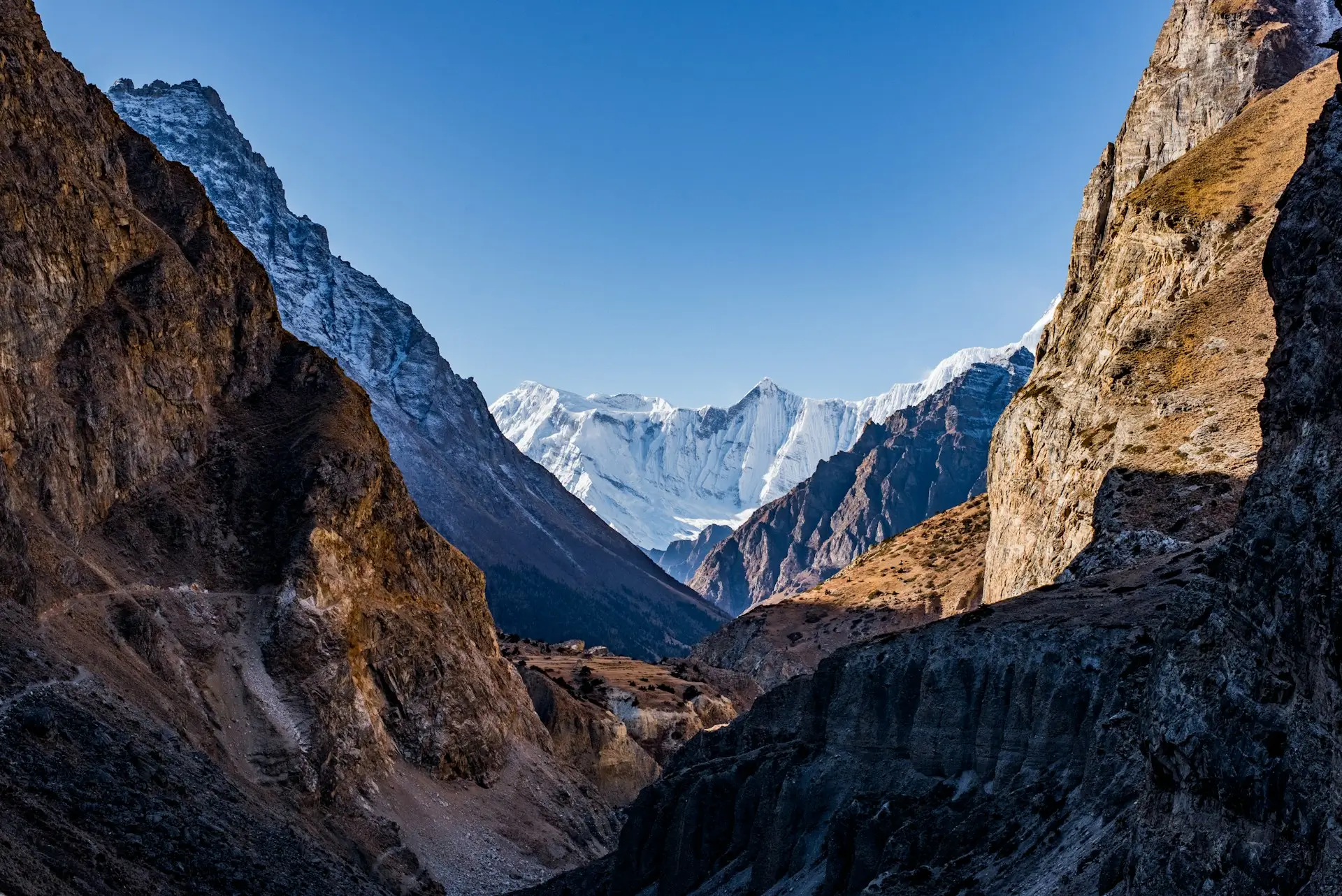
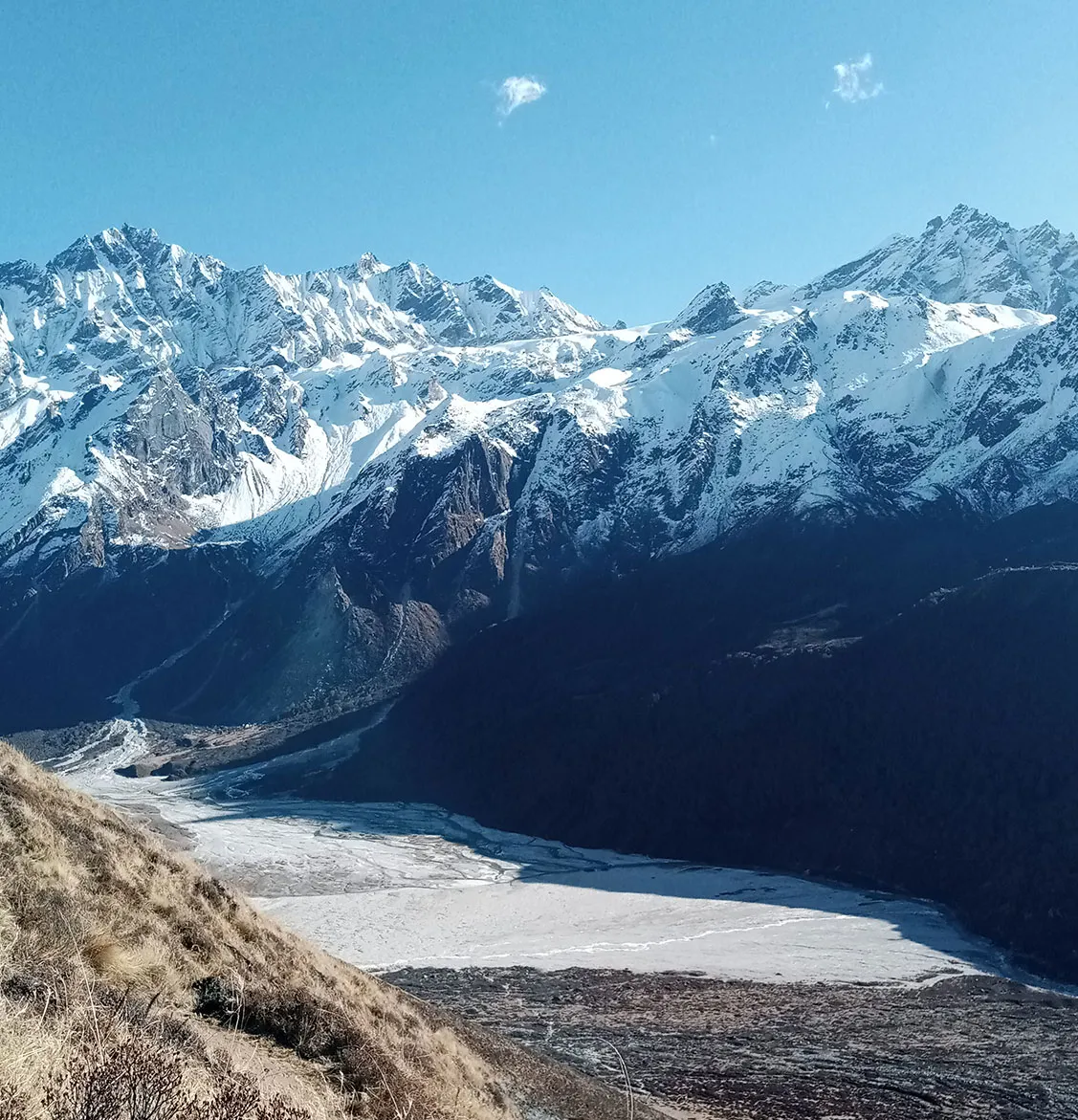
Route advisory, 1 September 2026. A glacial flood on 26 August 2026 destroyed road access in Rasuwa district, including Syabrubesi, the road trailhead for this trek. The Nepal Tourism Board has advised postponing travel through the Galchhi to Nuwakot to Rasuwa to Syabrubesi corridor, and the Prithvi Highway has been closed. Early estimates for restoring basic road access run from several weeks to several months and are not yet firm.
The trails themselves are largely intact. What has closed the region is the loss of the single road that serves the Langtang, Gosaikunda and Tamang Heritage routes together. The costs, distances and route detail below describe this trek in normal conditions and remain accurate for planning a future trip, but they should not be used to travel now. The Everest and Annapurna regions, Kathmandu, Pokhara and Chitwan are unaffected and operating normally.
Update, 2 September 2026. We are now running a 16 day alternative that walks in and out from Sundarijal and avoids the damaged road entirely, reaching Gosaikunda and the Langtang valley on foot in both directions. It is longer and more demanding than the standard route and is priced differently. Please contact us for the day by day detail.
We will update this page when access is restored. If you are holding autumn dates, please contact us and we will give you the current position honestly, including if the answer is to postpone.
Quick answer: The Langtang region is the closest big trekking area to Kathmandu, reached by road with no flight. It sits inside Langtang National Park and offers treks from 5 to 15 days, reaching Tserko Ri (4,984 m) and Gosaikunda (4,380 m). The best seasons are spring and autumn.
The Langtang region is the closest big trekking area to Kathmandu, and you reach it by road, with no flight. It sits just north of the capital, against the Tibet border. So you get glaciers, 7,000 m peaks, and warm Tamang culture in a short, affordable trip. This guide walks you through the routes, permits, cost, difficulty, and best time, all in plain terms.
Key Takeaways
- Langtang lies inside Langtang National Park, Nepal’s first Himalayan national park.
- You drive in. There is no flight, just a 7 to 8 hour road trip to Syabrubesi.
- The main routes run from 5 to 15 days. So there is a trek for every level.
- The high points are Tserko Ri (4,984 m), Gosaikunda Lake (4,380 m), and Laurebina La pass (4,610 m).
- The best time is spring (March to May) and autumn (September to November).
- Budget roughly US$600 to US$1,100 for a guided trek, depending on the route.
This is the hub for everything we cover on Langtang. First, use it to plan the big picture. Then follow the links to our deeper guides and the full trek itineraries.
What is the Langtang region?
The Langtang region is a chain of valleys north of Kathmandu, in Rasuwa district. It runs from green river gorges up to glaciers and high peaks. The whole area sits inside Langtang National Park.
This was Nepal’s first Himalayan national park, set up in 1976. It covers about 1,710 km² (Nepal Tourism Board, retrieved 2026-06-23). So it protects deep forest, high pasture, and rare wildlife like the red panda.
The highest peak here is Langtang Lirung (7,234 m). The valley below is often called the “Valley of Glaciers.” In short, you get huge mountain scenery close to the city, without a long approach.
What are the main Langtang treks?
Langtang offers four classic treks, from an easy 5-day walk to a 15-day high-pass trip. So you can match the route to your time and fitness. Here they are at a glance.
| Trek | Days | Grade | High point | Best for |
|---|---|---|---|---|
| Helambu Trek | 5 | Easy | about 3,650 m | A short, low first trek near Kathmandu |
| Langtang Valley Trek | 10 | Moderate | Tserko Ri 4,984 m | The classic valley and glacier views |
| Tamang Heritage Trek | 11 | Easy to Moderate | about 3,165 m | Village culture and hot springs |
| Langtang Gosaikunda Trek | 15 | Moderate to Strenuous | Laurebina La 4,610 m | Valley, sacred lake, and a high pass |
The Langtang Valley Trek is the most popular. It climbs the main valley to Kyanjin Gompa and the Tserko Ri viewpoint. The Langtang Gosaikunda Trek adds the sacred lake and a pass into Helambu. Meanwhile, the Tamang Heritage and Helambu treks stay lower, with more culture and gentler days.
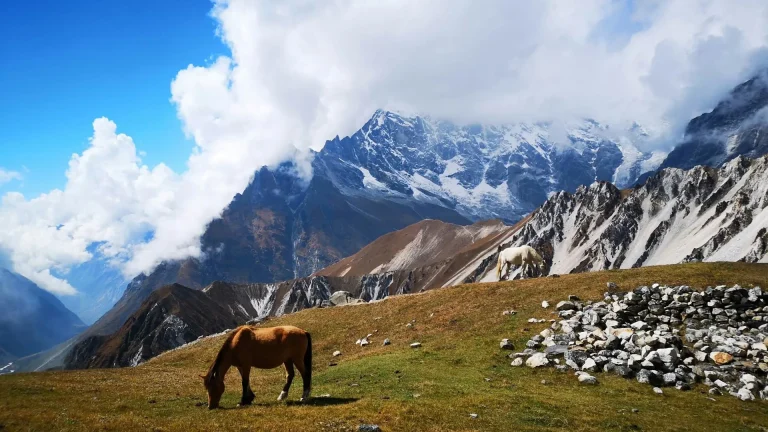
For the full day-by-day plans, follow the links in the table above.
What is the route, and how do you get there?
Every Langtang trek starts with a road trip, not a flight. You drive from Kathmandu to the trailhead at Syabrubesi (1,460 m). The road follows the Trishuli River north through the hills. So the drive takes about 7 to 8 hours, over roughly 120 km.
The road is rough and bumpy in places. It is often under repair after monsoon landslides. So a private jeep is faster and comfier than the local bus. From Syabrubesi, the walking begins up the Langtang Valley.
Because there is no Lukla-style flight, Langtang avoids that cost and those weather delays. In fact, this is the main reason the region is so good value. For most treks, you return the same way to Syabrubesi and drive back to Kathmandu. For a full day-by-day route, see our Langtang Valley Trek distance and map guide. In a hurry? You can also fly in by Langtang helicopter tour. We run it as a 1-day flight from Kathmandu with a landing at Kyanjin Gompa. For how that compares with the Everest and Annapurna flights, see our Nepal helicopter tours guide.
What permits do you need for the Langtang trek?
Langtang is a national park, not a restricted area, but you still need permits and a licensed guide. So the rules are simpler than on Manaslu, yet you cannot just walk in alone.
You need two main papers:
- Langtang National Park entry permit. This costs NPR 3,000 (about US$25) for foreign trekkers (Nepal Tourism Board, retrieved 2026-06-23).
- TIMS card (Trekkers’ Information Management System). This costs NPR 2,000 for foreign trekkers, or NPR 1,000 for SAARC nationals.
Since 2023, Nepal has required foreign trekkers to use a licensed guide in national park trekking areas. The Nepal Tourism Board brought in this rule on 31 March 2023 (Nepal Tourism Board, retrieved 2026-06-23). So a solo, guide-free Langtang trek is no longer allowed. A ranger checks your permits at the Dhunche gate on the drive in.
Spade Himalaya is a registered agency, so we arrange the guide and both permits for you. For the full breakdown, see our Langtang trek permit cost guide.
How much does a Langtang trek cost?
A guided Langtang trek usually costs about US$600 to US$1,100 per person in 2026. The exact price depends on the route, group size, and season. The short Helambu and Tamang Heritage treks sit at the lower end. The longer Gosaikunda trek sits at the top.
Langtang is one of the cheapest classic regions in Nepal. The reason is simple. There is no flight to pay for, and the permits are low. So your money goes to the guide, the porter, transport, food, and lodging.
For a full line-by-line breakdown, see our Langtang Valley Trek cost guide.
Trek difficulty: the Spade Himalaya Trek Difficulty Scale
We grade every trek from 1 to 5, so you can compare them fast. This is our own scale, based on altitude, length, remoteness, and lodging.
| Grade | Name | What it means | Example treks |
|---|---|---|---|
| 1 | Easy | Under 3,500 m, short, gentle days | Poon Hill |
| 2 | Moderate | Up to about 4,200 m, no high pass | Annapurna Base Camp |
| 3 | Strenuous | 5,000 to 5,550 m, a base camp or one high pass, good lodges | Everest Base Camp, Annapurna Circuit, Manaslu Circuit |
| 4 | Challenging | Remote, above 5,000 m, long rough days, simple lodges or some camping | Makalu, Everest Three Passes |
| 5 | Expedition | Very remote, full camping, or several high passes | Upper Dolpo |
So here is how the Langtang treks sit on this scale:
- Helambu Trek: Grade 1 (Easy). It stays low, with short days near Kathmandu.
- Tamang Heritage Trek: Grade 1 to 2 (Easy to Moderate). It is cultural and gentle.
- Langtang Valley Trek: Grade 2 (Moderate). The Tserko Ri hike is the one hard part.
- Langtang Gosaikunda Trek: Grade 3 (Strenuous). It crosses the 4,610 m Laurebina La pass.
For more detail, see our guide to Langtang Valley Trek difficulty and best time.
What are the temperatures by season?
Here are rough temperatures by season, so you know what to pack. These are field-experience ranges from our guides, not exact figures, because mountain weather changes fast.
| Season | Lower valley (day) | High points like Tserko Ri (night) | Verdict |
|---|---|---|---|
| Spring (Mar to May) | 12 to 20°C | -6 to -12°C | Excellent, rhododendrons bloom |
| Autumn (Sep to Nov) | 10 to 18°C | -8 to -15°C | Excellent, clearest views |
| Winter (Dec to Feb) | 4 to 12°C | -12 to -20°C | Cold, snow up high |
| Monsoon (Jun to Aug) | 15 to 22°C | -2 to -8°C | Wet, leeches, cloud |
When is the best time to trek Langtang?
Spring (March to May) and autumn (September to November) are the best seasons. Both bring stable weather and clear skies. So the mountain views are at their best.
In spring, the rhododendron forests bloom red and pink. In autumn, the air is crisp and clean after the rains. Autumn is the most popular season for sharp, long views.
Winter is cold, and snow can fall above 3,000 m. Still, the lower valley treks stay possible on clear days. So for the full cold-season picture, see our Langtang Valley Trek in winter guide. The summer monsoon brings rain, leeches, and landslide risk, so most trekkers skip it.
Langtang Valley or Gosaikunda?
Choose the Langtang Valley Trek for the classic glacier views in 10 days; choose Gosaikunda to add a sacred lake and a high pass in 15 days. Both start the same way, up the main valley to Kyanjin Gompa.
The Langtang Valley Trek is shorter and a touch easier. It suits fit beginners and anyone short on time. The Gosaikunda Trek is longer and harder, because it crosses Laurebina La (4,610 m) into Helambu.
For a full head-to-head, read Langtang Valley vs Gosaikunda.
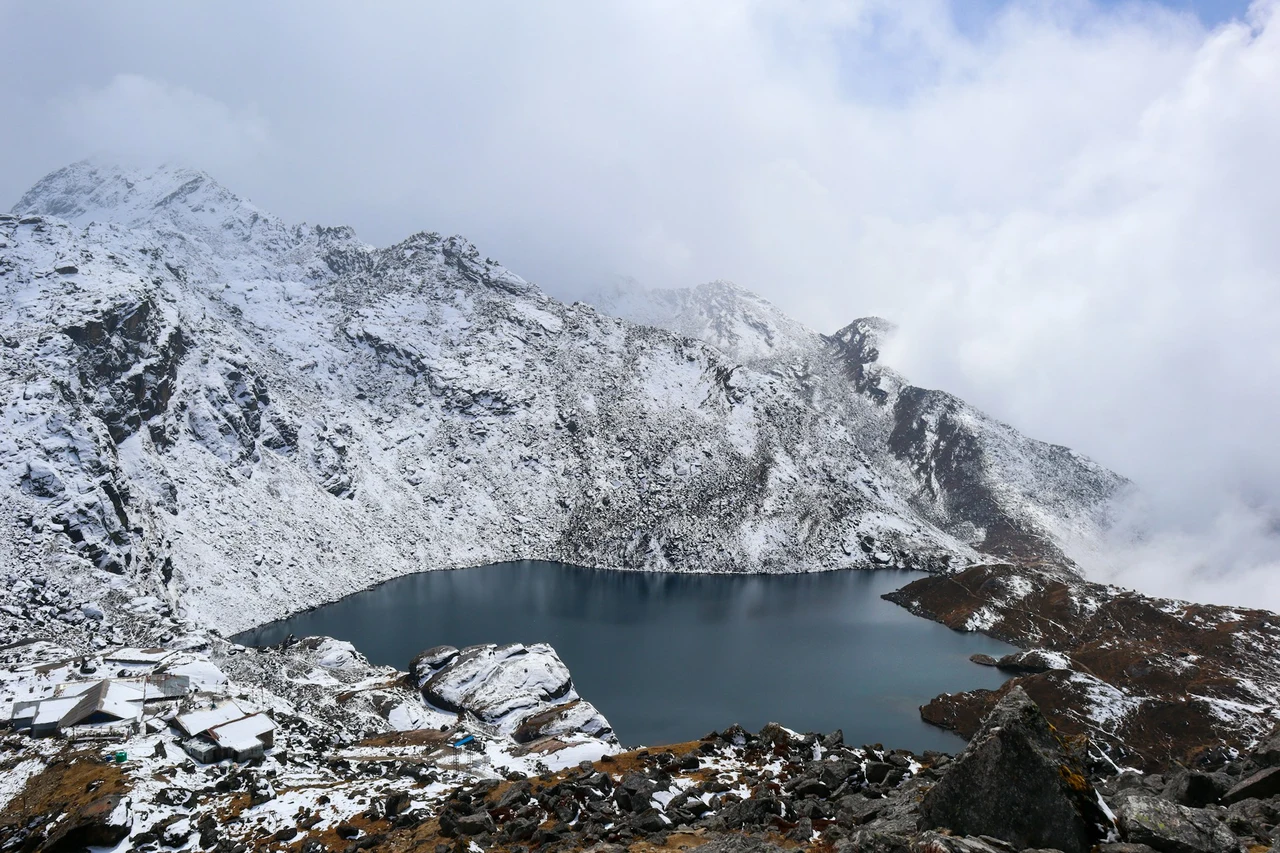
Langtang Gosaikunda Lake, a sacred Himalayan alpine lake and one of the highlights of the Langtang Gosaikunda Trek in Nepal.
How did the 2015 earthquake affect the valley?
In April 2015, a huge landslide buried the old Langtang village. It was the worst-hit trekking valley in Nepal. Many lives were lost, and the trail closed for a time.
However, the valley has come back strong. The trekking route reopened in 2017. Since then, the villages and lodges have been rebuilt, often better than before. So the trail is fully open and safe today.
When you trek here now, your money goes straight to a community that rebuilt with great spirit. Many lodge owners are happy to share their story. In short, a Langtang trek is both a beautiful walk and a real act of support.
How do you stay safe at altitude?
Altitude is the main risk on the higher Langtang treks, but it is very manageable with a slow pace. Altitude sickness (AMS) gets more likely the higher you go. In one study of Nepali Himalaya trekkers, AMS affected about 15% of people at 4,000 to 4,500 m and 51% at 4,500 to 5,000 m (PubMed, retrieved 2026-06-23).
So the plan is simple. First, climb slowly. Next, take the rest day at Kyanjin Gompa before the Tserko Ri hike. Also, drink 3 to 4 litres of water a day, and skip alcohol up high. Your guide carries a pulse oximeter and checks you daily.
Watch for two rare but serious problems too. HACE affects the brain, and HAPE affects the lungs. For both, the best treatment is to go down fast (CDC Yellow Book, retrieved 2026-06-23). So tell your guide early if you feel unwell.
What are accommodation and food like?
You sleep in simple teahouses, the small family lodges along the route. Lower down, rooms are basic but comfortable. Higher up, they get colder and plainer. So a warm sleeping bag matters above Lama Hotel.
The food is filling and good for trekking. For example, you get dal bhat, noodles, potatoes, soup, and Tibetan bread. You can also taste fresh yak cheese at Kyanjin Gompa. Vegetarian meals are easy to find too.
The trail runs on cash, and there are no ATMs. So carry enough Nepalese rupees from Kathmandu. Wi-Fi, charging, and hot showers all cost a small fee that rises with altitude.
What should you pack?
The key is layers, because the trek runs from warm valleys to a freezing viewpoint. Here is a short list of essentials:
- Waterproof trekking boots, broken in, plus warm socks
- Base layers, a fleece or down mid-layer, and a waterproof shell
- A four-season sleeping bag and a down jacket (you can rent both in Kathmandu)
- Warm hat, sun hat, sunglasses, buff, and gloves
- Headlamp, trekking poles, sunscreen, and a water bottle
- Micro spikes for Tserko Ri or the pass, in case of snow
For the full kit, with what to pack and why, see our Langtang Valley Trek packing list.
Who should trek Langtang?
Langtang suits almost everyone, from first-time trekkers to seasoned hikers. There is a route for every level, and none of them need climbing skills. So it is one of the best regions for a first Himalayan trek. New to trekking? See our guide to the Langtang Valley Trek for beginners.
New trekkers can start with the short Helambu Trek or the cultural Tamang Heritage Trek. Fitter walkers can take on the Langtang Valley Trek or the longer Langtang Gosaikunda Trek.
If you are comparing regions, our Langtang vs Everest Base Camp vs Annapurna Base Camp guide is the quickest way to decide. You can also read our Everest region guide, Annapurna region guide, and Manaslu Circuit guide.
More Langtang guides
Here are all our detailed Langtang guides in one place. So you can plan every part of your trek.
- Langtang Valley Trek cost in 2026
- Langtang trek permits 2026
- Langtang Valley Trek difficulty and best time
- Langtang Valley Trek distance and map
- Langtang Valley Trek in winter
- Langtang Valley Trek packing list
- Langtang Valley Trek for beginners
- Kyanjin Ri vs Tserko Ri viewpoints
- Langtang Valley vs Gosaikunda
- Langtang vs Everest Base Camp vs Annapurna Base Camp
- Langtang helicopter tour and heli return
- Gosaikunda Lake Trek cost
- Gosaikunda Trek difficulty and best time
- Gosaikunda and the Janai Purnima festival
- Tamang Heritage Trail vs Langtang Valley
- Helambu Trek: cost, difficulty, and best time
- Best short treks near Kathmandu
FAQs
How many days do you need for a Langtang trek?
It depends on the route. The Helambu Trek takes about 5 days. The classic Langtang Valley Trek takes about 10 days. The Langtang Gosaikunda Trek takes about 15 days. So you can pick a trek to fit your holiday.
Do you need a guide for the Langtang trek?
Yes. Since 2023, foreign trekkers must use a licensed guide in national park areas like Langtang (Nepal Tourism Board, retrieved 2026-06-23). You also need a park permit and a TIMS card. Spade Himalaya is a registered agency, so we arrange the guide and both permits for you.
Can you taste yak cheese in Langtang?
Yes. There is a cheese factory at Kyanjin Gompa producing fresh yak cheese, and trying a slice with Tibetan bread is one of the small pleasures of the valley. It has been made here since Swiss experts helped set it up decades ago.
Is the Langtang trek hard?
Most Langtang treks are easy to moderate. The classic Langtang Valley Trek is graded moderate, with one steep hike to Tserko Ri. The Gosaikunda Trek is harder, because it crosses a 4,610 m pass. None of them need climbing skills.
Is Langtang safe after the 2015 earthquake?
Yes. The trail reopened in 2017, and the villages and lodges have been rebuilt. The route is fully open and safe today. Your visit also supports a community that is still recovering.
What is Kyanjin Gompa?
It is the monastery settlement at the head of the valley and the usual high point of the trek. Most itineraries finish here, using it as a base for the Kyanjin Ri and Tserko Ri viewpoints.
How do you get to Langtang?
You drive from Kathmandu to Syabrubesi in about 7 to 8 hours, over roughly 120 km. There is no flight. A private jeep is the comfiest option, and a tourist bus is the budget choice. So Langtang is one of the easiest Himalayan regions to reach.
Accuracy note: official fees, rules, and hard facts in this guide are cited inline from their sources; trail and price details are Spade Himalaya field research; route details reviewed by Yubaraj Katel, government-licensed trekking guide (Licence No. 19827) with 10 years of experience leading treks in the Langtang region.

Start Planning Your Trek
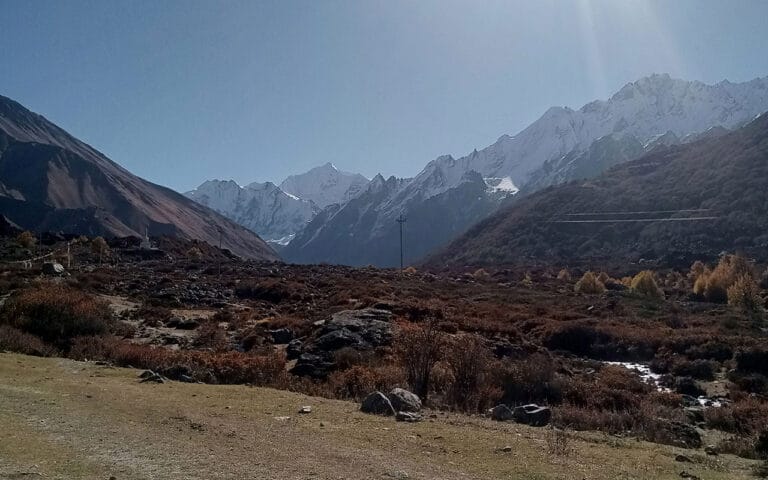
Updated: 1 Sep, 2026
7 min
Langtang Valley Trek Cost in 2026: A Full Price Breakdown
Route advisory, 1 September 2026. A glacial flood on 26 August 2026 destroyed road access in...
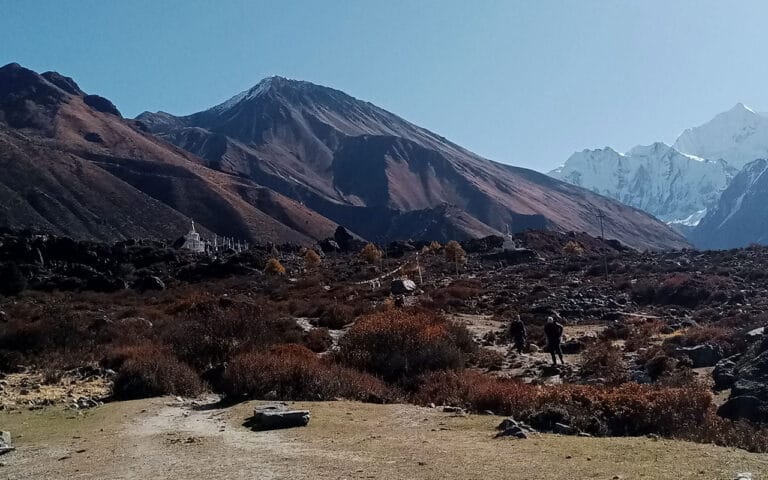
Updated: 1 Sep, 2026
7 min
Langtang Valley Trek Difficulty and Best Time (2026 Guide)
Route advisory, 1 September 2026. A glacial flood on 26 August 2026 destroyed road access in...
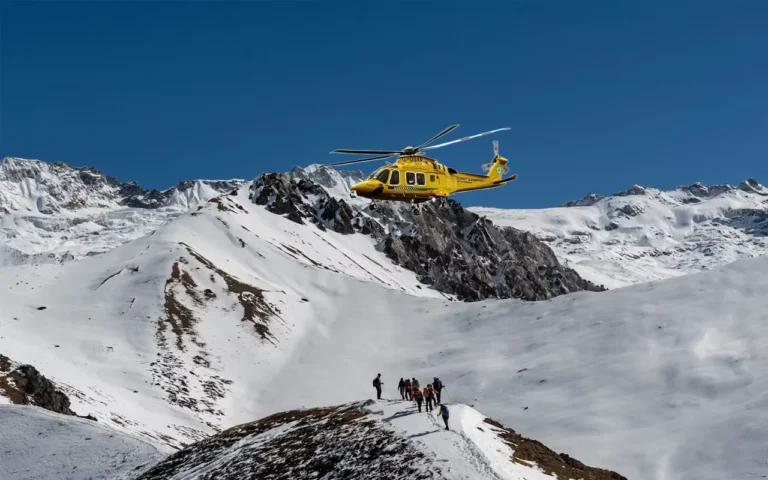
Updated: 14 Sep, 2026
6 min
Langtang Helicopter Tour and Heli Return: Cost and Options (2026)
Access note, 1 September 2026. A glacial flood on 26 August 2026 destroyed road access in...