Quick answer: Pikey Peak is a 4,065 m (13,337 ft) viewpoint in Solukhumbu, lower Everest region. You reach it by road from Kathmandu, so there is no Lukla flight to be cancelled. A typical trek runs 7 days, tops out below the altitude where most people struggle, and delivers a summit panorama that includes Everest itself. It suits fit walkers who want a Himalayan view without a two week commitment.
Key takeaways
- Pikey Peak is 4,065 m (13,337 ft), in the Solukhumbu district. That is roughly 1,500 m lower than Everest Base Camp, so altitude sickness risk is far lower.
- No Lukla flight. You drive to the trailhead at Dhap and finish at Phaplu. This removes the single biggest cause of ruined Everest itineraries.
- 7 days is the standard. Shorter 5 day versions exist, and they work, but they cut the buffer you want for weather.
- Graded Moderate on our scale, at the gentle end of it. Long walking days, real elevation gain, no technical ground.
- Best window is October to May, with October and November giving the clearest air.
- Permit requirements depend on which side you approach from, and published sources disagree. We explain why below.
Most people who want to see Everest assume they have to fly to Lukla and walk for two weeks. Pikey Peak is the counterargument. It is a drive from Kathmandu and a week on foot. Then a summit morning where the whole eastern Himalaya lines up in front of you.
So this guide covers what the trek actually involves. The route with real altitudes, the honest difficulty, and the costs. It also covers the permit situation, which almost every article online states with more confidence than the evidence supports.
How high is Pikey Peak?
Pikey Peak is 4,065 metres, or 13,337 feet.
In fact, that number matters more than it looks. Generally, altitude sickness becomes a serious planning concern above roughly 3,500 m, and gets significantly harder above 5,000 m. Pikey sits in between. So you go high enough to feel the thin air on the final climb. But you sleep lower, and you are never near the altitudes where evacuation becomes likely.
By comparison, Everest Base Camp is 5,364 m and Kala Patthar is 5,545 m. Pikey is about 1,300 to 1,500 m below both. That single fact is why the trek suits people who have decided Base Camp is too much.
What can you actually see from the summit?
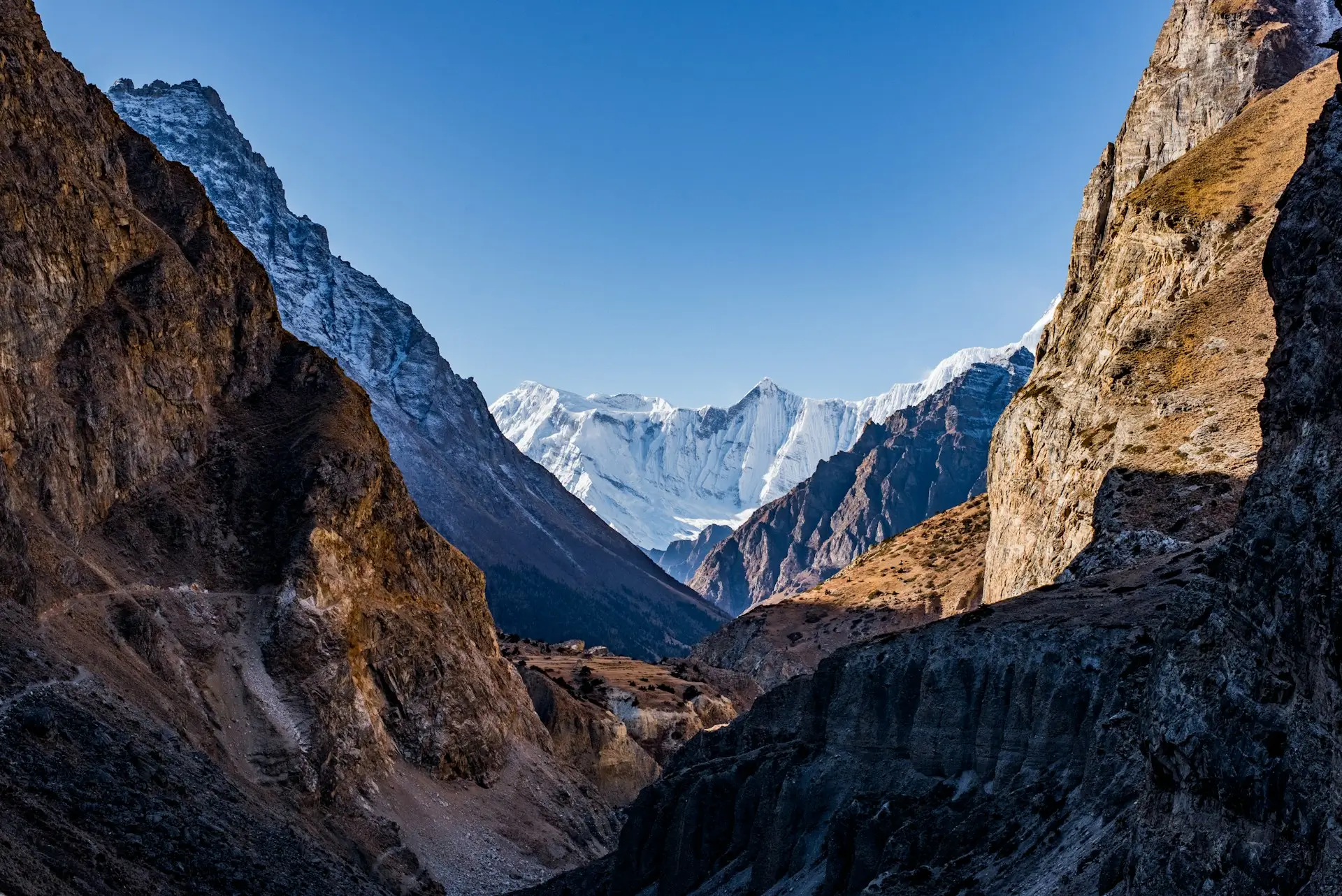
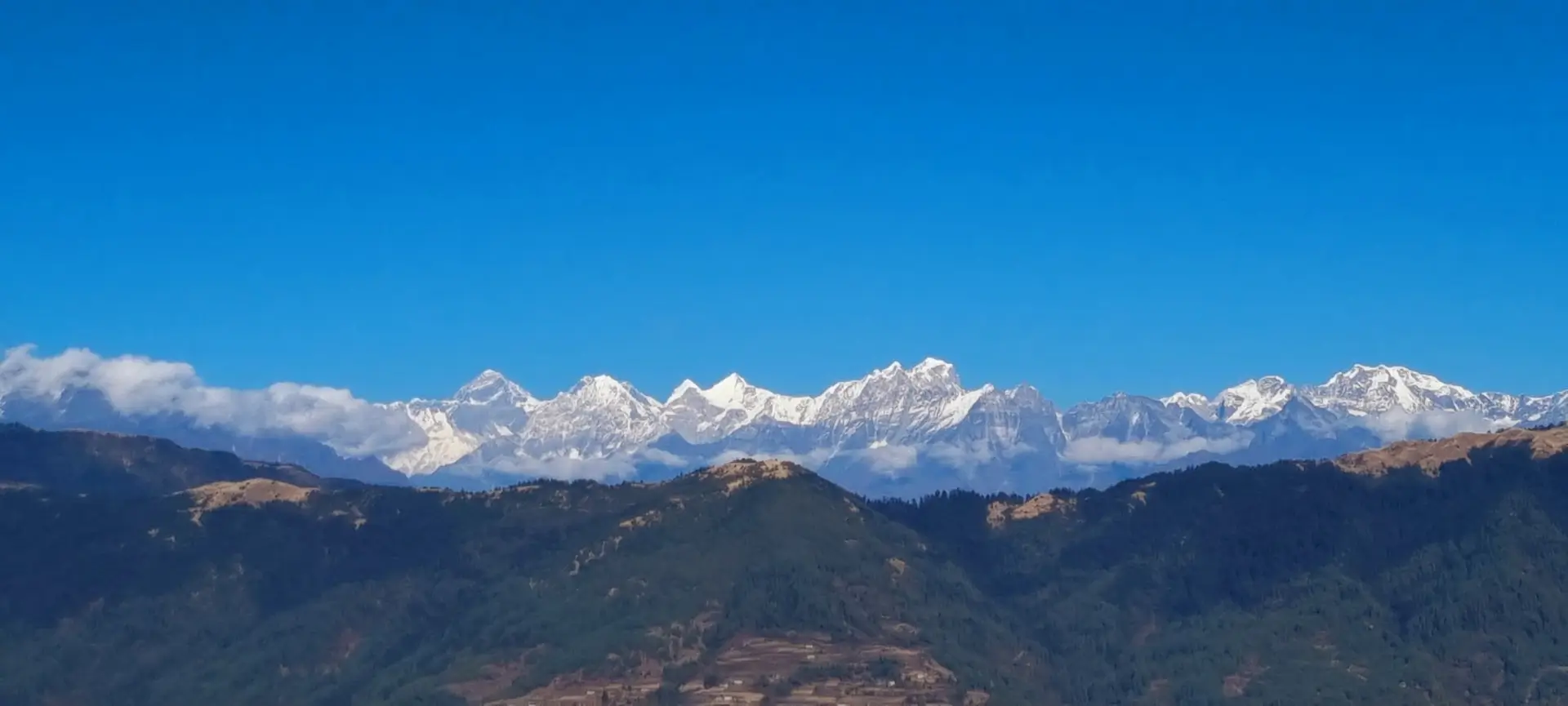
In short, the summit gives a long eastern Himalayan skyline rather than one headline mountain. On a clear morning that includes Everest, along with several other 8,000 m peaks.
It is worth being straight about the Edmund Hillary claim, because you will see it everywhere. For example, many operators state flatly that Pikey Peak was Hillary’s favourite view of Everest. The honest version is that this is widely repeated but not well documented. Even Wikipedia hedges it as “what is said to have been” his favourite view. So treat it as trekking folklore rather than verified fact. Judge the view on its own merits, which are considerable.
Still, the more reliable selling point is simpler. Pikey stands apart from the main Khumbu wall. So you see the range laid out in width, rather than looking up at one face from underneath.
Why go here instead of Everest Base Camp?
Three honest reasons, and one honest reason not to.
No Lukla flight. This is the big one. Flights to Lukla are cancelled regularly for weather, and a grounded flight can cost you days at either end of a trip. Pikey removes that variable entirely, because you drive.
Time. In total, seven days door to door from Kathmandu, against roughly fourteen for Base Camp.
Altitude. Topping out at 4,065 m rather than 5,545 m changes who can realistically do the trek.
And the honest reason not to: you do not stand at the foot of Everest. If the goal is the Base Camp photograph and the Khumbu Icefall, Pikey is not a substitute. It is a different trip that happens to share a mountain view.
The route, with real altitudes
Our 8 day Pikey Peak Trek runs from Dhap to Phaplu. Here is what the profile actually looks like.
| Stage | Place | Altitude | Note |
|---|---|---|---|
| Drive | Kathmandu | 1,400 m | Long road day to the trailhead |
| Trek | Dhap | 2,850 m | Trailhead, rhododendron forest |
| Trek | Jhapre | 2,900 m | Gentle day, Sherpa settlement |
| Trek | Pikey Base Camp | 3,640 m | The real climbing day, about 740 m of gain |
| Summit | Pikey Peak | 4,065 m | Pre dawn start for sunrise |
| Trek | Phaplu | 2,700 m | Long descent out |
| Drive | Kathmandu | 1,400 m | Road, or fly from Phaplu |
And the pattern is worth noticing. Specifically, you gain most of your height on one day, between Jhapre and Pikey Base Camp. That is the day that decides how the trek feels, and it is the day to walk slowly.
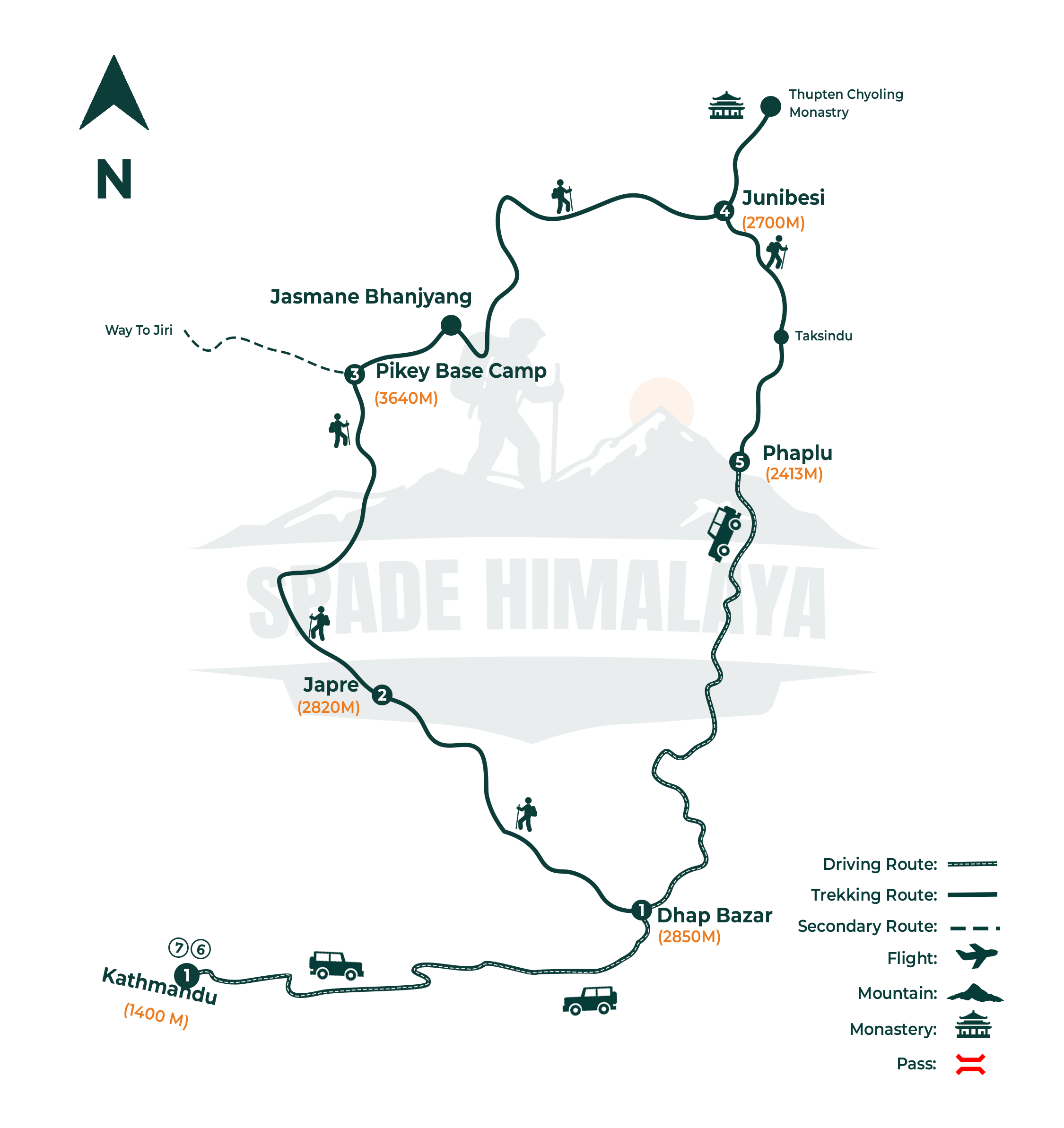
Our own Pikey Peak trek map. The route runs Dhap (2,850 m), Jhapre (2,820 m) and Pikey Base Camp (3,640 m) to Pikey Peak (4,065 m), then descends through Junbesi (2,700 m) to Phaplu (2,413 m).
How difficult is the Pikey Peak trek?
We grade it Moderate, at the gentle end of the band. At 4,065 m it sits well under the 4,500 m ceiling for Grade 2. Here is what that means against the rest of what we run.
| Grade | Name | What it means | Example treks |
|---|---|---|---|
| 1 | Easy | Under 3,500 m, short, gentle days | Poon Hill |
| 2 | Moderate | Up to about 4,500 m, no high pass | Annapurna Base Camp, Mardi Himal, Kori, Pikey Peak |
| 3 | Strenuous | 5,000 to 5,550 m, a base camp or one high pass, good lodges | Everest Base Camp, Annapurna Circuit |
| 4 | Challenging | Remote, above 5,000 m, long rough days, simple lodges or some camping | Makalu, Everest Three Passes |
| 5 | Expedition | Very remote, full camping, or several high passes | Upper Dolpo |
So in practical terms, it comes down to this. If you can walk six hours on a hilly day and repeat that, you can do this trek. Importantly, you do not need technical skills, crampons, or previous altitude experience. What you do need is patience on the climb to Base Camp. You also need warm clothing for the summit morning, which is genuinely cold before dawn.
What does the Pikey Peak trek cost?
Costs split into three parts, and the trekking itself is the cheap bit.
On the trail, teahouse accommodation and meals typically run around US$25 to US$30 per day. Lodges on this route are simpler than the busy Khumbu trail, which is part of the appeal, though several now have hot showers and attached bathrooms.
Meanwhile, transport is the variable that moves the total most. A private jeep to Dhap and back from Phaplu costs considerably more than a shared local jeep. And the shared option is a long, crowded day. Flying out of Phaplu is a third option that saves a full day.
Then guide and permits sit on top. Since April 2023 Nepal has required trekkers on its main routes to walk with a licensed guide booked through a registered agency. So guide cost is not optional in the way it once was.
Also, carry rupees. There is an ATM in Phaplu, and effectively nothing on the trail.
Do you need a permit for Pikey Peak?
This is where you should be careful, because the internet disagrees with itself.
Some guides state flatly that no permit is required. Others state equally flatly that the Gaurishankar Conservation Area Permit is mandatory and costs NPR 3,000. Both claims are published with total confidence.
So here is what is actually verifiable. Officially, the Gaurishankar Conservation Area was established in 2010 and covers the Ramechhap, Dolakha and Sindhupalchok districts. Pikey Peak itself sits in Solukhumbu, which is not one of those three. So the requirement appears to depend on which side you approach from. The western route in from Jiri or Shivalaya passes through Dolakha. The southern route from Dhap does not.
So the practical answer is that your permit requirement is a function of your route, not of the mountain. And the requirement can change.
In practice, what we tell our own clients is simple. Confirm the current position before you travel, rather than trusting any article, including this one. Then let your agency handle the paperwork. If you are booking with anyone, ask them specifically which permits your itinerary needs and what they cost. A straight answer is a good sign.
When is the best time to go?
October to May, with the two ends of that window behaving differently.
October and November give the clearest air of the year and the sharpest mountain views. This is the best time to go for the panorama, which is the entire point of the trek.
December to February is cold, particularly the pre dawn summit push, but the skies stay stable and the trail is quiet. This works if you are properly equipped.
March to May brings warmer walking and rhododendron flowering through the lower forest, at the cost of a little haze on the horizon.
June to September is monsoon. The mountains hide for days at a time, so we steer people away from it.
What should you pack?
Notably, most Pikey guides skip this entirely, which is odd for a trek where the summit morning is the coldest hour of the trip.
So here are the essentials that people actually get wrong:
- A proper insulated jacket for the summit. You will start walking in the dark at around 3,600 m. It is cold in a way that a fleece does not solve.
- Gloves and a warm hat. Same reason, and both are easy to forget on a trek this short.
- A headlamp. The summit push starts before dawn. This is not optional.
- Layers rather than one heavy coat. You will be warm walking uphill and cold the moment you stop.
- Broken in boots. The descent to Phaplu is long and hard on the toes.
- Cash in rupees. Covered above, and worth repeating.
Who is this trek right for?
It suits you if you want a real Himalayan view on a one week schedule, you would rather not gamble on a Lukla flight, or you are not confident about going above 5,000 m.
It does not suit you if your goal is specifically Everest Base Camp, or if you want the busy teahouse social scene of the main Khumbu trail. Ultimately, Pikey is quieter, and that cuts both ways.
FAQs
How high is Pikey Peak in feet?
Pikey Peak is 13,337 feet, or 4,065 metres.
Can you do the Pikey Peak trek in 5 days?
Yes, and shortened versions are commonly sold. The trade is buffer. A 5 day itinerary has no room to absorb a weather day or a slow walker, so if the summit morning is clouded in, you do not get a second attempt. We run 7 days for that reason.
Do you need a Lukla flight for Pikey Peak?
No. You drive from Kathmandu to the trailhead at Dhap and exit from Phaplu. Flying out of Phaplu is optional and saves a day on the return.
Is Pikey Peak harder than Poon Hill?
Yes, moderately. Pikey is higher (4,065 m against 3,210 m), the days are longer, and there is one substantial climbing day. Poon Hill remains the easier introduction.
Do you need a guide for Pikey Peak?
Since April 2023 Nepal requires trekkers on its main routes to use a licensed guide booked through a registered agency. Beyond the rule, this route is less travelled than the Khumbu trail, so a guide matters more for navigation and lodge knowledge than it would on a busy trail.
Is altitude sickness a risk on Pikey Peak?
Overall, it is a lower risk than on the high Everest treks, because you top out at 4,065 m and sleep lower. It is not zero. Symptoms can appear above 2,500 m in susceptible people, so walk slowly on the Base Camp day, drink properly, and tell your guide early if you feel unwell.
What is Dudh Kunda, and can you add it?
Dudh Kunda is a sacred lake at around 4,592 m, held holy by both Hindus and Buddhists, and it is often combined with Pikey Peak on longer itineraries. However, adding it lengthens the trek significantly, so treat it as a different trip rather than a small extension.
Will you actually see Everest?
On a clear morning, yes, along with a wide stretch of the eastern Himalaya. Like any mountain view it depends on the weather, which is why the October to November window and a spare day both matter.
Route altitudes and stages in this guide match the profile we run on our own Pikey Peak departures. Permit rules in Nepal change, and published sources currently disagree on the Pikey Peak requirement, so confirm the current position with your agency or the Nepal Tourism Board before you travel. Route detail reviewed by Yubaraj Katel, senior licensed trekking guide, Nepal licence 19827.

Deciding between Everest routes?
Updated: 18 Jul, 2026
7 min
Lukla Airport: How Dangerous Is the Flight to Everest?
Quick answer: Lukla’s Tenzing-Hillary Airport is the gateway to Everest Base Camp, famous for a 527...
Updated: 6 Jul, 2026
8 min
Everest Base Camp Trek Difficulty and Training (2026 Guide)
Quick answer: The Everest Base Camp Trek is graded strenuous, so it is hard but needs...
Updated: 20 Jul, 2026
15 min
Everest Region Treks: Routes, Cost & Best Time (2026 Guide)
Quick answer: The Everest region, or Khumbu, is home to Everest Base Camp, the Gokyo Lakes,...