Trip Facts
Country:
Nepal
Duration:
9 Days
Max Altitude:
4,130 m
Activities:
Trekking and driving
Region:
Annapurna region
Starting Point:
Pokhara
Ending Point:
Pokhara
Grade:
Moderate
Group Size:
Min 1
Accomodation:
Teahouses on the trek (8 nights)
Best Season:
Mar-May & Sep-Nov
Notice
This trek starts and ends in Pokhara. On the way it takes in two of Nepal’s best-known viewpoints: Poon Hill (3,210 m) on Day 3 and Annapurna Base Camp (4,130 m) on Day 6.
It is long rather than technical, about 89 km in nine days. In particular, Day 4 crosses two river valleys on steep stone steps. And on Day 6 you sleep at 4,130 m, which is 930 m higher than the night before.
Nepal’s rules require a licensed guide on this route, which appears on the official list as the Poon Hill-ABC Trek. So we include the guide, a porter for every two trekkers and both permits. Insurance is yours to arrange, and it must cover 4,130 m and helicopter evacuation.
Overview of Annapurna Base Camp Trek via Poon Hill 9 Days
Quick answer: The Annapurna Base Camp trek via Poon Hill is a 9-day trek from Pokhara. It adds the Poon Hill sunrise (3,210 m) to the classic walk into the Annapurna Sanctuary. The trek finishes at Annapurna Base Camp (4,130 m), and in all it covers about 89 km. On the Spade Himalaya Trek Difficulty Scale it is Grade 2, Moderate. Spade Himalaya, which organises treks and tours across Nepal from Kathmandu, runs it as a private trip with a licensed guide.
The quickest way into the Sanctuary from Pokhara climbs straight up the Modi valley to Chhomrong. This route takes three extra days to get there. Instead of the direct climb, it starts at Birethanti and follows the Poon Hill trail through Ulleri, Ghorepani and Tadapani. Only at Chhomrong does it join the main trail. In exchange you get a sunrise, two nights in ridge villages and legs that are used to the stairs before the gorge begins.
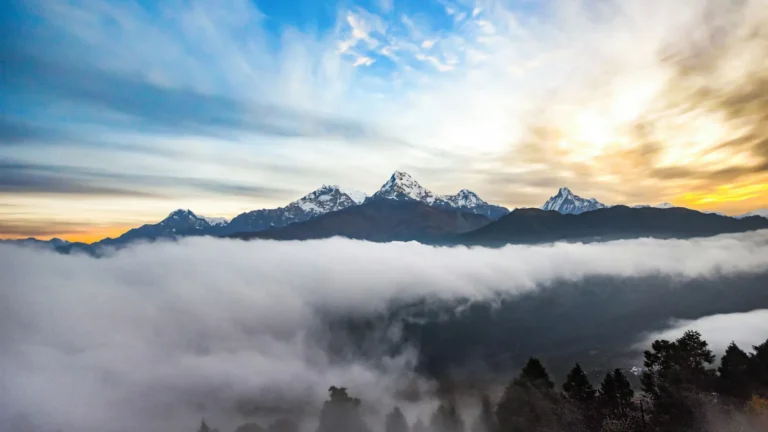
The two sunrises are the point of doing it this way. The first, from Poon Hill on Day 3, is the famous wide view, with Dhaulagiri and the Annapurnas strung out along the horizon. Then, on Day 7, you watch the second from inside the ring itself, with Annapurna I straight above you. So you see the same mountains twice: once from outside, and once from within.
Nothing on the trail is technical. Still, it is long, and the steps around Ulleri and Chhomrong never seem to end. Day 4 crosses two deep river valleys. After that, Day 6 takes you up to sleep at 4,130 m, and Day 7 drops about 1,800 m in one go. Fit beginners manage it well. For what the height does to your body and how to handle it, see our Annapurna Base Camp altitude guide.
The permits are simple, because the whole route lies inside the Annapurna Conservation Area. In fact, Nepal’s revised TIMS rule names this route. The Poon Hill-ABC Trek is on the Nepal Tourism Board’s list of treks where you must walk with a licensed guide (Nepal Tourism Board, retrieved 25 November 2026). Your guide, ACAP permit and TIMS card are included. Plus, you get a porter for every two trekkers and every meal on the trail.
Weighing this up against a straight base camp trek? Our Poon Hill vs Annapurna Base Camp comparison sets the two side by side. And the table under Good To Know lists every Annapurna Base Camp and Poon Hill trip we run.
Trips Highlights
- Watch two sunrises: Dhaulagiri and the Annapurnas from Poon Hill (3,210 m), then Annapurna I from base camp.
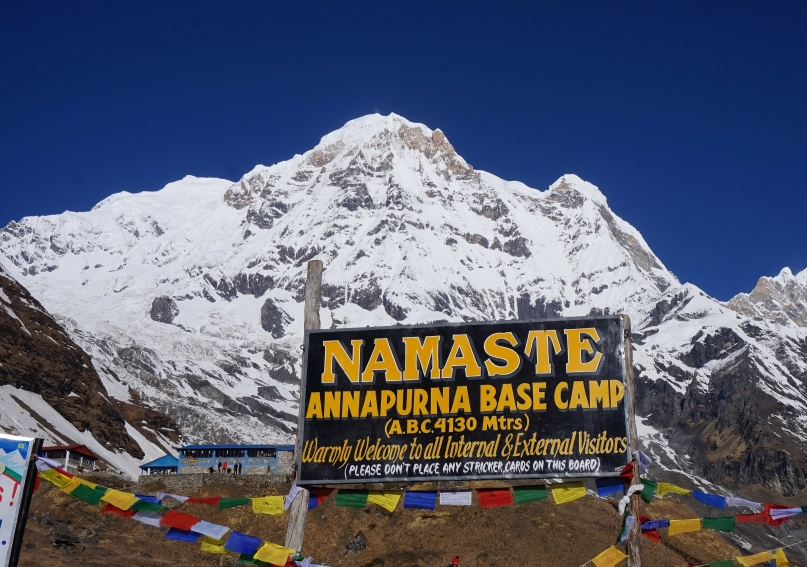
- Sleep at Annapurna Base Camp (4,130 m), in a ring of peaks below the south face of Annapurna I (8,091 m).
- Walk up the Modi Khola gorge through Bamboo, Dovan and Himalaya into the Annapurna Sanctuary.
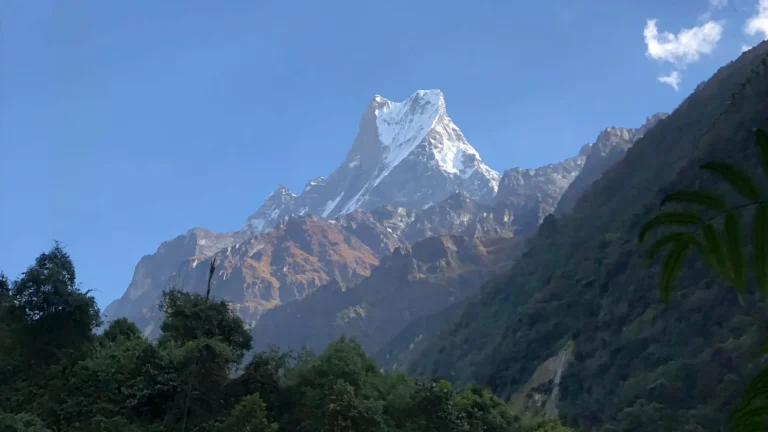
- Stand at Machhapuchhre Base Camp (3,700 m), close under the sacred Fishtail peak (6,993 m).
- Climb the long stone staircase to Ulleri and spend a night on the ridge at Ghorepani (2,874 m).
- See the rhododendron forest around Ghorepani and Tadapani in flower if you come in spring.
- Stop in Chhomrong (2,170 m), the big Gurung village at the mouth of the Sanctuary valley.
- Soak tired legs in the hot spring pools at Jhinu Danda, right beside the Modi Khola.
- Build up gently on the Poon Hill trail before the high section of the trek.
- Begin and end in Pokhara, with a private vehicle at both ends of the trail.
Pokhara (822 m) → drive to Birethanti → Tikhedhunga → Ulleri (2,050 m) → Ghorepani (2,874 m) → Poon Hill (3,210 m) → Tadapani (2,610 m) → Chhomrong (2,170 m) → Sinuwa (2,360 m) → Bamboo → Dovan → Himalaya (2,920 m) → Deurali (3,200 m) → Machhapuchhre Base Camp (3,700 m) → Annapurna Base Camp (4,130 m) → Bamboo (2,310 m) → Chhomrong → Jhinu Danda (1,780 m) → New Bridge → Siwai → drive to Pokhara.
For three days the route follows the Poon Hill trail. Then it turns north at Tadapani and crosses to Chhomrong, where it meets the main trail up the Modi Khola gorge. You walk up the gorge to base camp and come back down the same way as far as Chhomrong. After that you leave the valley through Jhinu Danda, about 89 km on foot in all.
Trips Itinerary
You reach Annapurna Base Camp on Day 6, but this route takes the long way in, over Poon Hill. That is why today’s road runs out to Birethanti instead of up the Modi valley. After breakfast a private vehicle picks you up from your Pokhara hotel. The drive takes about an hour and a half.
Birethanti is a string of shops and lodges just over 1,000 m above sea level. It sits where the Bhurungdi Khola runs into the Modi. Here your guide shows the permits at the checkpoint. Then the first few hours are easy, along the stream and past terraced fields, to lunch at Tikhedhunga.
Tikhedhunga is where the easy walking ends. A bridge crosses the stream below the village, and from there stone steps climb almost without a break to Ulleri (2,050 m), a Magar village spread across the hillside. Count the steps if you like; most people lose track somewhere past a thousand. As you arrive, Annapurna South shows up above the roofs.
- Duration: 1.5 hrs drive, 5 hrs hike
- Max Altitude: 2,050 m
- Meals: Lunch & Dinner
- Accommodation: Guest House
The steps keep going for the first hour. Then they ease off as the trail leaves the last fields of Ulleri behind and goes into the forest. From here it is mostly oak and rhododendron, with tea stops at Banthanti and Nangethanti, where porters rest their loads against the walls.
You reach Ghorepani (2,874 m) in the early afternoon, about 8 km and 900 m of climbing after Ulleri. In season it is a crowded little place: a ridge of lodges with warm dining rooms, and a few shops selling chocolate and spare batteries. So get an early night. The alarm goes off in the dark.
- Duration: 5 to 6 hrs hike
- Max Altitude: 2,874 m
- Meals: Breakfast, Lunch & Dinner
- Accommodation: Guest House
Head torches on, you leave Ghorepani about an hour before dawn. The climb to the top of Poon Hill (3,210 m) is roughly 330 m of steps. Until the sun arrives it is cold up there, so carry your down jacket and gloves even if the walk up makes you sweat.
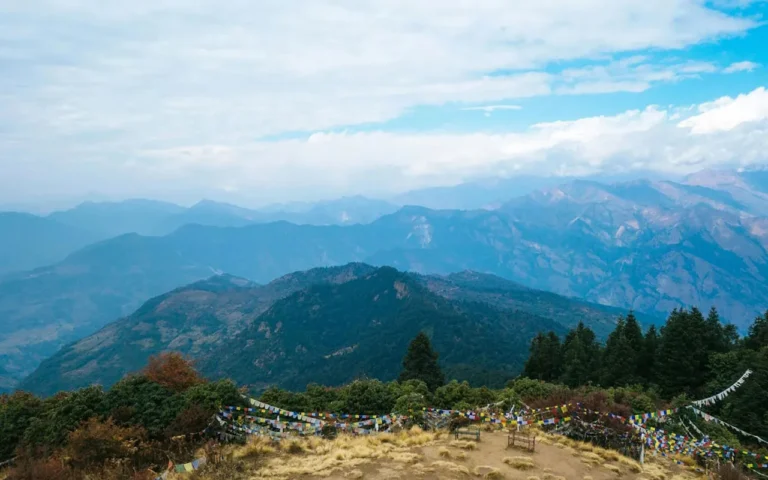
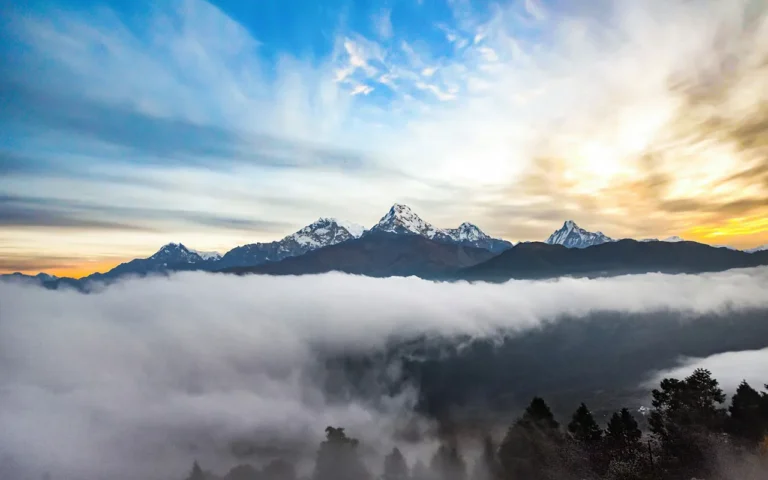
The view runs from Dhaulagiri I (8,167 m) in the west across to Annapurna I (8,091 m), Annapurna South and Machhapuchhre. Now find Hiunchuli and the Fishtail. The narrow gap between them is the gorge that leads into the Annapurna Sanctuary. In two days you will be walking up it.
After breakfast back in Ghorepani, you climb to the Deurali ridge. Then the trail follows it down through rhododendron forest to Tadapani (2,610 m), about 11 km in all once the Poon Hill climb is counted. Here most Poon Hill trekkers go down to Ghandruk and the road. Tomorrow you turn north instead.
- Duration: 6 to 7 hrs hike
- Max Altitude: 3,210 m
- Meals: Breakfast, Lunch & Dinner
- Accommodation: Guest House
Today has two big valleys in it, and you cross both. The trail drops steeply through forest from Tadapani to the Kimrong Khola, then climbs out the other side. After that it follows the hillside round to Chhomrong (2,170 m), the last real village before the Sanctuary.
Chhomrong is a large Gurung village built in steps down a steep slope. At the top of it you can see exactly where you are going. Annapurna South and Hiunchuli fill the head of the valley, and below them is the dark cut of the Modi Khola gorge.
You stop here for lunch. Afterwards the stone stairs begin again, this time going down through the village to a suspension bridge over the Chhomrong Khola. On the far side the path climbs for about an hour to Sinuwa (2,360 m), a small group of lodges on the ridge.
On paper it is only 12.5 km. In practice the steps make it one of the harder days of the trek, with about 850 m of climbing and 1,100 m of descent. So use poles on the long drops to the two rivers.
- Duration: 6 to 7 hrs hike
- Max Altitude: 2,610 m
- Meals: Breakfast, Lunch & Dinner
- Accommodation: Guest House
From Sinuwa the trail dips and then enters the Modi Khola gorge. Here the forest is thick enough to keep you in shade for most of the morning. Bamboo, the first stop, is about an hour away, and it is named after exactly what grows around it.
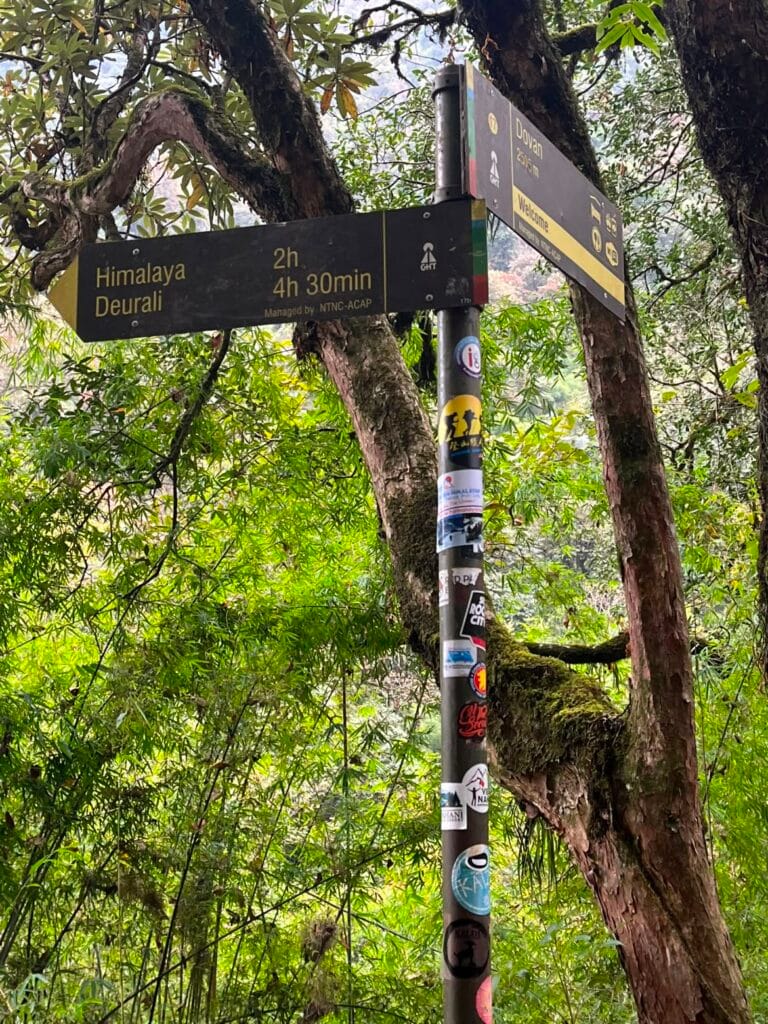
Above Bamboo come Dovan and Himalaya (2,920 m), each just a few lodges beside the river. Next is a big rock overhang known as Hinku Cave. All the way up, the valley keeps narrowing. By early afternoon you are out of the tall trees and among grass, boulders and waterfalls coming off the cliffs.
Deurali (3,200 m) is a cold, tightly packed group of lodges near the head of the gorge. Because you have climbed about 1,000 m today, take the evening easy, drink plenty and eat properly. Tomorrow you sleep higher than at any other point on this trek.
- Duration: 6 to 7 hrs hike
- Max Altitude: 3,200 m
- Meals: Breakfast, Lunch & Dinner
- Accommodation: Guest House
Most groups set off early, and for a good reason. Above Deurali the trail runs under steep slopes that can carry avalanche risk after heavy snowfall. That is mainly a concern in deep winter and during the early spring melt. So your guide checks conditions each morning and holds the group back if the trail is not safe.
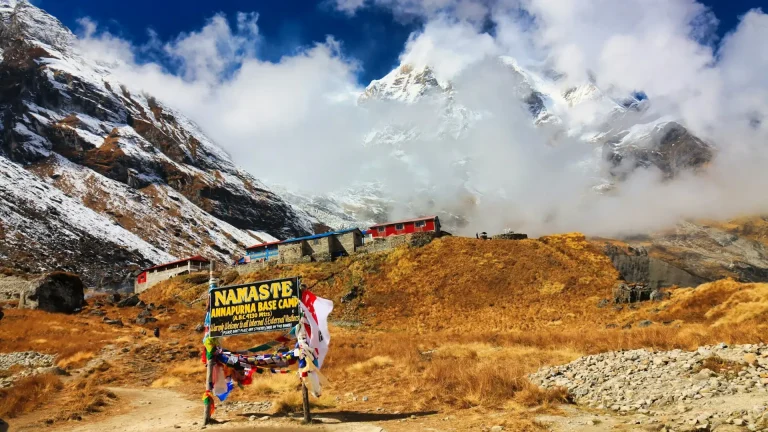
After about two hours the valley opens out at Machhapuchhre Base Camp (3,700 m), right under the mountain. From here it is about 3 km and 430 m of steady climbing up the open valley. At the top is Annapurna Base Camp (4,130 m), on the moraine below the south face of Annapurna I.
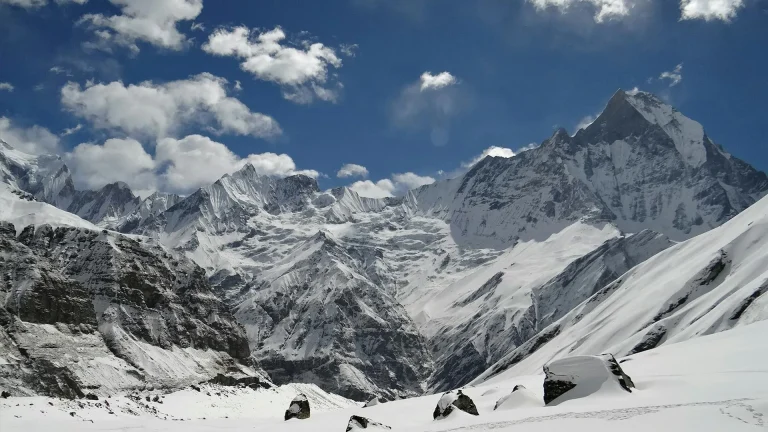
Base camp is a ring of peaks with you at the bottom of it. Annapurna I (8,091 m) fills the north. To the west rise Annapurna South (7,219 m) and Hiunchuli. Meanwhile Machhapuchhre (6,993 m) looks back at you from the east, with Gangapurna and Annapurna III closing the circle.
Tonight you sleep 930 m higher than last night, the biggest single step of the trek. A dull headache is common. Your guide checks your oxygen level and pulse in the evening and again in the morning. And if your symptoms get worse, you go down, which here means a short walk back to Machhapuchhre Base Camp or Deurali.
- Duration: 4 to 5 hrs hike
- Max Altitude: 4,130 m
- Meals: Breakfast, Lunch & Dinner
- Accommodation: Guest House
Get outside before sunrise. The sun comes up behind Machhapuchhre and lights the top of Annapurna I first. For a few minutes the whole south face turns orange while the lodges are still in shadow. It is the tenth highest mountain on earth, and in 1950 it became the first 8,000 m peak anyone climbed.
After breakfast the long way down begins, back past Machhapuchhre Base Camp, Deurali and Himalaya to the forest at Bamboo (2,310 m). It is about 14 km, and you finish the day some 1,800 m lower than you started, the biggest drop of the trek. So take the rocky sections below Deurali steadily.
Bamboo sits in deep forest beside the river. After a night at 4,130 m it feels almost warm. Most people sleep better here than anywhere else on the trek, and appetites come back with a vengeance.
- Duration: 6 to 7 hrs hike
- Max Altitude: 4,130 m
- Meals: Breakfast, Lunch & Dinner
- Accommodation: Guest House
The day starts with a climb, which feels unfair after yesterday. You go back up to Sinuwa, down to the Chhomrong Khola, and up the stone stairs into Chhomrong itself. These are the same steps you came down on Day 4, and nobody enjoys them twice.
From Chhomrong the trail leaves the way you came in. It drops steeply to Jhinu Danda (1,780 m), a cluster of lodges above the Modi Khola. In all it is about 9.5 km, with roughly 500 m of climbing and 1,050 m of descent.
Below the village, a steep path leads down to pools filled by a natural hot spring on the bank of the Modi Khola. It takes about 15 minutes to get there, and a little longer to come back up. After eight days on the trail, an hour in warm water is hard to beat.
- Duration: 5 to 6 hrs hike
- Max Altitude: 2,360 m
- Meals: Breakfast, Lunch & Dinner
- Accommodation: Guest House
The last walk is short and mostly downhill. First you go down to the river at New Bridge, then along the Modi Khola to Siwai, about 7.5 km in two and a half to three hours. Because the second half follows a jeep road, it feels less like a trek and more like a stroll out of the mountains.
At Siwai a private jeep meets you and drives you back to Pokhara, two to three hours depending on the road. So you should be at your hotel by mid-afternoon, with time for a shower that does not cost extra and a meal by the lake.
- Duration: 2.5 to 3 hrs hike, 2 to 3 hrs drive
- Max Altitude: 1,780 m
- Meals: Breakfast & Lunch
Trips Include
What is included: From the moment you leave your Pokhara hotel until you are dropped back, the essentials are covered: transport, eight teahouse nights, every meal on the trek, both permits, a licensed guide and porters. You pay for drinks, teahouse extras, tips and your gear.
- Private vehicle from your Pokhara hotel to Birethanti on Day 1.
- Private jeep from Siwai back to your Pokhara hotel on Day 9.
- Eight nights in teahouses on the trek.
- A rented sleeping bag for the trek, arranged for you in Pokhara.
- All meals on the trek: lunch and dinner on Day 1, three meals a day on Days 2 to 8, and breakfast and lunch on Day 9.
- Safe drinking water using a filter or purification tablets.
- Annapurna Conservation Area Permit (ACAP) and TIMS card.
- A licensed, English-speaking Spade Himalaya guide (a second guide for groups over 7).
- Pulse oximeter checks of your oxygen level and heart rate, twice a day on the high section.
- Porter support, one porter per two trekkers.
- Pay, food, lodging, equipment and insurance for all staff.
- Help arranging a rescue in an emergency, paid for through your travel insurance.
- Spade Himalaya trip-completion certificate.
- All local taxes and office service charges.
Trips Exclude
What is not included: Getting to Pokhara, your hotel there, and anything else outside the nine trek days. Please budget for these as well.
- Transport between Kathmandu and Pokhara.
- Hotels and meals in Pokhara and Kathmandu.
- International flights and airport taxes.
- Nepal entry visa (US$30 for 15 days, US$50 for 30 days, US$125 for 90 days).
- Travel and medical insurance covering trekking to 4,130 m and helicopter evacuation (required).
- Drinks, snacks, hot showers, Wi-Fi and device charging on the trail.
- Extra nights and meals if you finish early, arrive late or change the plan.
- Tips for your guide, porter and driver.
- Personal trekking gear and personal expenses.
- Anything not listed under Cost Includes.
Trips Altitude
Trips Gallery
Packing List
General
- Sleeping bag liner (the sleeping bag itself is included)
- Down jacket for the evenings and the base camp sunrise
- Duffel bag for your porter to carry
- Daypack (25 to 35 litres) with a rain cover
- Two water bottles or a 2-litre bladder
Upper Body
- Warm hat that covers your ears
- Sun hat or cap
- Buff or neck gaiter
- Sunglasses with good UV protection (the snow at base camp is bright)
- Two base-layer tops
- Fleece or wool mid-layer
- Waterproof, windproof shell jacket
Lower Body
- Two pairs of trekking trousers
- Thermal leggings for the high nights
- Waterproof over-trousers
- Comfortable trousers for the evenings
Hands
- Thin liner gloves
- Warm insulated gloves for base camp
Feet
- Broken-in waterproof boots with ankle support
- Four or five pairs of wool trekking socks
- Sandals or flip-flops for the evenings and the hot springs
Undergarments
- Quick-dry underwear
- Sports bras (women)
- Thermal set to sleep in
First Aid Kits
(Your guide carries a first-aid kit and a pulse oximeter, but bring a small kit of your own.)
- Blister plasters and tape
- Painkillers such as paracetamol or ibuprofen
- Rehydration salts
- Any prescription medicine you take
- Altitude medicine such as acetazolamide (Diamox), only on a doctor's advice
- Water purification tablets
Others
- Passport, two passport photos and a copy of your insurance
- Head torch with spare batteries for the Poon Hill and base camp mornings
- Sunscreen (SPF 50) and lip balm
- Swimwear and a quick-dry towel for Jhinu Danda
- Toilet paper and hand sanitiser
- Snacks such as nuts, chocolate and energy bars
- Nepalese rupees in cash for the whole trek
Optional
- Trekking poles (a big help on the Ulleri and Chhomrong stairs)
- Power bank
- Camera and a spare memory card
- Microspikes for snow above Deurali in winter and early spring
- Earplugs for crowded lodges
- A book or cards for the evenings
Good to Know
Before you set off on the Annapurna Base Camp trek via Poon Hill
Three things are worth sorting out before you leave home. Your travel insurance has to cover trekking to 4,130 m and helicopter evacuation, and you should carry a copy. For the permits you need your passport and two passport photos. And because nobody on the trail takes cards, plan to draw enough rupees in Pokhara for nine days of drinks, snacks and charging. Arriving a day early also gives you a buffer if your flight or bus is late.
This route suits people who want Annapurna Base Camp without rushing it. It also suits anyone who would rather warm up on Poon Hill than start straight into the gorge. In particular, it works well for:
- Fit first-timers. Three days on the busy Poon Hill trail are a gentle way to find your trekking legs before the long climb to 4,130 m.
- People who want the classic views and villages. Ghorepani, Chhomrong and Jhinu Danda are all on the way.
- Photographers. You get two sunrises, one wide and one right under the face of Annapurna I.
- Two-week holidays. Add a travel day at each end from Kathmandu and the whole trip takes eleven days.
- Solo travellers. You choose the start date, and the guide is yours alone.
It is the wrong trek if you only have four or five days, which is exactly what our 4-day Ghorepani Poon Hill Trek is for. Skip it, too, if you dislike stairs, since this route has thousands of them, or if you need to stay below 3,500 m. And if you want to start in Kathmandu with fewer days on the trail, look at our Annapurna Base Camp Trek 9 Days instead.
We run five trips that go to Annapurna Base Camp or Poon Hill. They differ in time, in where they start and in how much walking you do.
| Time you have | What you get | Highest point | Choose |
|---|---|---|---|
| 1 day | Annapurna Base Camp by helicopter from Pokhara, no walking | Annapurna Base Camp, 4,130 m | Annapurna Base Camp Helicopter Tour |
| 4 days | The Poon Hill sunrise and Ghandruk, staying low | Poon Hill, 3,210 m | Ghorepani Poon Hill Trek 4 Days |
| 9 days from Kathmandu | The direct route to base camp via Ghandruk, with Kathmandu nights and a flight back | Annapurna Base Camp, 4,130 m | Annapurna Base Camp Trek 9 Days |
| 9 days from Pokhara | Poon Hill first, then the walk up the gorge to base camp | Annapurna Base Camp, 4,130 m | This trek |
| 13 days from Kathmandu | The Mardi Himal ridge and Annapurna Base Camp in one trip | Mardi Himal Base Camp, 4,500 m | Mardi Himal and Annapurna Base Camp Trek 13 Days |
Want both the Poon Hill sunrise and the Sanctuary? Then this is the trek. If you only need one of them, pick the shorter trip that covers it.
Each distance here was measured along the trail as it appears on OpenStreetMap. The climbs and descents come from SRTM satellite elevation data, checked against the altitudes on this page and rounded.
| Day | Route | Distance | Climb | Descent | Walking time |
|---|---|---|---|---|---|
| 1 | Birethanti to Ulleri | 9 km | 1,150 m | 150 m | 5 hrs |
| 2 | Ulleri to Ghorepani | 8 km | 900 m | 100 m | 5 to 6 hrs |
| 3 | Ghorepani to Poon Hill and Tadapani | 11 km | 900 m | 1,150 m | 6 to 7 hrs |
| 4 | Tadapani to Sinuwa via Chhomrong | 12.5 km | 850 m | 1,100 m | 6 to 7 hrs |
| 5 | Sinuwa to Deurali | 10.5 km | 1,000 m | 150 m | 6 to 7 hrs |
| 6 | Deurali to Annapurna Base Camp | 7 km | 1,000 m | 50 m | 4 to 5 hrs |
| 7 | Annapurna Base Camp to Bamboo | 14 km | 150 m | 1,950 m | 6 to 7 hrs |
| 8 | Bamboo to Jhinu Danda | 9.5 km | 500 m | 1,050 m | 5 to 6 hrs |
| 9 | Jhinu Danda to Siwai | 7.5 km | 100 m | 500 m | 2.5 to 3 hrs |
| Total | about 89 km | about 6,550 m | about 6,200 m | 9 walking days |
Your own GPS will probably show a slightly bigger number, since no map records every bend in the path. Walking times assume a steady pace with short breaks. On top of that, Day 9 has a 2 to 3 hour drive from Siwai to Pokhara.
The first half of the trek stays at or below 3,210 m. Meanwhile the nights at Ghorepani (2,874 m) and Tadapani (2,610 m) give your body an easy start. Then the real test comes at the end of Day 6, when you sleep at 4,130 m, about 930 m higher than at Deurali.
Most people feel it a little: a dull headache, a restless night, a racing pulse on the way to the toilet. Twice a day on the high section, your guide checks your oxygen level and heart rate. If your symptoms get worse rather than better, you go down. You can also take the last step more gently. For example, you can sleep at Machhapuchhre Base Camp (3,700 m) and walk up to base camp before dawn on Day 7. That makes Day 7 longer, but the night is easier. Before you go, read our altitude sickness guide.
Spring (March to May) and autumn (September to November) are the main seasons. Autumn usually has the clearest skies. In spring, by contrast, the rhododendron is out around Ghorepani and in the lower gorge. In both seasons days on the lower trail sit around 10 to 20°C, and nights near base camp drop to freezing or below.
| Season | What to expect | Watch out for |
|---|---|---|
| Spring (Mar to May) | Rhododendron in flower, warm days, more haze by May | Afternoon cloud, and snow above Deurali early in the season |
| Autumn (Sep to Nov) | The clearest mountain views of the year | Busy lodges at Deurali and base camp |
| Winter (Dec to Feb) | Quiet trails and sharp, clear mornings | Nights of -10°C or colder at base camp, and avalanche caution after heavy snow |
| Monsoon (Jun to Aug) | Green, empty trails | Rain, leeches in the forest and cloud over the peaks |
Winter is quiet and often clear. However, heavy snow brings avalanche risk to the gorge above Deurali, and the same caution applies during the early spring melt. So your guide checks conditions before the high section, and on a bad day you wait.
This route needs two permits, and we arrange both. The first is the Annapurna Conservation Area Permit, which is NRs. 3,000 per person per entry for foreign nationals (Nepal Tourism Board). The second is a TIMS card, at NPR 2,000, or NPR 1,000 for SAARC nationals (Nepal Tourism Board, both retrieved 25 November 2026).
Since 31 March 2023, Nepal has required a licensed guide and an agency-issued TIMS card on a list of named routes. The Poon Hill-ABC Trek is one of them. All you need to bring is your passport and two passport photos, because your guide carries the permits and shows them at the checkpoints. For the rules in every other region, see our Nepal trekking permits guide.
The lodges change as you go up. Ghorepani, Chhomrong and Jhinu Danda are proper villages, with hot showers and sometimes attached bathrooms. Above Bamboo things get simpler. At Deurali and base camp you share small, cold rooms, and in peak season the dining hall is packed.
The menus are long and much the same all the way up: dal bhat, noodles, fried rice, pasta, potatoes, soups and eggs. As you climb, the prices climb too, because everything above Chhomrong arrives on foot. Still, a plate of dal bhat with a second helping included is the best value on any menu.
Nobody on the trail takes cards, and there is no ATM after Pokhara. So bring rupees for all nine days. Most lodges charge for hot showers, Wi-Fi and charging, and Chhomrong is the last good place to buy snacks, sunscreen or a spare battery.
The trek starts and ends in Pokhara. From Kathmandu it is a 6 to 7 hour drive or a short flight. You can arrange that yourself, or add it to your booking along with Kathmandu nights and airport transfers.
Because the trip is private, the plan can bend. For instance, you can sleep at Machhapuchhre Base Camp instead of base camp, add a rest day in Chhomrong, or stay a second night at Jhinu Danda for the hot springs. Tell us what you have in mind on our customize your trip page.






Trips FAQs
Below are the questions we hear most about this route. They cover how long it is, how hard it is, the altitude at base camp, permits, seasons and the lodges. Anything missing? Then send us your question, and our Kathmandu team will reply.
Route & Itinerary
Yes, and this trek does exactly that. You walk the Poon Hill loop as far as Tadapani, then cross to Chhomrong and join the main trail up the Modi Khola gorge to base camp. So the two link up on foot, with no backtracking and no drive in the middle.
Nine days from Pokhara, as planned here. That is three days to Poon Hill and Tadapani, three more up to base camp, and three to walk out. If you are coming from Kathmandu, add a day each way. And a tenth day, for a rest in Chhomrong or a second night at Jhinu Danda, makes the whole trip more relaxed.
About 89 km on foot over nine days, measured along the trail on OpenStreetMap. The Poon Hill section as far as Tadapani is about 28 km. The rest, up to base camp and out to Siwai, is about 61 km. In all, the longest day is the walk down from base camp to Bamboo, at about 14 km.
It starts in Pokhara with a 1.5-hour drive to Birethanti. At the other end it finishes at Siwai, where a private jeep takes you back to Pokhara in 2 to 3 hours. Both transfers are included in the price.
Difficulty & Altitude
It is Grade 2, Moderate, on the Spade Himalaya Trek Difficulty Scale. Nothing is technical, but the trek is long and full of stone steps. Three days stand out. Day 4 has about 850 m up and 1,100 m down, Day 6 climbs to 4,130 m, and Day 7 drops about 1,800 m. So a few weeks of hill walking or stair training before you come makes a real difference.
Not really harder, just longer. The Poon Hill section adds three days and a lot more stairs, but it also gives your body time to adjust before the gorge. So by the time you reach the high section above Deurali, you have already had several days of practice on the steps.
Yes, if you are fit and give yourself time to train. The first three days on the Poon Hill trail are busy and gentle, which makes them a good introduction. After that the days get longer and higher. So it suits fit beginners far better than people who have never walked for more than a few hours.
Annapurna Base Camp is at 4,130 m (13,550 ft), and on this trek you sleep there on night 6. Before it comes Machhapuchhre Base Camp, at 3,700 m (12,139 ft). On the Poon Hill side, the highest point is Poon Hill itself, at 3,210 m (10,531 ft).
Mild symptoms such as a headache or poor sleep are common at Deurali and base camp, so expect to feel the height. However, serious altitude sickness is less common on a plan that builds up through Ghorepani and the gorge. It is still possible, mainly on the night at 4,130 m. So walk slowly, drink plenty and tell your guide about symptoms early. For a gentler last step, you can sleep at Machhapuchhre Base Camp instead.
Permits, Guide & Insurance
Yes. The Nepal Tourism Board lists the Poon Hill-ABC Trek by name among the routes that need a licensed guide and an agency-issued TIMS card (Nepal Tourism Board, retrieved 25 November 2026). You also need the ACAP permit (NRs. 3,000) and the TIMS card itself (NPR 2,000). Both permits and your guide are included in this package.
Take a policy that covers trekking to at least 4,130 m and helicopter evacuation. In the Sanctuary, a serious problem usually means flying out. Read the altitude limit in the small print, because many policies stop lower or leave out trekking. And keep your policy details handy, as your guide will need them on the trail.
Best Time & Safety
October and November give the clearest views. In spring, from March to May, the rhododendrons come into flower. In both seasons the days on the lower trail are mild and the nights near base camp are freezing. December to February works too if you do not mind the cold, with avalanche caution after heavy snow.
Yes, in some conditions. The gorge above Deurali can carry avalanche risk after heavy snowfall, mainly in deep winter and during the early spring melt. So guides watch conditions closely and wait when the risk is high. Outside those times the risk is low.
Views & Highlights
From Poon Hill you see Dhaulagiri I (8,167 m), Annapurna I (8,091 m), Annapurna South (7,219 m), Hiunchuli and Machhapuchhre (6,993 m). At base camp, Annapurna I is straight above you. Around the ring you also see Annapurna South, Hiunchuli, Gangapurna, Annapurna III and Machhapuchhre.
They are two groups of lodges about 3 km apart in the same valley. Machhapuchhre Base Camp (3,700 m) sits right under Machhapuchhre, the Fishtail, which is sacred and has never been climbed. Annapurna Base Camp (4,130 m) is higher. It lies at the foot of the south face of Annapurna I and gives you the full ring of the Sanctuary. This trek visits both.
Teahouses & Practical Questions
Yes, at Jhinu Danda, where you stay on Day 8. The pools are fed by a natural hot spring beside the Modi Khola, about 15 minutes below the lodges on a steep path. So bring swimwear and a towel.
Basic and busy. Rooms at Deurali, Machhapuchhre Base Camp and Annapurna Base Camp are small, unheated and usually shared, and the dining hall is the only warm room. Lower down, in Ghorepani, Chhomrong and Jhinu Danda, the lodges are more comfortable, and some have hot showers.
Yes. We only run private departures. So travelling alone simply means you walk with your own licensed guide, on your dates, at the one-person rate in the price table. Want to bring the cost down? Then ask us about sharing with another guest on similar dates. We only pair people when both of them agree.