Trip Facts
Country:
Nepal
Duration:
8 Days
Max Altitude:
4,500 m
Activities:
Trekking and driving
Region:
Annapurna region
Starting Point:
Pokhara
Ending Point:
Pokhara
Grade:
Moderate
Group Size:
Min 1
Accomodation:
Teahouses on the trek (7 nights)
Best Season:
Mar-May & Sep-Nov
Notice
This trek joins two of the Annapurna region’s favourite treks in 8 days, starting and ending in Pokhara. First you watch sunrise from Poon Hill (3,210 m) on Day 3. Then you reach Mardi Himal Base Camp (4,500 m) on Day 7.
Two days are hard. Day 5 climbs about 1,450 m from Landruk to Low Camp. Then Day 7 is a pre-dawn start to base camp and back down to Badal Danda, roughly 14 km in all.
Nepal’s guide rule covers both Poon Hill and Mardi Himal, so a licensed guide is required. Your guide, porter, ACAP permit and TIMS card are included. But travel insurance that covers 4,500 m is not.
Overview of Mardi Himal and Poon Hill Trek 8 Days
Quick answer: The Mardi Himal and Poon Hill trek is an 8-day trek from Pokhara. It links the Poon Hill sunrise (3,210 m) with Mardi Himal Base Camp (4,500 m). You walk about 69 km, sleep in teahouses, and never sleep higher than 3,580 m. It is Grade 2, Moderate, on the Spade Himalaya Trek Difficulty Scale. Spade Himalaya, which organises treks and tours across Nepal from Kathmandu, runs it privately with a licensed guide.
Most people who come to Pokhara for a week pick one trek or the other. This route, often called the Mardi Himal trek via Poon Hill, gives you both, in the order that works best. First come three days on the Poon Hill side. You climb the stone staircase to Ulleri, walk the rhododendron forest around Ghorepani, and watch the famous sunrise. Then you cross through the Gurung villages of Ghandruk and Landruk to the Mardi ridge. Here the trail is quieter and higher, and it takes you much closer to the mountains.
Doing Poon Hill first also helps with the altitude. By the time you reach the Mardi ridge, you have slept two nights above 2,600 m. You have also stood on Poon Hill, at 3,210 m. Then your highest night is High Camp, at 3,580 m. Base camp is a day visit. So you climb to 4,500 m and come back down the same day to sleep at Badal Danda, at 3,250 m.
The trek is hard in places, but not because of technical ground. There is none. Instead, it has two big days. Day 5 climbs about 1,450 m from Landruk to Low Camp in roughly 7 km. Then Day 7 reaches base camp and drops about 1,300 m back to Badal Danda. So fit beginners who train for a few weeks manage it well. Our Mardi Himal trek difficulty guide explains how to prepare.
Both halves of the trek sit inside the Annapurna Conservation Area. Nepal’s revised TIMS rule has been in force since 31 March 2023. It names both the Poon Hill and Mardi Himal treks as routes that need a licensed guide (Nepal Tourism Board, retrieved 25 November 2026). So your guide, your ACAP permit and your TIMS card are all part of this package. Plus, porter support and every meal on the trail are included.
Eight days is enough to fit the whole Poon Hill loop and the Mardi ridge into one trek. That is why we built this one. Still deciding between the two treks instead? Our Mardi Himal vs Poon Hill comparison puts them side by side. Also, the table under Good To Know shows every Mardi and Poon Hill trip we run.
Trips Highlights
- Watch the sunrise reach Dhaulagiri I (8,167 m) and Annapurna I (8,091 m) from Poon Hill (3,210 m).
- Walk the Mardi Himal ridge to base camp at 4,500 m, right under Machhapuchhre (6,993 m).
- Climb the long stone staircase to Ulleri and sleep in the ridge village of Ghorepani (2,874 m).
- Walk through rhododendron forest, Nepal's national flower, between Ghorepani and Tadapani.
- Explore Ghandruk, a large Gurung village of stone houses with its own small museum.
- Cross the Modi Khola to Landruk and climb into the quiet forest of the Mardi ridge.
- Watch sunset light on Annapurna South and Hiunchuli from High Camp (3,580 m).
- See two classic Annapurna treks in one trip, with no backtracking between them.
- Never sleep higher than 3,580 m, because base camp is a day visit from High Camp.
- Start and finish in Pokhara, with your guide, porter, permits and trail meals arranged.
Pokhara (822 m) → drive to Birethanti → Tikhedhunga → Ulleri (2,050 m) → Ghorepani (2,874 m) → Poon Hill (3,210 m) → Tadapani (2,610 m) → Ghandruk (1,940 m) → Landruk (1,565 m) → Forest Camp → Low Camp (2,970 m) → Badal Danda (3,250 m) → High Camp (3,580 m) → Mardi Himal Base Camp (4,500 m) → Badal Danda → Siding (1,750 m) → drive to Pokhara.
In short, you walk the Poon Hill loop first, with the sunrise on Day 3. Then you cross the Modi Khola at Landruk and climb the Mardi Himal ridge to base camp. After that, you come down to Siding and drive back to Pokhara, about 69 km on foot in all.
Trips Itinerary
Your trek starts on the Poon Hill side of the Annapurna foothills and ends on the Mardi Himal ridge. So today the road heads north-west out of Pokhara. First, a private vehicle collects you from your hotel after breakfast. Then, about 1.5 hours later, you reach Birethanti, where your guide shows your permits at the checkpoint.
Birethanti sits at just over 1,000 m beside the river. Here the trail turns up the Bhurungdi Khola, past rice terraces and small tea shops, to Hile and Tikhedhunga. Lunch is usually in Tikhedhunga. So eat well there, because the hardest hour of the day comes straight after it.
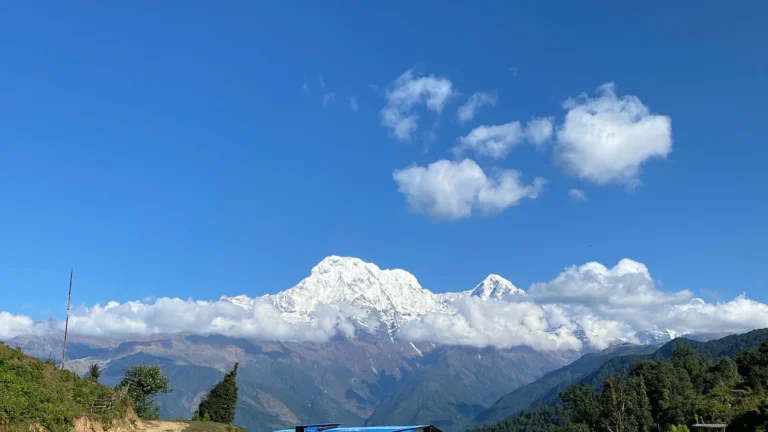
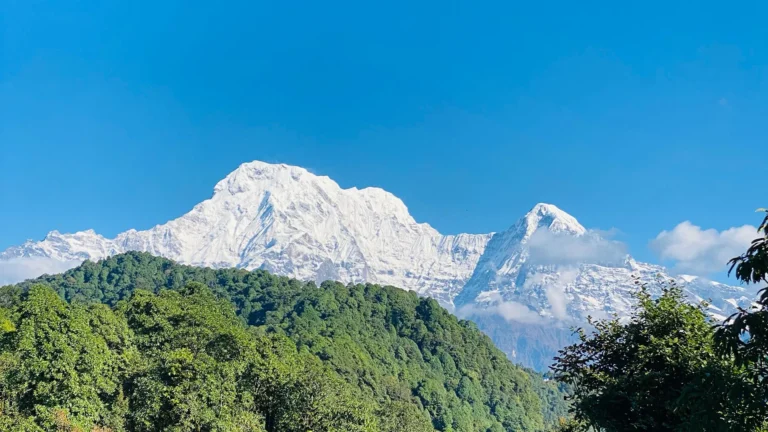
After Tikhedhunga, a stone staircase climbs the hillside to Ulleri (2,050 m), a Magar village of slate-roofed houses. The steps run into the thousands, so set a slow, steady rhythm and let the mule trains pass. Then from the lodge you see Annapurna South and Hiunchuli for the first time, after about 9 km on foot.
- Duration: 1.5 hrs drive, 5 hrs hike
- Max Altitude: 2,050 m
- Meals: Lunch & Dinner
- Accommodation: Guest House
Today the climb is gentler than the staircase, and most of it is in the shade. Above Ulleri the terraces end, and you walk into a forest of oak and rhododendron. On the way you stop for tea at Banthanti and again at Nangethanti. And if you come in March or April, the rhododendron, Nepal’s national flower, is in bloom all the way up.
Ghorepani (2,874 m) comes into view in the early afternoon, after about 8 km and roughly 900 m of climbing. It is the biggest lodge village on this side of the trek. Here you find bakeries, small shops and dining rooms warmed by stoves. So eat early and sleep early, because tomorrow starts in the dark.
- Duration: 5 to 6 hrs hike
- Max Altitude: 2,874 m
- Meals: Breakfast, Lunch & Dinner
- Accommodation: Guest House
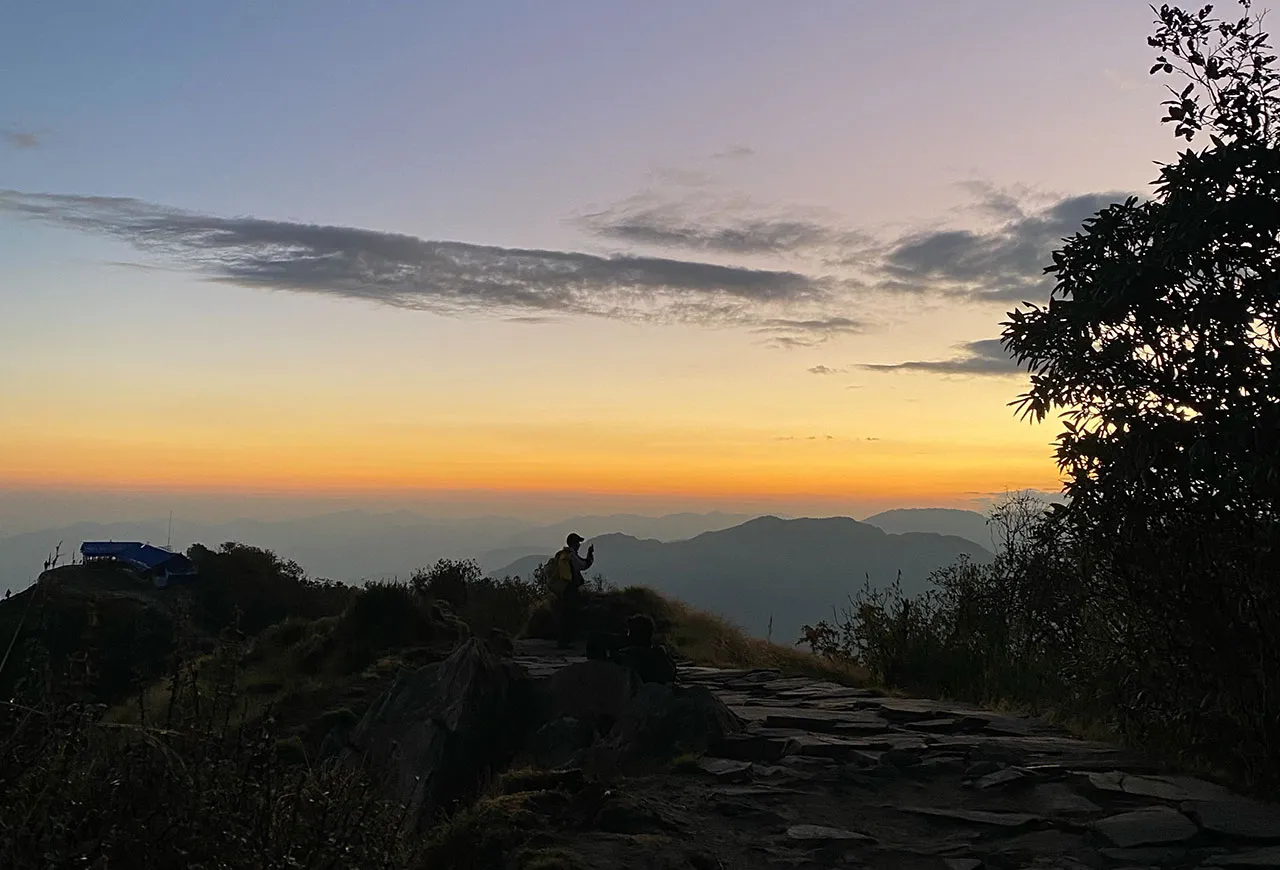
First, you leave Ghorepani about an hour before sunrise, with a head torch and every warm layer you own. The stepped path to Poon Hill (3,210 m) gains about 330 m, and there is a viewing tower at the top. Also expect a crowd in season, because almost everyone sleeping in Ghorepani makes the same climb.
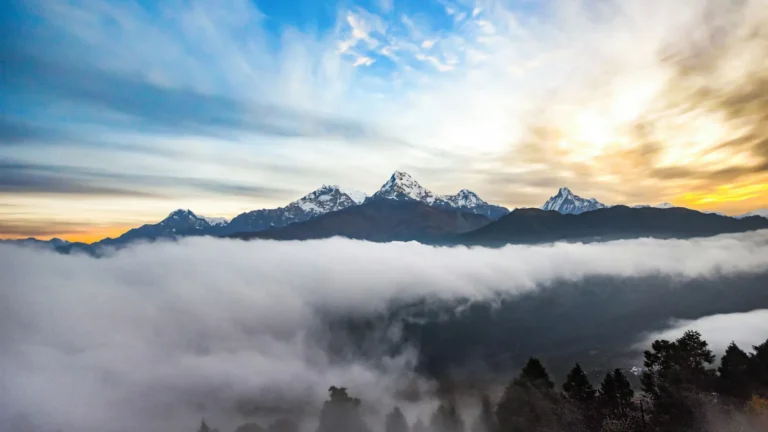
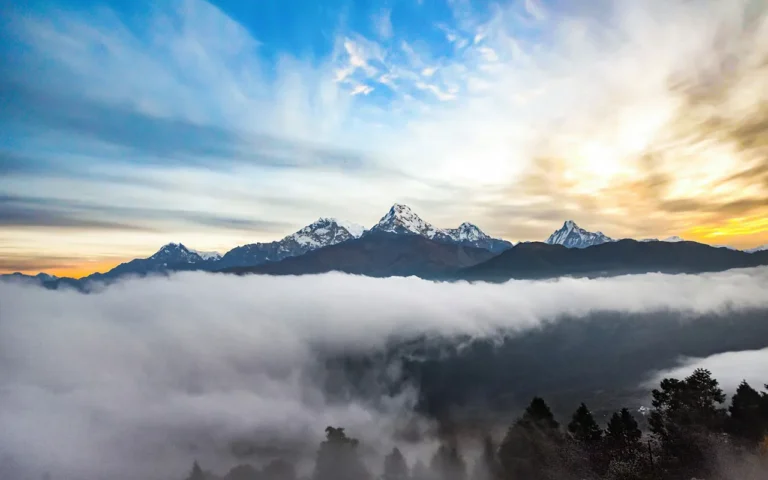
As the sky gets light, the sun reaches Dhaulagiri I (8,167 m) and Annapurna I (8,091 m) first. Then it moves along to Annapurna South, Hiunchuli and the sharp tip of Machhapuchhre. That is two of the world’s fourteen 8,000 m peaks from one hilltop. In Nepali the hill is Pun Danda, named after the Pun Magar families of these villages.
After breakfast back in Ghorepani, the trail climbs to the ridge top at Deurali. Then it heads east through thick rhododendron forest towards Tadapani. Most of the afternoon is downhill. But the path can be muddy where streams cross it, so take your time on the wet stones.
Tadapani (2,610 m) is a small group of lodges in a forest clearing. It sits about 11 km from Ghorepani, once you count the Poon Hill climb, and its name means far water in Nepali. When the evening is clear, Machhapuchhre and Annapurna South fill the view from the dining room, so keep your camera close.
- Duration: 6 to 7 hrs hike
- Max Altitude: 3,210 m
- Meals: Breakfast, Lunch & Dinner
- Accommodation: Guest House
The morning is a long walk down. First the trail drops through forest, then through terraced fields. After two to three hours you reach Ghandruk (1,940 m), a large Gurung village whose paved lanes, stone houses and slate roofs climb the hillside in rows. Also, many households here have a long tradition of Gurkha service.
So take an hour in the village before lunch. The small Gurung museum keeps old farm tools, clothes and kitchen pots. And from the upper lanes, Annapurna South rises straight above the rooftops. It is also a good place to rest your knees, because the afternoon still has one steep section in it.
After lunch the path drops steeply to a suspension bridge over the Modi Khola, the river that drains the Annapurna Sanctuary. Then it climbs steadily to Landruk (1,565 m), a quieter Gurung village that faces Ghandruk across the valley. In all you have walked about 10 km today, most of it downhill.
- Duration: 5 to 6 hrs hike
- Max Altitude: 2,610 m
- Meals: Breakfast, Lunch & Dinner
- Accommodation: Guest House
This is the hardest climbing day of the trek, so you start early and keep a slow, steady pace. Above Landruk the trail leaves the fields for dense forest. Then it climbs about 1,450 m in roughly 7 km. So fill your water bottles and carry snacks, because most of the day is spent under the trees.
Once you reach Forest Camp, you are on the main Mardi Himal trail, and most groups stop here for lunch. The lodges sit among the trees with no mountain view. Above them the forest stays thick, its branches hung with moss and pale lichen. After lunch the last stretch feels long, so keep the breaks short.
Low Camp (2,970 m) sits where the trees begin to thin out. And on a clear afternoon, Machhapuchhre appears directly above it. You arrive tired, and a climb this big in one day can bring a mild headache. So drink plenty of water and eat a full dinner. Best of all, tomorrow is a short day.
- Duration: 7 to 8 hrs hike
- Max Altitude: 2,970 m
- Meals: Breakfast, Lunch & Dinner
- Accommodation: Guest House
Today is short on purpose, about 4 km with roughly 650 m of climbing, so your body has time to adjust. On the way you pass Badal Danda (3,250 m), whose name means cloud ridge. Here the forest gives way to rhododendron scrub and grass. Then the ridge narrows, and the views open up on both sides.
You reach High Camp (3,580 m) around lunchtime, with the afternoon free to rest. No lodge on this trek sits higher. Rooms are small and cold. Also, the menu is shorter than lower down, since every sack of rice and gas bottle is carried up the ridge. Then at sunset, walk a few minutes above the camp to watch Annapurna South and Hiunchuli turn gold.
- Duration: 4 to 5 hrs hike
- Max Altitude: 3,580 m
- Meals: Breakfast, Lunch & Dinner
- Accommodation: Guest House
This is the big day. You leave High Camp at about 5 in the morning, wrapped up warm with head torches on. Then you follow the open ridge as it climbs. Parts of the path are steep, with long drops on both sides. So your guide keeps the group close and checks how everyone feels.
After roughly 2 to 3 hours you reach the upper viewpoint, at around 4,200 m, where many trekkers turn back. Here the trail carries on for about another hour over rough ground to Mardi Himal Base Camp (4,500 m). In winter, snow can cover this last section, and your guide decides on the day how far it is safe to go.
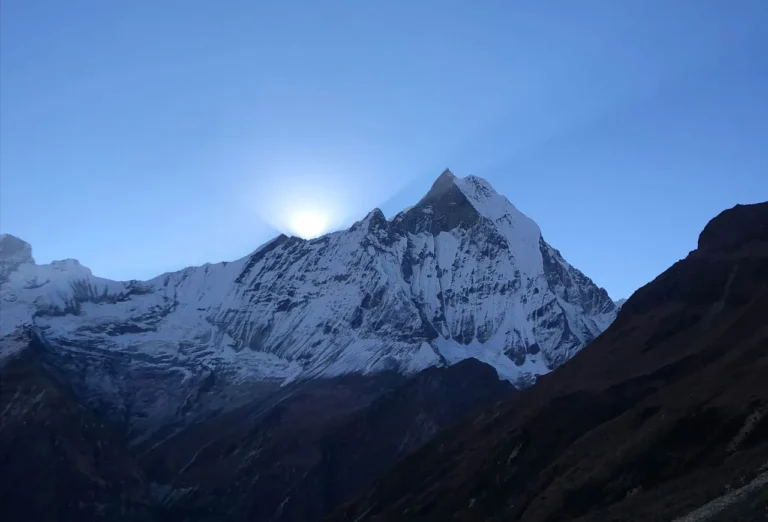
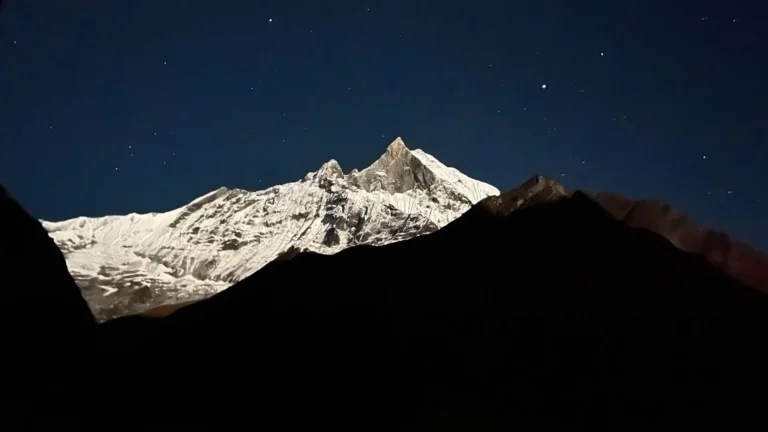
At base camp you stand right under Machhapuchhre (6,993 m), with Mardi Himal (5,587 m) beside it. Across the valley rise Annapurna South and Hiunchuli. Local people hold Machhapuchhre sacred to Shiva, and it stays closed to climbing. So its summit is still untouched, which is rare for a Himalayan peak this famous.
After your photos, you walk back down the same ridge, past High Camp, to Badal Danda (3,250 m) for the night. In all you climb about 950 m and come down about 1,300 m today, over roughly 14 km. Also, sleeping lower than High Camp helps tired legs and heads recover.
- Duration: 7 to 8 hrs hike
- Max Altitude: 4,500 m
- Meals: Breakfast, Lunch & Dinner
- Accommodation: Guest House
The last day is downhill all the way. First you walk back to Low Camp from Badal Danda. Then a steep forest trail drops east towards the Mardi Khola valley, losing about 1,500 m in roughly 5.5 km. Trekking poles make a real difference here, so use them, and go slowly on the steepest steps.
You reach Siding (1,750 m), a farming village above the Mardi Khola, around lunchtime. After lunch a private jeep follows the bumpy valley road out to Pokhara, about 2 to 3 hours away. You are back at your Pokhara hotel by late afternoon, where the trek ends.
- Duration: 5 to 6 hrs hike, 2 to 3 hrs drive
- Max Altitude: 3,250 m
- Meals: Breakfast & Lunch
Trips Include
What is included: Your package covers both road transfers and every night on the trail with all meals. It also covers your permits, a licensed guide and porter support. So the only costs left are drinks, teahouse extras, tips and your own gear.
- Private vehicle from your Pokhara hotel to Birethanti on Day 1.
- Private jeep from Siding back to your Pokhara hotel on Day 8.
- Seven nights in teahouses on the trek.
- A rented sleeping bag for the trek, arranged for you in Pokhara.
- All meals on the trek: lunch and dinner on Day 1, three meals a day on Days 2 to 7, and breakfast and lunch on Day 8.
- Safe drinking water using a filter or purification tablets.
- Annapurna Conservation Area Permit (ACAP) and TIMS card.
- A licensed, English-speaking Spade Himalaya guide who carries a first-aid kit and checks your health each day (a second guide for groups over 7).
- Porter support, one porter per two trekkers.
- Pay, food, lodging, equipment and insurance for all staff.
- Help arranging a rescue in an emergency, paid for through your travel insurance.
- Spade Himalaya trip-completion certificate.
- All local taxes and office service charges.
Trips Exclude
What is not included: This trek starts and ends in Pokhara. So anything before Day 1 or after Day 8 sits outside the package. Please budget for these too.
- Transport between Kathmandu and Pokhara.
- Hotels and meals in Pokhara and Kathmandu.
- International flights and airport taxes.
- Nepal entry visa (US$30 for 15 days, US$50 for 30 days, US$125 for 90 days).
- Travel and medical insurance that covers trekking to 4,500 m and helicopter evacuation (this is a must).
- Drinks, snacks, hot showers, Wi-Fi and device charging on the trail.
- Extra nights and meals if you finish early, arrive late or change the plan.
- Tips for your guide, porter and driver.
- Personal trekking gear and personal expenses.
- Anything not listed under Cost Includes.
Trips Altitude
Trips Gallery
Packing List
General
- Sleeping bag liner (the sleeping bag itself is included)
- Down jacket for the evenings and the base camp morning
- Duffel bag for your porter to carry
- Daypack (25 to 35 litres) with a rain cover
- Water bottles holding 2 litres in total
Upper Body
- Warm hat that covers the ears
- Sun hat or cap
- Buff or neck gaiter
- Sunglasses with UV protection
- Base-layer tops (2)
- Fleece or wool mid-layer
- Waterproof, windproof shell jacket
Lower Body
- Trekking trousers (2 pairs)
- Thermal leggings for cold nights
- Waterproof over-trousers
- Comfortable trousers for the teahouse evenings
Hands
- Light liner gloves
- Warm insulated gloves for the base camp morning
Feet
- Waterproof trekking boots with ankle support, well broken in
- Wool trekking socks (4 to 5 pairs)
- Sandals or light shoes for the evenings
Undergarments
- Quick-dry underwear
- Sports bras (women)
- Thermal underwear set for sleeping
First Aid Kits
(Your guide carries a first-aid kit, but a small personal kit helps too.)
- Blister plasters and tape
- Painkillers such as paracetamol or ibuprofen
- Rehydration salts
- Any prescription medicine you take
- Altitude medicine such as acetazolamide (Diamox), only on a doctor's advice
- Water purification tablets
Others
- Passport, two passport photos and a copy of your insurance
- Head torch with spare batteries, for the Poon Hill and base camp starts
- Sunscreen (SPF 50) and lip balm
- Toilet paper, hand sanitiser and a small towel
- Snacks such as nuts, chocolate and energy bars
- Cash in Nepalese rupees from Pokhara
Optional
- Trekking poles (very useful on the Ulleri steps and the Siding descent)
- Power bank
- Camera and a spare memory card
- Microspikes for snow on the upper ridge in winter
- Earplugs for thin teahouse walls
- A book or cards for the evenings
Good to Know
Before you go on the Mardi Himal and Poon Hill trek
You need four things sorted before Day 1. First, reach Pokhara the day before, so you start rested. Then bring your passport and two passport photos for the permits. Also carry enough Nepalese rupees for drinks, snacks, showers and charging, because there are no ATMs on the trail. Finally, check that your travel insurance covers trekking to 4,500 m and helicopter evacuation.
This trek is built for people who want both Poon Hill and Mardi Himal in one trip. It needs about 8 days from Pokhara. So it suits:
- First-time trekkers who want a real mountain finish. The first three days are gentle and well-trodden, so you build fitness before the Mardi ridge.
- Photographers. You get the wide Poon Hill sunrise and then the close-up Machhapuchhre views from the ridge, two very different kinds of mountain light.
- Anyone curious about village life. Ulleri, Ghorepani, Ghandruk and Landruk are lived-in Magar and Gurung villages, not just lodge stops.
- Trekkers with one to two weeks of leave. With a day each way between Kathmandu and Pokhara, it fits into about ten days.
- Solo travellers. Every departure is private, so you walk with your own guide on your own dates.
This is the wrong trip if you want to stay below 3,500 m all the way. In that case the 4-day Ghorepani Poon Hill Trek is the better fit. Also, skip it if long, steep descents hurt your knees, because Days 4, 7 and 8 each drop over 1,000 m. And if you only have five days, the Short Mardi Himal Trek gives you the ridge without the Poon Hill loop.
We run five trips on these two trails. They differ in length and in how much of each trail you see. So pick the one that fits the time you have.
| Time you have | What you get | Highest point | Choose |
|---|---|---|---|
| 4 days | Poon Hill sunrise, Ghorepani and Ghandruk, low altitude | Poon Hill, 3,210 m | Ghorepani Poon Hill Trek 4 Days |
| 5 days | The Mardi ridge only, fast, from Pokhara | Mardi Himal Base Camp, 4,500 m | Short Mardi Himal Trek 5 Days |
| 8 days | Poon Hill sunrise, Gurung villages and the Mardi ridge in one trek | Mardi Himal Base Camp, 4,500 m | This trek |
| 10 days | The Mardi ridge at a gentler pace, with Kathmandu and Pokhara nights | Mardi Himal Base Camp, 4,500 m | Mardi Himal Trek 10 Days |
| 13 days | The Mardi ridge plus Annapurna Base Camp | Mardi Himal Base Camp, 4,500 m | Mardi Himal and Annapurna Base Camp Trek 13 Days |
In short, choose this trek if you want Poon Hill and the Mardi ridge in one go. But choose a shorter one if you would rather do one of them well.
Here is how the eight days add up. First, we measured each day along the trail as it is mapped on OpenStreetMap. Then we read the climbs from SRTM satellite elevation data and rounded them.
| Day | Route | Distance | Climb | Descent | Walking time |
|---|---|---|---|---|---|
| 1 | Birethanti to Ulleri | 9 km | 1,150 m | 150 m | 5 hrs |
| 2 | Ulleri to Ghorepani | 8 km | 900 m | 100 m | 5 to 6 hrs |
| 3 | Ghorepani to Poon Hill and Tadapani | 11 km | 900 m | 1,150 m | 6 to 7 hrs |
| 4 | Tadapani to Landruk via Ghandruk | 10 km | 400 m | 1,450 m | 5 to 6 hrs |
| 5 | Landruk to Low Camp via Forest Camp | 7 km | 1,450 m | 50 m | 7 to 8 hrs |
| 6 | Low Camp to High Camp via Badal Danda | 4 km | 650 m | 50 m | 4 to 5 hrs |
| 7 | High Camp to Mardi Himal Base Camp and Badal Danda | 14.5 km | 950 m | 1,300 m | 7 to 8 hrs |
| 8 | Badal Danda to Siding | 5.5 km | 50 m | 1,500 m | 5 to 6 hrs |
| Total | about 69 km | about 6,450 m | about 5,750 m | 8 walking days |
A GPS watch usually reads a little more, because no map catches every zigzag. The walking times are for a steady pace without long stops. Also, on Day 8, add 2 to 3 hours for the jeep from Siding to Pokhara.
Altitude is the one real risk on this trek, so the plan is built around it. First you sleep at Ghorepani (2,874 m) and Tadapani (2,610 m), and you climb Poon Hill (3,210 m). Only then do you reach the Mardi ridge. Then your highest night is High Camp, at 3,580 m, and base camp at 4,500 m is a day visit. So you climb high and sleep lower, which is the safest way to visit altitude.
Still, mild headaches and poor sleep are common above 3,000 m. So walk slowly, drink 3 to 4 litres of water a day, and tell your guide about any symptoms early. Also, your guide checks how you feel every day. And if a headache gets worse, or you feel sick, very tired or breathless at rest, you go down. Some trekkers take acetazolamide (Diamox), but only on a doctor’s advice. For the warning signs, read our altitude sickness guide.
The best months are March to May and September to November. October and November usually give the clearest skies. In March and April the rhododendron forests flower around Ghorepani and on the Mardi ridge. December to February works too, with clear, cold days, but snow can block the last stretch to base camp. Then June to August is the monsoon. The trails are wet, leeches are common in the forest, and cloud often hides the peaks.
| Season | Poon Hill: day / dawn | Mardi ridge: day / High Camp night |
|---|---|---|
| Spring (Mar to May) | 14 to 22°C / 2 to 8°C | 12 to 20°C / -5 to -10°C |
| Autumn (Sep to Nov) | 12 to 20°C / 0 to 6°C | 10 to 18°C / -7 to -12°C |
| Winter (Dec to Feb) | 8 to 16°C / -5 to 2°C | 4 to 12°C / -12 to -18°C |
| Monsoon (Jun to Aug) | 16 to 24°C / 6 to 12°C | 15 to 22°C / -2 to -6°C |
These are typical ranges, not forecasts. In every season, nights at High Camp are the coldest of the trek. So we include a rented sleeping bag, and a liner of your own adds a little extra warmth.
You need two permits, and both are included. The Annapurna Conservation Area Permit (ACAP) costs NRs. 3,000 per person per entry for foreign nationals (Nepal Tourism Board). The TIMS card costs NPR 2,000, or NPR 1,000 for SAARC nationals (Nepal Tourism Board, both retrieved 25 November 2026).
Nepal’s revised TIMS rule has applied since 31 March 2023. It lists both the Poon Hill and Mardi Himal treks as routes where you must walk with a licensed guide and carry a TIMS card issued through an agency. So Spade Himalaya arranges both for you. Then just bring your passport and two passport photos, and your guide shows the permits at each checkpoint. For every region’s rules in one place, see our Nepal trekking permits guide.
You sleep in family-run teahouses every night, usually in twin rooms with thin walls. Lower down, some lodges have attached bathrooms and hot showers. But at Low Camp and High Camp the rooms are basic and unheated. There the only warm place is the dining room stove.
The food is simple and filling. Dal bhat, rice with lentils and vegetables, is the best value and usually comes with a free refill. Also, menus carry noodles, soups, pasta, potatoes and eggs.
Bring cash for the whole trek. There are no ATMs on the trail, so take out Nepalese rupees in Pokhara before you start. Also, most lodges charge for hot showers, Wi-Fi and phone charging, and prices rise the higher you go. So a power bank saves both money and worry.
This trek starts and ends in Pokhara, so plan to arrive the day before. From Kathmandu it is a 6 to 7 hour drive or a short domestic flight. Transport between Kathmandu and Pokhara is not included, and neither is your Pokhara hotel. But we can add both, along with Kathmandu nights and airport transfers.
Because every departure is private, the plan can bend too. For example, a night at Forest Camp splits the long climb on Day 5 and makes the trek 9 days. In winter, a spare day gives the weather a second chance at base camp. So tell us what you need through our customize your trip page.






Trips FAQs
These answers cover what trekkers ask us most often about this trek: the route and distance, how hard it is, altitude, permits, weather and life in the teahouses. And if your question is not here, send it to us and our Kathmandu team will answer it.
Route & Itinerary
Yes, and this itinerary does exactly that. First you walk the Poon Hill loop, from Birethanti up to Ghorepani and the Poon Hill sunrise. Then you cross through Ghandruk and Landruk to join the Mardi Himal ridge at Forest Camp. So the two treks link up on foot, with no backtracking and no extra drive in the middle.
Eight days from Pokhara is enough, as this plan shows. You spend three days on the Poon Hill side, one day crossing to Landruk and four days on the Mardi ridge. But if you would rather split the long climb to Low Camp, add a night at Forest Camp and make it nine. Also, from Kathmandu, allow a day each way to reach Pokhara.
It is about 69 km on foot over eight days. We measured it along the trail as mapped on OpenStreetMap. The Poon Hill side to Landruk is about 38 km, and the Mardi ridge down to Siding is about 31 km. In all, the longest day is the base camp day, at roughly 14 km.
Do Poon Hill first. That order lets you sleep at 2,874 m and climb to 3,210 m before the higher Mardi ridge. So your body has time to adjust. It also saves the closest mountain views for the end of the trek. And the jeep road from Siding gives you a quick finish back to Pokhara.
Difficulty & Altitude
It is Grade 2, Moderate, on the Spade Himalaya Trek Difficulty Scale. There is no technical climbing, but two days are hard. First, Day 5 climbs about 1,450 m from Landruk to Low Camp. Then Day 7 goes up to 4,500 m and back down to 3,250 m. So train for a few weeks with hill walks or stairs. Our Mardi Himal difficulty guide has more on fitness.
Yes, for fit beginners. The first three days are gentle and busy, so you settle into trail life before the harder Mardi section. Still, you need to be ready for two long days and some steep descents. And if you have never trekked and want something easier, the 4-day Ghorepani Poon Hill Trek stays below 3,500 m.
Mardi Himal Base Camp is at 4,500 m (14,764 ft), the highest point of this trek. Many trekkers stop at the upper viewpoint, at around 4,200 m. But this itinerary carries on to base camp when conditions allow. Also, the highest place you sleep is High Camp, at 3,580 m (11,745 ft).
Poon Hill is 3,210 m (10,531 ft) above sea level, about 330 m above the village of Ghorepani. The climb from Ghorepani takes about an hour on a stepped path. And on this trek you reach it before sunrise on Day 3. For more on that side of the trek, see our Ghorepani Poon Hill trek guide.
It is possible, mainly on the Mardi ridge above 3,000 m, so treat it seriously. This plan lowers the risk. First, you visit 3,210 m early. Then you never sleep higher than 3,580 m, and you see base camp as a day trip. Still, walk slowly, drink plenty of water and tell your guide about headaches or nausea straight away.
Permits, Guide & Insurance
Yes. Nepal’s revised TIMS rule lists both the Poon Hill and Mardi Himal treks among the routes that need a licensed guide (Nepal Tourism Board, retrieved 25 November 2026). You also need the ACAP permit (NRs. 3,000) and a TIMS card (NPR 2,000). And all three are included in this package.
You need a policy that covers trekking up to 4,500 m and helicopter evacuation. A serious problem on the Mardi ridge usually means a helicopter. But many standard policies stop at a lower altitude or leave out trekking. So check the wording before you buy. Also carry a copy on the trek, as your guide needs the details in an emergency.
Best Time to Trek
March to May and September to November are best. October and November usually give the clearest views. In March and April the rhododendrons flower in the forests. But nights at High Camp drop below freezing in both seasons, often to -7 to -12°C in autumn.
Yes, with care. December to February brings clear, cold days and quieter trails. But nights at High Camp often drop to -12 to -18°C, and snow can block the last section to base camp. So your guide decides on the day how far it is safe to go. A rented sleeping bag is included, but bring a liner and warm layers for the coldest nights.
Views & Highlights
From Poon Hill you see Dhaulagiri I (8,167 m) and Annapurna I (8,091 m), two of the world’s fourteen 8,000 m peaks. Annapurna South (7,219 m), Hiunchuli, Nilgiri and Machhapuchhre (6,993 m) line up beside them. Then on the Mardi ridge the view swings close to Machhapuchhre, Mardi Himal (5,587 m), Annapurna South and Hiunchuli.
No. This trek ends at Mardi Himal Base Camp, at 4,500 m. The summit of Mardi Himal (5,587 m) is a separate climb that needs its own permit and gear. As for Machhapuchhre (6,993 m), it is held sacred and closed to climbers, so its summit has never been climbed.
Teahouses & Practical Questions
They are simple, family-run lodges with twin rooms and a warm dining room with a stove. Most have shared bathrooms. But the lodges at Low Camp and High Camp are the most basic, and their rooms are unheated. Also, most lodges charge a small fee for hot showers, Wi-Fi and charging, so carry cash from Pokhara.
Yes. Every Spade Himalaya departure is private. So a solo trekker walks with their own licensed guide on the dates they choose, and the one-person rate on the price table applies. But if you would like to share the cost, we can ask whether another guest on similar dates wants to join. We only pair you if you both agree.
The trek starts in Pokhara. On Day 1 a private vehicle takes you from your hotel to Birethanti, about 1.5 hours away, where the walking begins. Before that, reach Pokhara from Kathmandu the day before, by a 6 to 7 hour drive or a short flight.