Trip Facts
Country:
Nepal
Duration:
20 Days
Max Altitude:
5,545 m (18,192 ft)
Activities:
Trekking
Region:
Everest / Khumbu region
Starting Point:
Kathmandu
Ending Point:
Kathmandu
Grade:
Challenging
Group Size:
1 to 12 pax
Accomodation:
Teahouses, Hotel in Kathmandu
Best Season:
Mar-May & Sep-Nov
Notice
This is the toughest teahouse trek in the Khumbu. It crosses three high passes, all above 5,300 m: Kongma La (5,535 m), Cho La (5,420 m), and Renjo La (5,360 m). It also takes in Everest Base Camp, Kala Patthar, and the Gokyo Lakes.
The top point of the trek is Kala Patthar (5,545 m). The highest pass is Kongma La (5,535 m). Cho La has a glacier, so micro spikes, an early start, and your guide’s judgment all matter.
Lukla flights leave from Kathmandu (35 minutes) in quiet months. In the busy months, they leave from Manthali, after a 5 to 6 hour drive. A direct helicopter is also an option for about US$550 per person (on 5 person shared basis).
Overview of Everest Three Passes Trek 20-Days
Quick answer: The Three Passes Trek is the hardest teahouse route in Nepal, and the most complete. In 20 days you cross Kongma La, Cho La (5,420 m), and Renjo La. And you still collect Everest Base Camp, Kala Patthar, and the Gokyo lakes in one loop. Both permits and a licensed guide are included, with prices from US$ 1,790. So come with real trekking experience, and aim for spring or autumn, when the passes stay open.
The Everest Three Passes Trek is a 20-day loop through the Khumbu region of Nepal. It links the three great high passes of the Everest area into one circuit. On the way, it reaches Everest Base Camp, climbs Kala Patthar for the classic Everest view, and drops into the turquoise Gokyo Lakes. So it is the complete Khumbu experience, and a clear step up from the standard Everest Base Camp Trek.
The whole route lies inside Sagarmatha National Park, a UNESCO World Heritage Site. It also circles some of the highest mountains on earth. From the passes and viewpoints, you see four of the world’s six tallest peaks. These are Everest (8,849 m), Lhotse (8,516 m), Makalu (8,463 m), and Cho Oyu (8,188 m). The dawn climb up Gokyo Ri (5,357 m) shows all four at once. Below it lies the Ngozumpa Glacier, the longest glacier in Nepal.
The trek starts with the famous flight to Lukla. Then it follows the classic trail through Namche Bazaar, Tengboche, and Dingboche. There are two rest days built in for safety. From Chhukung, you cross Kongma La to Lobuche. After that, you visit Everest Base Camp and Kala Patthar. Then you cross Cho La into Gokyo. Finally, you climb Gokyo Ri and cross the last pass, Renjo La. The trail ends through the quiet village of Thame, back to Namche and Lukla.
Each pass is a long, hard day on rough, often icy ground. That is exactly why this trek feels like a real mountain expedition, not just a walk. Spade Himalaya runs this trek with licensed Sherpa guides. So your guide sets a safe pace, watches the weather, and checks your health each day. Want a shorter trip instead? Try the Everest Base Camp Trek, the Annapurna Circuit Trek, the remote Manaslu Circuit Trek, or the lower Annapurna Base Camp Trek. Or, for the Gokyo Lakes and just one pass, see the Everest Base Camp Gokyo Trek. Torn between this route and the classic? Then read our honest Base Camp vs Three Passes comparison. For planning, the Everest region trekking guide and the permit guide cover the rest. Even on the hardest Everest route, the first days are the same: the Lukla flight, then the Namche Bazaar climb and rest day, and later the Kala Patthar viewpoint.
Trips Highlights
- Cross all three high passes of the Everest region: Kongma La (5,535 m), Cho La (5,420 m), and Renjo La (5,360 m).
- Stand at Everest Base Camp (5,364 m), at the foot of the highest mountain on earth.
- Climb Kala Patthar (5,545 m) at dawn for the best Everest view on the trek.
- Reach Gokyo Ri (5,357 m) for one view of Everest, Lhotse, Makalu, and Cho Oyu.
- See the turquoise Gokyo Lakes and the huge Ngozumpa Glacier, the longest in Nepal.
- Take the dramatic Lukla flight, one of the most thrilling flights anywhere.
- Explore Namche Bazaar, the lively heart of the Khumbu.
- Visit Tengboche Monastery, the biggest monastery in the region.
- Walk through quiet Sherpa villages like Chhukung, Dzongla, and Thame.
- Enjoy warm Sherpa hospitality far from the busiest parts of the trail.
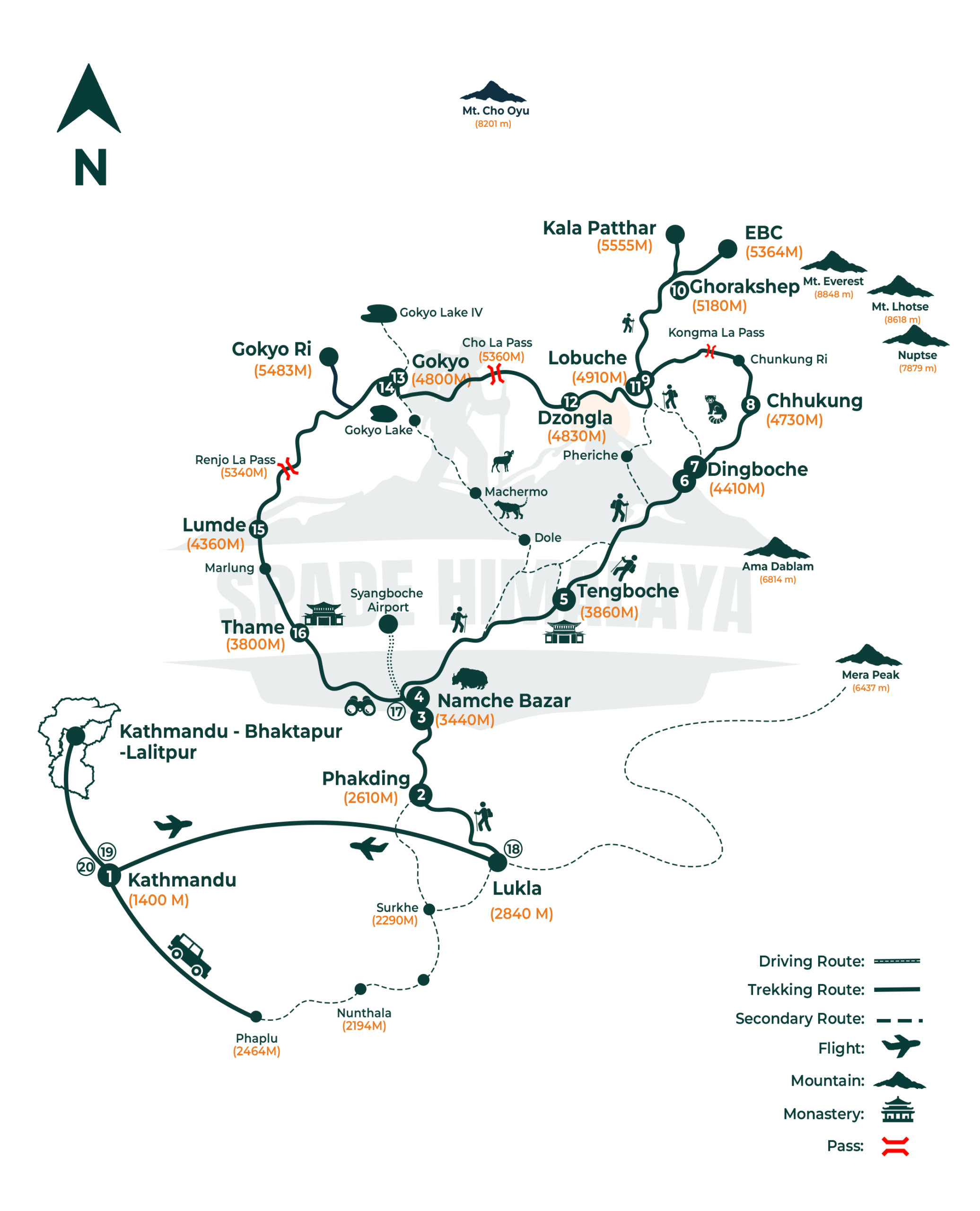
Kathmandu (1,400 m) → fly to Lukla (2,846 m) → Phakding (2,610 m) → Namche Bazaar (3,440 m) → Tengboche (3,860 m) → Dingboche (4,410 m) → Chhukung (4,730 m) → Kongma La (5,535 m) → Lobuche (4,910 m) → Everest Base Camp (5,364 m) → Gorak Shep → Kala Patthar (5,545 m) → Dzongla (4,830 m) → Cho La (5,420 m) → Gokyo (4,790 m) → Gokyo Ri (5,357 m) → Renjo La (5,360 m) → Lumde (4,360 m) → Thame (3,800 m) → Namche Bazaar → Lukla → fly to Kathmandu.
In short, you climb the classic Everest trail to Chhukung. Then you cross Kongma La to Lobuche, and visit base camp and Kala Patthar. After that, you cross Cho La into the Gokyo valley and climb Gokyo Ri. Finally, you cross Renjo La and descend via Thame back to Lukla.
Trips Itinerary
A Spade Himalaya representative meets you at Tribhuvan International Airport and drives you to your hotel, about thirty minutes from the terminal depending on traffic.
Kathmandu sits at 1,400 m, so there is no altitude to manage yet. In the evening you meet the team for the briefing and a kit check, and they handle the permit paperwork, so bring your passport, two photographs and a copy of your insurance.
- Duration: 30 min Drive
- Max Altitude: 1,400 m
- Accommodation: 3 Star Hotel (Shared)
An early thirty five minute flight takes you to Lukla, where you meet your porter and start walking, dropping through Ghat beside the Dudh Koshi to Phakding.
Lukla is at 2,846 m and Phakding at 2,610 m, so the first day loses height rather than gaining any, across three or four easy hours of gentle downhill walking.
In the busiest months the flight leaves from Manthali after an early road transfer. This first stretch gives you your first look at Khumbu life, with mani walls and prayer wheels along the way.
- Duration: 3 to 4 hrs Hike
- Max Altitude: 2,840 m
- Meals: Breakfast, Lunch & Dinner Included
- Accommodation: Guest House
A long climbing day follows the river north across high bridges, enters Sagarmatha National Park at Monjo, and then grinds up the steep hill to Namche Bazaar.
Namche stands at 3,440 m, around 830 m above Phakding, across five or six hours. The climb after lunch at Jorsalle is the hardest part of the day by a long way.
You cross the high Hillary Bridge where two rivers meet. Near the top of the hill Everest appears for the first time on a clear day, and Namche is the trading heart of the Khumbu.
- Duration: 5 to 6 hrs hike
- Max Altitude: 3,440 m
- Meals: Breakfast, Lunch & Dinner
- Accommodation: Guest House
You stay in Namche for a second night and spend the day walking above the town to the Hotel Everest View, then come back down to sleep at the lower height.
The hotel terrace is at 3,880 m, so you climb around 440 m and return, across four or five hours. Everest, Lhotse, Nuptse and Ama Dablam all stand in view from up there, and the afternoon is free for the Sherpa culture museum and any last gear.
- Duration: 4 to 5 hrs hike
- Max Altitude: 3,880 m
- Meals: Breakfast, Lunch & Dinner
- Accommodation: Guest House
A high trail along the hillside with wide mountain views drops to the river at Phunki Thenga for lunch, then climbs steadily through forest to the ridge at Tengboche.
Tengboche is at 3,860 m and the walk takes five or six hours. You finish only a little above Namche, but the long descent and the re-climb make it a proper day.
Tengboche Monastery is the largest in the Khumbu, with Ama Dablam in front of it and Everest behind. Try to arrive in time for the afternoon prayers, which visitors may sit in on.
- Duration: 5 to 6 hrs hike
- Max Altitude: 3,860 m
- Meals: Breakfast, Lunch & Dinner Included
- Accommodation: Guest House
You drop through forest to Deboche, cross the Imja Khola under the face of Ama Dablam, then climb gently through Pangboche and up the valley to Dingboche.
Dingboche is at 4,410 m after five or six hours, so you gain around 550 m. Above Pangboche the trees stop entirely and the country turns to open stone and grazing land.
Pangboche has one of the oldest monasteries in the Khumbu and is worth a short stop. Dingboche is a patchwork of stone walled fields where yaks graze through the summer months.
- Duration: 5 to 6 hrs hike
- Max Altitude: 4,410 m
- Meals: Breakfast, Lunch & Dinner Included
- Accommodation: Guest House
Your second day of settling into the height, spent climbing part way up the Nangkartshang ridge above the village and then coming back down for lunch and an easy afternoon.
The ridge tops out around 5,083 m, four or five hours up and back, then you sleep at 4,410 m. This is the last easy day before the passes begin in earnest.
From the ridge you can see Makalu at 8,463 m, the fifth highest mountain in the world, far away to the east, along with Lhotse, Cholatse and Island Peak across the valley.
- Duration: 4 to 5 hrs hike
- Max Altitude: 5,083 m
- Meals: Breakfast, Lunch & Dinner Included
- Accommodation: Guest House
A deliberately short day up the Imja valley, past stone walled farms and yak pastures, finishing early in the afternoon at the small settlement of Chhukung.
Chhukung is at 4,730 m, four or five hours of gentle climbing. The early finish is on purpose, because tomorrow is the first and the highest of the three passes. Eat well, drink plenty and get your kit ready tonight rather than in the morning.
- Duration: 4 to 5 hrs hike
- Max Altitude: 4,730 m
- Meals: Breakfast, Lunch & Dinner
- Accommodation: Guest House
The first pass, and the highest of the three. You start early for a long climb past glacial pools to the Kongma La, then descend and cross the Khumbu Glacier to Lobuche.
The Kongma La is 5,535 m and Lobuche is at 4,910 m, eight or nine hours in all. It is roughly 800 m up and then 600 m down across genuinely rough ground.
You carry food and water for the whole day, because there are no teahouses anywhere on this crossing and there is nowhere at all to stop if the weather turns.
From the top you look across Lhotse and Makalu with prayer flags snapping in the wind. Chhukung sits directly below the south face of Lhotse behind you.
- Duration: 8 to 9 hrs hike
- Max Altitude: 5,535 m
- Meals: Breakfast, Lunch & Dinner
- Accommodation: Guest House
You follow the glacier up to Gorak Shep, rest there, then continue out over rock and ice to Everest Base Camp before returning the same way for the night.
Gorak Shep is at 5,164 m and Base Camp at 5,364 m, eight or nine hours in total. The ground is loose moraine and the height makes every step slower than it looks.
The Khumbu Icefall tumbles down in huge blocks above the camp. This is as close to Everest as anyone gets without a climbing permit, and in spring the tents cover the ice.
- Duration: 8 to 9 hrs hike
- Max Altitude: 5,364 m
- Meals: Breakfast, Lunch & Dinner
- Accommodation: Guest House
You climb Kala Patthar before dawn, return to Gorak Shep for breakfast, then walk back down the valley past the Thukla Pass memorials to the lodges at Lobuche.
Kala Patthar is 5,545 m, the highest point of the whole trek, and Lobuche is at 4,910 m. Seven to nine hours in all, with the climb done in the dark and the cold.
The sunrise from the top gives the clearest Everest view on the route, with Nuptse, Pumori and Changtse around you. It is a hard day but it is the one people remember.
- Duration: 7 to 9 hrs hike
- Max Altitude: 5,545 m
- Meals: Breakfast, Lunch & Dinner
- Accommodation: Guest House
A shorter and very scenic day. You leave the Khumbu valley, cross the Chola Khola and walk past the glacial lake of Chola Tsho to the lodges at Dzongla.
Dzongla is at 4,830 m, four or five hours of walking with little net height change. The short stage puts you in position for the second pass tomorrow, and the lake sits below the trail with Cholatse standing above it.
- Duration: 4 to 5 hrs hike
- Max Altitude: 4,830 m
- Meals: Breakfast, Lunch & Dinner
- Accommodation: Guest House
The second pass of the three. You start very early to cross the Cho La before the weather changes, climbing steep loose rock and then a small glacier near the top.
The Cho La is 5,420 m and Gokyo is at 4,790 m, eight or nine hours in total. Micro spikes are genuinely useful on the glacier section, so have them to hand.
The descent on the far side crosses the Ngozumpa, which is the longest glacier in Nepal and takes a good deal longer to get over than it looks from the near side.
Gokyo sits on the shore of the third lake at the end of it. After a day like this one, arriving beside still water feels like a real reward for the effort.
- Duration: 8 to 9 hrs hike
- Max Altitude: 5,420 m
- Meals: Breakfast, Lunch & Dinner
- Accommodation: Guest House
A short, steep climb up Gokyo Ri in the early morning takes you to one of the great viewpoints in the Himalaya, and the afternoon is then free by the lakes.
Gokyo Ri is 5,357 m, around 570 m above the village, and the round trip takes three or four hours. It is steep the whole way, with nowhere flat to recover.
From the top you can see four mountains over 8,000 m at once: Everest, Lhotse at 8,516 m, Makalu at 8,463 m and Cho Oyu, with the turquoise lakes and the glacier below.
- Duration: 3 to 4 hrs hike
- Max Altitude: 5,357 m
- Meals: Breakfast, Lunch & Dinner
- Accommodation: Guest House
The third and final pass. A long steady climb takes you up to the Renjo La, and the descent on the far side drops you into a much quieter western valley.
The Renjo La is 5,360 m and Lumde is at 4,360 m, seven or eight hours in all. That is around 570 m of climbing and then a full 1,000 m of descent afterwards.
The framed view of Everest from the top of the pass, with the Gokyo lakes laid out below it, is rated by a great many people as the best on the whole trek.
You leave the crowds behind from here onwards. These western valleys see a fraction of the traffic that the main Base Camp trail carries through the season.
- Duration: 7 to 8 hrs hike
- Max Altitude: 5,360 m
- Meals: Breakfast, Lunch & Dinner
- Accommodation: Guest House
You walk down through high pasture and past old stone settlements to Thame, which is one of the most historic Sherpa villages anywhere in the whole Khumbu.
Thame is at 3,800 m, so you drop around 560 m across four or five hours. This valley is quiet and you will see very few other trekkers on this side of the region.
Thame is the home village of several of the best known Everest climbers, including Kami Rita Sherpa. The monastery on the hillside above hosts the Mani Rimdu festival each spring.
- Duration: 4 to 5 hrs hike
- Max Altitude: 4,360 m
- Meals: Breakfast, Lunch & Dinner
- Accommodation: Guest House
A pleasant day in and out of forest along the canyon side, with good views the whole way, bringing you back into Namche Bazaar and onto the main trail.
Namche is at 3,440 m, a gentle drop of around 360 m across four or five hours. After the passes this feels like an afternoon stroll rather than a trekking day, and Namche has bakeries, hot showers and warm rooms waiting at the end of it.
- Duration: 4 to 5 hrs hike
- Max Altitude: 3,800 m
- Meals: Breakfast, Lunch & Dinner
- Accommodation: Guest House
The last trekking day retraces the river down through Monjo and Phakding again, and it finishes with the short climb back up into Lukla village itself.
You end at 2,846 m after six or seven hours. It reads as a downhill day, but that final climb is real and it catches people out on tired legs at the end of three weeks.
This is the evening to thank your guide and porters and settle tips. The lodges in Lukla are lively and the last dinner on the trail is usually a long one.
- Duration: 6 to 7 hrs hike
- Max Altitude: 3,440 m
- Meals: Breakfast, Lunch & Dinner
- Accommodation: Guest House
A morning flight takes you back to Kathmandu, either direct or by way of Manthali depending on the season, and the rest of the day is then entirely yours.
Lukla departures depend on the weather, so an early slot is always better than a late one, and your guide will confirm the timing the night before. In the evening Spade Himalaya hands you a trip certificate over a farewell dinner with the team.
- Max Altitude: 2,840 m
- Meals: Breakfast Included
- Accommodation: Star Hotel
Your trip ends today. After a relaxed breakfast a representative collects you and drives you to the airport, about thirty minutes from Thamel though traffic can stretch it. You leave having crossed three passes above 5,300 m and stood at Everest Base Camp.
- Meals: Breakfast Included
Trips Include
- Airport transfers in a private vehicle.
- Shared star hotel in kathmandu for 2 nights (arrival and post-trek), with breakfast Included. (Private room can be organized at extra cost).
- Round-trip flights between Kathmandu (or Manthali / Ramechhap) and Lukla.
- All ground transfers to and from Manthali / Ramechhap in peak season.
- All teahouse accommodation during the trek.
- All meals (breakfast, lunch, dinner) during the trek.
- Sagarmatha National Park entry permit and Khumbu Pasang Lhamu Rural Municipality permit.
- A licensed, experienced guide (pay, insurance, meals, lodging). 2 guides for group size more than 7 people.
- Porter support, one porter per two trekkers (pay, insurance, meals, lodging).
- Guide's first-aid kit, pulse oximeter, and daily health monitoring.
- Trip-completion certificate and all government taxes.
Trips Exclude
- International airfare to and from Nepal.
- Nepal entry visa (US$30 for 15 days, US$50 for 30 days, US$125 for 90 days).
- Travel and medical insurance (mandatory; must cover trekking above 5,500 m and helicopter evacuation).
- Lunches and dinners in Kathmandu.
- Drinks, snacks, hot showers, Wi-Fi, and device charging on the trail.
- Sleeping bag and down jacket (available to rent for about US$35 each).
- Optional Kathmandu to Lukla helicopter transfer (about US$550 per person, 5-person sharing).
- Tips for guide and porters.
- Personal expenses and any costs from early departure or itinerary changes.
- Anything not listed under Cost Includes.
Trips Altitude
Trips Map
Trips Gallery
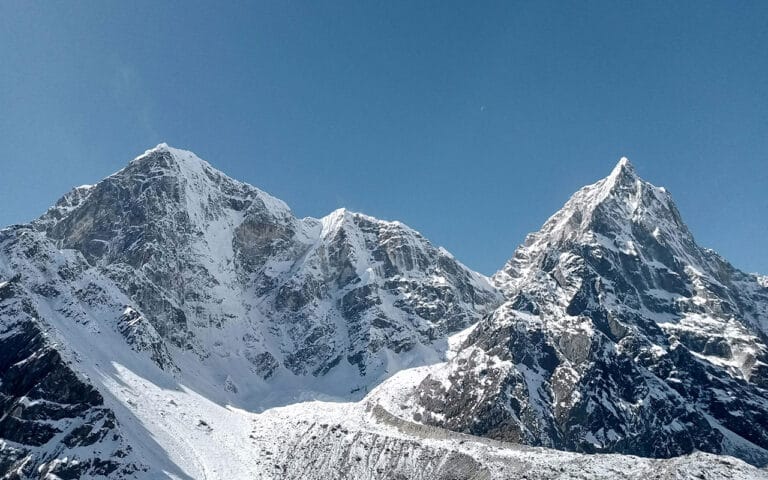
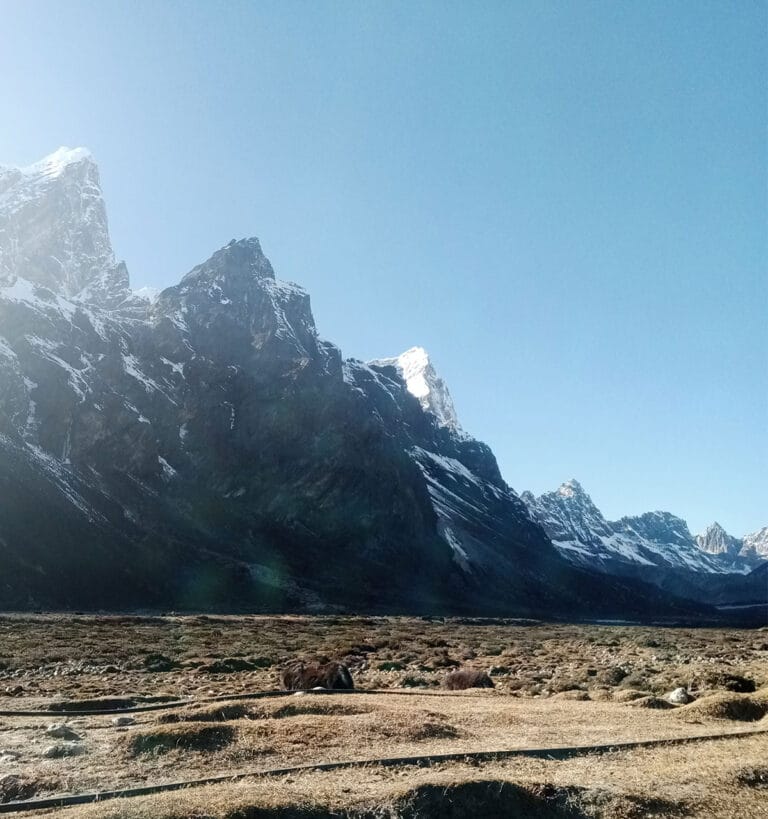
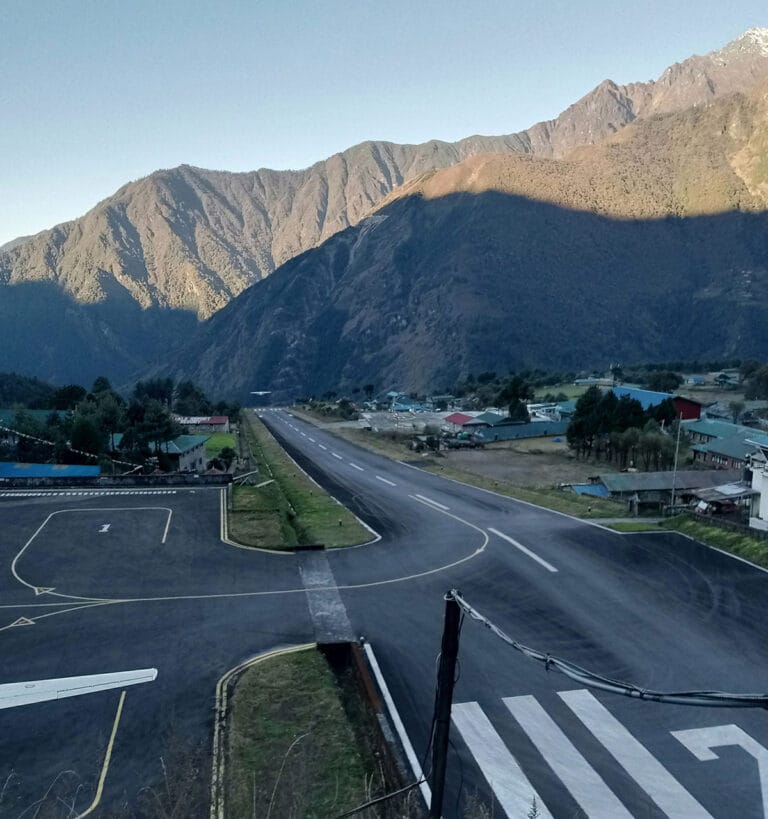
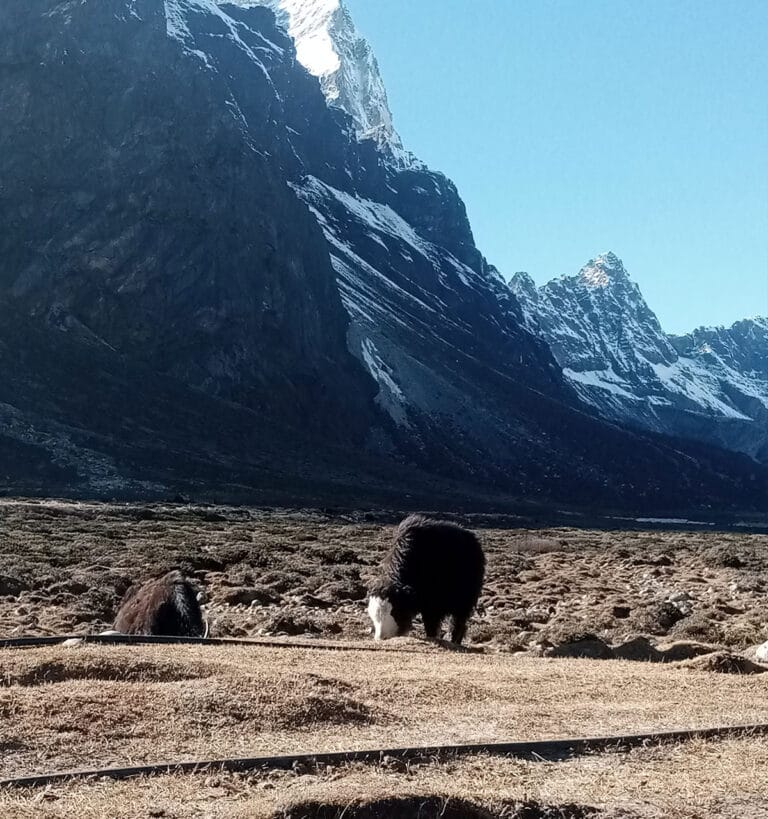
Packing List
General
- Four-season (zero degree) sleeping bag (available to rent for about US$35)
- Sleeping bag liner
- Puffy down jacket (available to rent for about US$35)
- Daypack, 35 to 45 litres, with a rain cover
Upper Body
- Sun hat or cap
- Knitted hat or beanie
- Neck gaiter, buff, or scarf
- Sunglasses (UV protection)
- Headlamp with spare batteries
- Technical base-layer tops (light for warm months, heavy for cold months)
- Short and long sleeve technical shirts
- Fleece jacket or pullover
- Waterproof, windproof shell jacket
Lower Body
- Technical base-layer trousers (weight to suit the season)
- Hiking trousers (2 pairs)
- Comfortable trousers for the teahouses
- Hiking shorts
- Waterproof, windproof shell trousers
Hands
- Wool or technical liner gloves
- Insulated hard-shell outer gloves
Feet
- Waterproof trekking boots (well broken in)
- Warm wool or technical socks, and hiking socks
- Liner socks (optional)
- Ice cleats or micro spikes (essential for the passes, especially Cho La)
- Gaiters (light for dust, heavier for snow)
- Casual shoes for the evenings
Undergarments
- Quick-drying technical underwear
- Sports bras (women)
- Sleeping clothes or pyjamas
First Aid Kits
(Your guide carries a kit, medication, and a pulse oximeter, but a personal kit is strongly recommended.)
- Sunscreen and lip balm
- Antiseptic ointment and blister care
- Cough syrup (the dry "Khumbu cough" is common at altitude)
- Personal medication and any altitude medication advised by your doctor
- Water purification tablets or a UV purifier
Others
- Passport and extra passport photos
- Reusable water bottle and a hydration bladder
- Toiletry kit, quick-dry towel, toilet paper, pillowcase
- High-protein snacks (bars, nuts)
- Waterproof or dry bags for documents and money
- Earplugs and trekking poles
Optional
- Power bank and spare batteries
- Camera or phone for photos
- Binoculars
- Cards or a book
- Whistle, thermos for hot water, and a comb
Good to Know
Before you go
You only need a few things ready. First, bring your passport, two photos, and a copy of your insurance. Then Spade Himalaya can sort your two permits. Also, draw enough cash in Kathmandu or Namche, because the trail runs on rupees. There is no reliable ATM past Namche. Last, train hard for months, because this is a challenging
Each pass is a long, committing day. Kongma La (5,535 m) is the highest. Cho La (5,420 m) has a glacier and is the most technical. Renjo La (5,360 m) is the most scenic. You start before dawn on pass days. You also carry food and water where there are no teahouses. Your guide checks the conditions first and turns back if a pass is unsafe. Micro spikes are a must, especially on Cho La.
Lukla is a small mountain airport, so weather can cause delays. In quiet months, you fly from Kathmandu in 35 minutes. In busy months, you fly from Manthali after a 5 to 6 hour drive. So it is wise to keep a spare day before your flight home. A direct helicopter is also an option for about US$550 per person.
The plan follows one rule: climb high, sleep low. So it adds rest days at Namche and Dingboche and a steady build-up before the passes. Drink 3 to 4 litres of water a day, and walk slowly. Skip alcohol up high, and eat well for energy. If you feel unwell, tell your guide at once. Going down is the best cure.
You sleep in cosy teahouses with simple twin rooms. On the passes and at Gokyo, rooms are basic and nights are very cold, so a good sleeping bag matters. The food is simple and filling: dal bhat, noodles, potatoes, soup, and bread. Vegetarian meals are easy to find, and meat is best avoided high up. For water, refill and purify rather than buy bottles. A dry “Khumbu cough” is common above Namche, so carry a buff and lozenges.
Trips Reviews
Worth the Challenge
Best Adventure Ever
Trips FAQs
Trek Difficulty & Altitude
It is graded challenging, the hardest standard teahouse trek in the Everest region. Over 20 days, you cross three passes above 5,300 m. On pass days, you walk 8 to 9 hours on steep, often icy ground, including a glacier on Cho La. There is no climbing skill needed. Still, you need strong fitness, hiking experience, and good acclimatization.
The three passes are Kongma La (5,535 m), Cho La (5,420 m), and Renjo La (5,360 m) (Wikipedia: Cho La, 2026). Kongma La is the highest and usually the toughest. Cho La is the most technical, because of its glacier. Renjo La gives perhaps the most beautiful framed view of Everest.
It is a real risk, because you spend many days above 4,500 m and cross three passes over 5,300 m. So the plan uses two rest days, a slow profile, and daily oximeter checks. Drink plenty of water, walk slowly, and skip alcohol up high. Tell your guide early if you feel unwell. Going down is the best cure.
Permits, Guide & Insurance
Not by law, but yes in practice. Nepal’s 2023 rule lists the Everest region (Nepal Tourism Board, retrieved 2026-06-29), but the local Khumbu Pasang Lhamu Rural Municipality rejected it and allows solo trekking (The Himalayan Times, 2023-03-28). So a guide is not legally required. However, the glaciers, the route-finding, and the altitude make a guide essential here. So Spade Himalaya gives you a licensed Sherpa guide. They handle the permits, the logistics, and daily health checks.
You need two. First, the Sagarmatha National Park permit (about NPR 3,000). Second, the Khumbu Pasang Lhamu permit (about NPR 3,000). There is no TIMS card in the Khumbu. Spade Himalaya arranges both, and a ranger checks them on the trail. They are paid in cash, in Nepalese rupees.
Yes, it is a must. Your policy has to cover trekking up to 5,500 m and a helicopter rescue. Many normal policies do not, so check the wording first. The passes here are remote, so good cover matters even more. Arrange it at home before you fly, and leave a copy with Spade Himalaya at the briefing.
Best Time to Trek
Spring (March to May) and autumn (late September to November) are best, with stable weather and open passes. Winter brings deep snow that can close Cho La and Renjo La, so it is not advised here. The summer monsoon brings cloud and rain. The passes need a clear weather window, so some flexibility helps. For how winter affects high trekking, see our Annapurna winter guide.
Trek Highlights & Views
The Gokyo Lakes are a chain of high turquoise lakes beside the Ngozumpa Glacier, the longest glacier in Nepal. Above them rises Gokyo Ri (5,357 m). From the top, you see four 8,000 m peaks at once: Everest, Lhotse, Makalu, and Cho Oyu (Wikipedia: Gokyo Ri, 2026). For many trekkers, the Gokyo Ri sunrise is the best view of the whole trip.
The standard Everest Base Camp Trek is 14 days. It tops out at Kala Patthar and follows one valley out and back. The Three Passes is 20 days. It adds Kongma La, Cho La, Renjo La, and the Gokyo Lakes, and forms a full loop. So choose Base Camp for the classic trip, and Three Passes for the complete, far harder adventure.
Transportation & Logistics
It comes down to air traffic. In the busy months (March, April, May, October, and November), flights move to Manthali to ease the load. So you drive 5 to 6 hours, then fly 20 minutes. In quiet months, you fly straight from Kathmandu in 35 minutes. A direct helicopter is also an option for about US$550 per person.