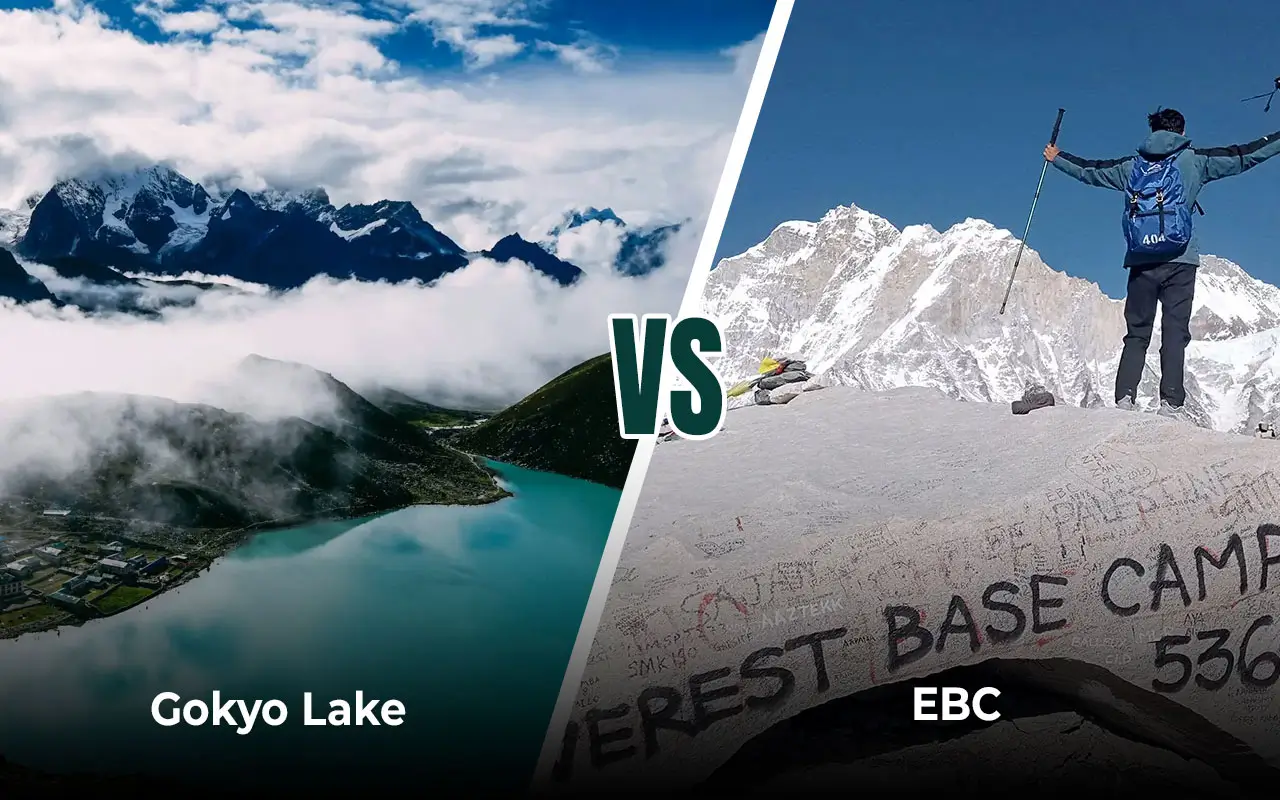
Quick answer: Choose Everest Base Camp for the iconic goal, the livelier trail, and the best lodges. Choose Gokyo Lakes for the better summit view, the turquoise lakes, and a fraction of the crowds. Both take 12 to 14 days, cost about the same, and use identical permits. Or link them over the Cho La pass and do both.
Here is the secret most trekkers never hear: these two treks share the same first two days. Both fly to Lukla. Both climb to Namche Bazaar. Then, a little above Namche, the trail forks at the small junction of Sanasa. Right goes to Everest Base Camp. Left goes to Gokyo. So the real question is not which trek to book. It is which turn to take at that fork, and our guides have walked both enough times to give you an honest answer.
Key Takeaways
- Same flight, same permits, same cost range. The two routes differ far less on paper than on the trail.
- EBC gives you the famous goal, Kala Patthar (5,545 m), and the busiest, best-supported trail in Nepal.
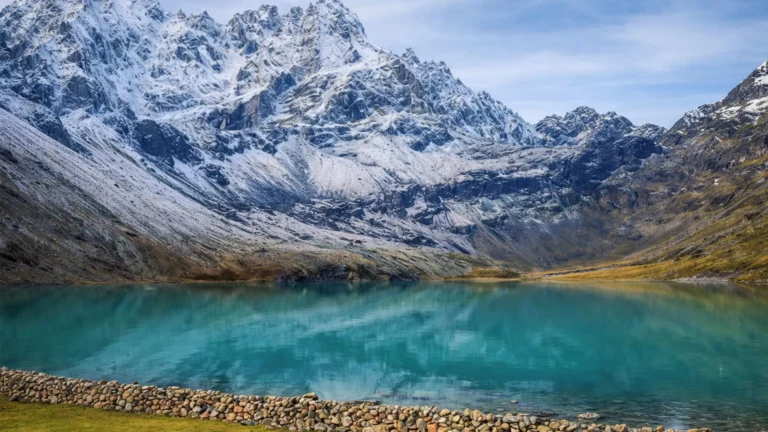
- Gokyo gives you six turquoise lakes, Gokyo Ri (5,357 m), and quiet trails, on the same schedule.
- You cannot see Everest’s summit well from Base Camp itself. You can see it superbly from Gokyo Ri.
- Fit trekkers with 18 to 19 days can combine both over the Cho La pass (5,420 m).
What do the two treks actually share?
More than any comparison admits: the flight, the permits, the season windows, and the first two days of trail. First, both treks start with the Kathmandu to Lukla flight and climb through Phakding to Namche Bazaar at 3,440 m. Both need the same two permits: the Sagarmatha National Park entry permit (NPR 3,000) and the Khumbu Pasang Lhamu Rural Municipality permit (NPR 3,000), about US$45 in total. There is no TIMS card in the Everest region for either route.
Both are best in October to November and March to May. Both sleep in teahouses the whole way. And both are graded 3, Strenuous, on the Spade Himalaya Trek Difficulty Scale. So the usual selling points people use to separate them are mostly shared.
The split comes above Namche, at Sanasa. From that junction, the routes become two different valleys with two different characters.
Gokyo vs Everest Base Camp: the side-by-side numbers
Here are the two treks in one honest table, using our own operating figures.
| Everest Base Camp | Gokyo Lakes | |
|---|---|---|
| Highest point | Kala Patthar, 5,545 m | Gokyo Ri, 5,357 m |
| Highest sleep | Gorak Shep, 5,164 m | Gokyo, 4,790 m |
| Days (typical) | 12 to 14 | 12 to 14 |
| Guided cost (2026) | US$1,400 to $2,500 | US$1,100 to $1,600 |
| Permits | NPR 3,000 + NPR 3,000 | Identical |
| Trail traffic | The busiest in Nepal | A fraction of EBC’s |
| Lodges | The best in the Khumbu | Simpler, quieter |
| Signature sight | Base camp + Khumbu Icefall | Six turquoise lakes + Ngozumpa Glacier |
| Spade Himalaya Trek Difficulty Scale | 3, Strenuous | 3, Strenuous |
So the price gap is modest, and the schedule is the same. What you are really choosing is the experience: fame and company on one side, lakes and silence on the other.
Which trek has the better view of Everest?
Gokyo Ri, and it is not close. This is the fact that surprises everyone: you cannot see Everest’s summit well from Everest Base Camp itself. Because base camp sits under the shoulder of Nuptse, the wall simply blocks the view. The classic Everest photo on the EBC trek comes from Kala Patthar, the viewpoint above Gorak Shep.
From Gokyo Ri, though, Everest stands in full view, and it brings company. In fact, you see four of the six highest mountains on Earth in one sweep. Those are Everest (8,849 m), Lhotse (8,516 m), Makalu (8,463 m), and Cho Oyu (8,188 m). Below them, the lakes and the Ngozumpa Glacier, the largest in Nepal, fill the valley.
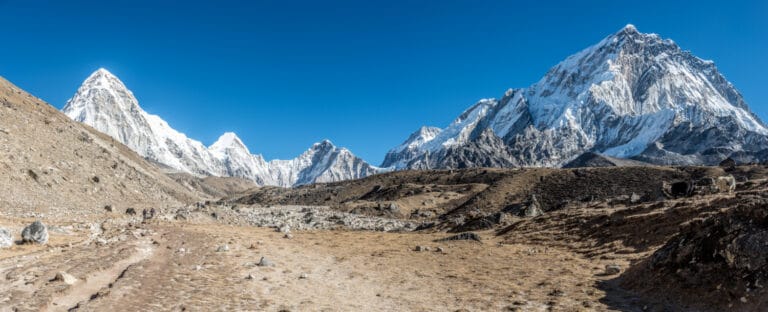
Kala Patthar answers back with closeness. It stands nearer the mountain, so Everest feels bigger and more personal there, especially at dawn. In short: Gokyo Ri wins on breadth, Kala Patthar wins on intimacy. Our Kala Patthar guide covers that viewpoint in full.
Which trek is harder?
They are close, and both are graded 3, Strenuous. EBC pushes you higher, while Gokyo climbs more gently. Everest Base Camp reaches 5,545 m at Kala Patthar and sleeps you at 5,164 m in Gorak Shep. That extra height is felt, and the final days across the moraine are long and stony.
Gokyo tops out lower, at 5,357 m, and you sleep at 4,790 m. The Gokyo valley also gains height more gradually, which is kinder for acclimatization. However, its lodges are simpler, and in peak season the smaller villages fill up earlier.
Importantly, neither trek needs ropes or climbing skill. For either one, the real work is walking 5 to 7 hours a day and respecting the altitude. Our altitude sickness guide explains the rules that keep you safe on both.
Which trek is quieter?
Gokyo, by a wide margin, and this is the biggest difference you will actually feel. Everest Base Camp is the busiest trail in Nepal. In October you will share it with a stream of trekkers, yak trains, and porters, and the famous photo spots can have queues. Some people love that energy. The teahouses are social, and you will make friends from ten countries.
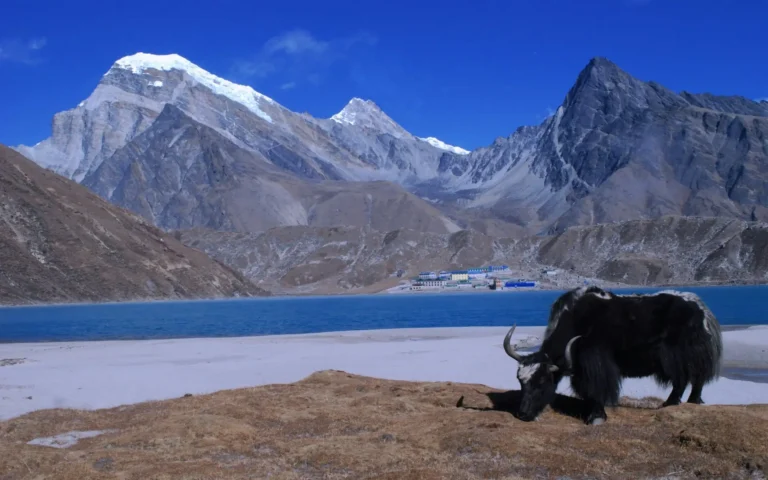
The Gokyo valley carries a fraction of that traffic. On the walk from Machhermo to the lakes, you can go an hour without meeting anyone. Also, at the fourth and fifth lakes, you may have the trail entirely to yourself. If your picture of the Himalaya is silence and space, that turn left at Sanasa is your answer.
Which trek should a first-timer choose?
Everest Base Camp, in most cases, and I say that as someone who prefers the Gokyo valley. EBC has the best infrastructure in the Nepali Himalaya: more lodges, more food choice, better connectivity, and more help nearby if something goes wrong. The trail is impossible to lose. And the goal itself carries real power. After all, standing at base camp finishes a story people have carried for years.
However, choose Gokyo first if crowds genuinely spoil the mountains for you. Also pick it if you have hiked at altitude before and want scenery over ceremony. It is not a harder trek. It is simply a quieter one with slightly simpler beds.
There is no wrong turn at Sanasa. One valley gives you the name, the other gives you the view.

Can you do both in one trek?
Yes, and it is the best long route in the Khumbu: Everest Base Camp and Gokyo linked by the Cho La pass at 5,420 m. The route climbs the Gokyo valley first, crosses Cho La, then joins the classic trail for base camp and Kala Patthar. You get the lakes, the glacier, the pass, base camp, and both great viewpoints in a single 18 to 19 day journey.
Be honest with yourself about the step up, though. Cho La is a real high pass with ice near the top, and it needs an early start and stable weather. So the combined route grades 4, Challenging, not 3. It suits trekkers who have been to altitude before and have the extra week.
If the pass appeals more than base camp does, the Everest Three Passes trek goes further still, crossing Renjo La and Kongma La as well.
How do the costs compare?
Gokyo usually runs a little cheaper, mainly because its lodges are simpler, but the gap is smaller than people expect. A guided 14-day Everest Base Camp trek costs about US$1,400 to $2,500 per person in 2026. A guided Gokyo Lakes trek runs roughly US$1,100 to $1,600.
After all, the big fixed costs are identical: the Lukla flights, the two permits, and the guide. What moves the number is lodge standard, group size, and days on the trail. For details, our Everest Base Camp cost guide breaks down every line. Meanwhile, the figures for Gokyo sit in our Gokyo Lakes trek guide.
One warning for budget planners: do not pick Gokyo purely to save money. The saving is a few hundred dollars on a trip of a lifetime. Pick the valley you actually want to walk.
When is the best season for each?
The same windows serve both: October to November for the sharpest skies, March to May for warmth and rhododendrons. Both routes depend on the same Lukla flights, and both reward the clear post-monsoon air.
Two seasonal notes set them apart. First, in winter the Gokyo lakes freeze over. That is beautiful, but it comes with hard cold and some closed lodges above Machhermo. Meanwhile, EBC keeps more lodges open year-round, so it handles a December trip better. And in peak October, Gokyo’s smaller villages fill up faster, so booking ahead matters more on that side. For the month-by-month picture, see our best time to trek Everest Base Camp guide.
FAQs
Is the Gokyo Lakes trek less crowded than Everest Base Camp?
Yes, dramatically. The Gokyo valley sees a fraction of the EBC trail’s traffic. Above Machhermo you can walk for an hour without meeting another trekker, even in October.
Do Gokyo and Everest Base Camp need different permits?
No. Both use the same two: the Sagarmatha National Park permit (NPR 3,000) and the Khumbu Pasang Lhamu Rural Municipality permit (NPR 3,000). Neither route uses a TIMS card.
Where do the Gokyo and EBC routes separate?
At Sanasa, a small junction just above Namche Bazaar. The right branch climbs toward Tengboche and base camp. The left branch enters the Gokyo valley via Dole and Machhermo.
Is Gokyo Ri higher than Kala Patthar?
No. Kala Patthar is higher at 5,545 m, against 5,357 m for Gokyo Ri. But height is not the same as view. Gokyo Ri shows four 8,000 m peaks at once, while Kala Patthar puts you closest to Everest itself.
How hard is the Cho La pass?
Cho La (5,420 m) is the hardest day of the combined route. Expect a pre-dawn start, a steep climb, and ice near the top in most seasons. It lifts the combined trek to grade 4, Challenging, on the Spade Himalaya Trek Difficulty Scale.
How many days do you need to combine Gokyo and Everest Base Camp?
Plan 18 to 19 days from Kathmandu. First, the route runs up the Gokyo valley and over Cho La. Then it reaches base camp and Kala Patthar, with acclimatization built in on the Gokyo side.
Can beginners do the Gokyo Lakes trek instead of EBC?
Yes. Gokyo is not harder than EBC, and it acclimatizes more gently. However, the trade-off for a first-timer is simpler lodges and fewer people around if something goes wrong. So we still guide most first-timers to EBC.
Which trek is better for photographers?
Gokyo, for most. The lakes give foregrounds that EBC’s moraine cannot, and Gokyo Ri’s panorama is wider. EBC answers with the Khumbu Icefall and the intimacy of Kala Patthar at dawn.
Accuracy note: permit fees (NPR 3,000 Sagarmatha National Park + NPR 3,000 Khumbu Pasang Lhamu Rural Municipality, no TIMS in the Khumbu) follow the Nepal Tourism Board and match our Everest permits guide; elevations are established figures (Everest 8,849 m, Lhotse 8,516 m, Makalu 8,463 m, Cho Oyu 8,188 m, Kala Patthar 5,545 m, Gokyo Ri 5,357 m, Cho La 5,420 m, Gorak Shep 5,164 m, Gokyo 4,790 m); cost ranges (EBC US$1,400 to $2,500; Gokyo US$1,100 to $1,600 guided) are Spade Himalaya 2026 operating figures consistent with our cost guides; route, junction, and season details are our guides’ first-hand experience on both valleys; reviewed by Yubaraj Katel, government-licensed trekking guide (Licence No. 19827) with 10 years of experience leading treks in the Everest region.

Still Deciding?
Updated: 6 Jul, 2026
9 min
Everest Base Camp Trek Cost in 2026: Full Breakdown
Quick answer: A guided Everest Base Camp Trek’s biggest single cost is the round-trip Lukla flight,...
Updated: 20 Jul, 2026
13 min
Gokyo Lakes Trek Guide (2026): Nepal’s Highest Freshwater Lakes
Gokyo Lakes trek guide: the route, cost, permits, Gokyo Ri at 5,357 m, lake depths, and...
Updated: 20 Jul, 2026
15 min
Everest Region Treks: Routes, Cost & Best Time (2026 Guide)
Quick answer: The Everest region, or Khumbu, is home to Everest Base Camp, the Gokyo Lakes,...