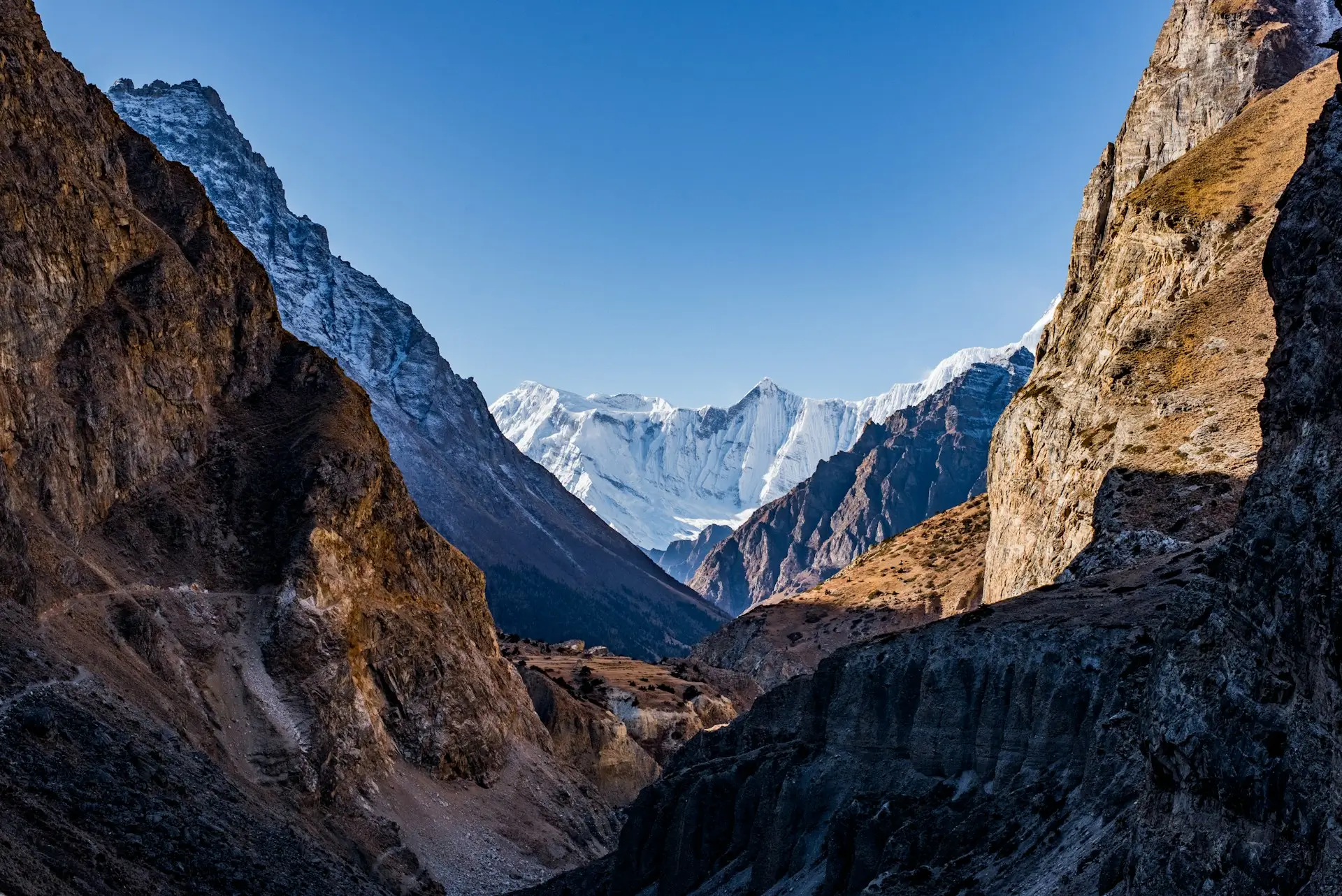
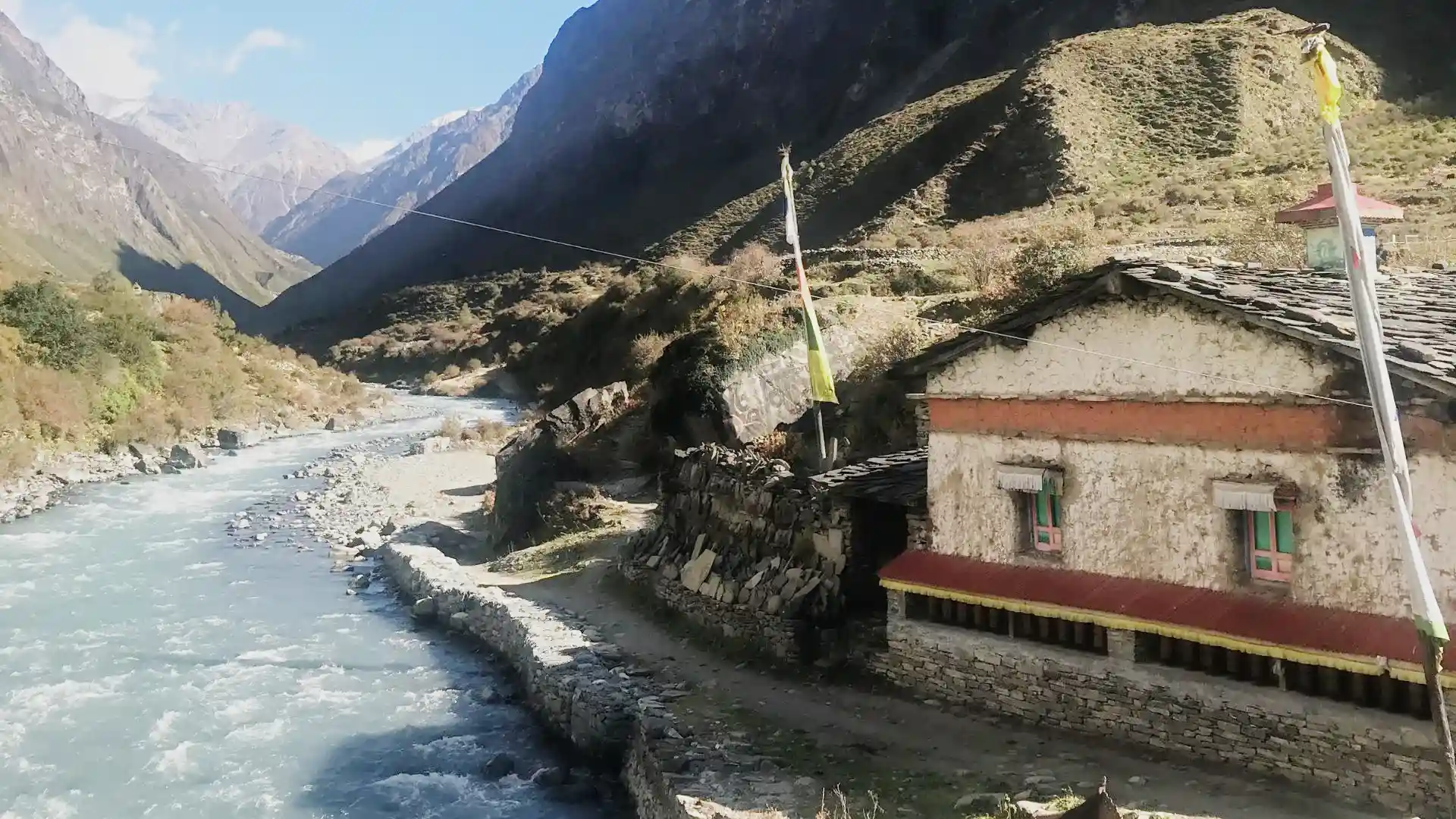
Quick answer: The Tsum Valley Trek is a 15-day, moderate trek into a Tibetan Buddhist valley on Nepal’s northern border. It reaches 3,700 m at Mu Gompa, crosses no high pass, and needs a restricted-area permit plus a licensed guide. The valley opened to foreign trekkers only in 2008, and a community vow means no meat is served there.
The Tsum Valley is the quietest major trek in Nepal that most people have never heard of. It sits in the Manaslu region of Gorkha district, hard against the Tibetan border. So while the Manaslu Circuit in the next valley has grown busy, Tsum has not. On many days you will pass more mule trains than trekkers.
First, this guide covers what the trek actually involves. That means the real permit costs, the day-by-day shape, how hard it is, and the one cultural rule that surprises almost every visitor.
Key Takeaways
- Tsum Valley stayed closed to foreign trekkers until 2008, which is why it feels unspoilt.
- The trek tops out at Mu Gompa, 3,700 m. There is no pass to cross.
- You need the Tsum Valley Restricted Area Permit, not the pricier Manaslu one. They are different permits.
- A licensed guide is required by law, even after the March 2026 rule change for solo travellers.
- The valley lives under a shyagya vow of non-violence, so no meat is served. Plan to eat vegetarian for a week.
- Best months are October and November, then March to May.
Where is the Tsum Valley?
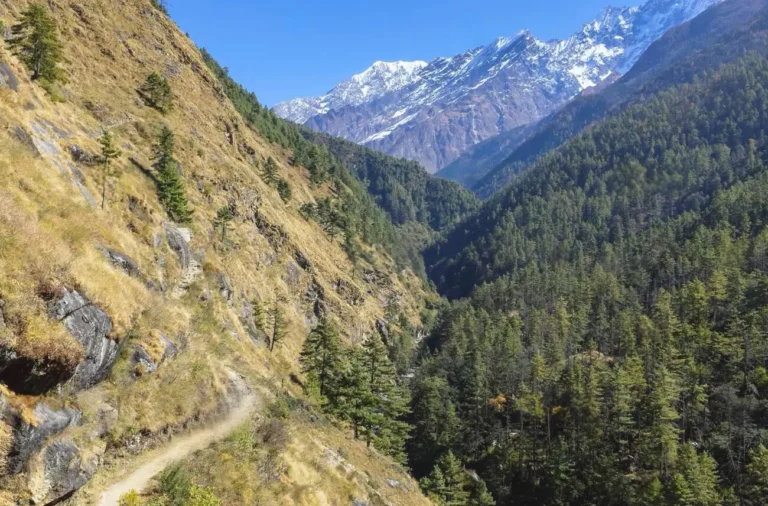
Tsum is a side valley off the Manaslu trail, running north east towards Tibet. You reach it from Kathmandu by road to Machha Khola, then on foot up the Budhi Gandaki river.
First the two routes share a trail. Then, just past the village of Philim, they part. The Manaslu Circuit carries on north up the main valley. Instead, you turn east and climb into the Shiar Khola, and that turn is where the Tsum Valley begins.
Because the valley dead-ends at the border, it is not a loop. So you walk in, and you walk back out the same way, though the return uses the opposite bank for much of the distance.
Why did Tsum only open in 2008?
Tsum sits in a sensitive border zone, so Nepal kept it closed to foreigners for decades. It opened to trekking in 2008, which in Himalayan terms is very recent indeed.
So the late opening explains almost everything you notice there. The villages were never rebuilt around tourism. Instead, they are still farming and herding settlements that happen to have a few lodges. Also the trail furniture is thin. There are fewer signs, fewer menus in English, and far fewer people.
Once, Tsum was a small kingdom in its own right, with strong trading and religious ties across the Tibetan border rather than south towards Kathmandu. So the culture reads as Tibetan, not Nepali.
How difficult is the Tsum Valley Trek?
It is a moderate trek. Several operators sell it as strenuous, and we think that overstates it.
Here is the honest version. There is no pass to cross. The highest place you sleep is Mu Gompa at 3,700 m. There is no technical ground anywhere on the route, and no equipment beyond normal trekking kit.
What makes it demanding is different. You walk five to seven hours a day for about ten days. Two climbs are genuinely steep, the one to Lokpa and the one out of the Shiar Khola. And the valley is remote, so the nearest road is several days away at all times.
So we grade every trek we run on the same scale, so you can compare them honestly.
| Grade | Name | What it means | Example treks |
|---|---|---|---|
| 1 | Easy | Under 3,500 m, short, gentle days | Poon Hill |
| 2 | Moderate | Up to about 4,500 m, no high pass | Tsum Valley, Annapurna Base Camp, Mardi Himal, Kori |
| 3 | Strenuous | 5,000 to 5,550 m, a base camp or one high pass, good lodges | Everest Base Camp, Annapurna Circuit, Manaslu Circuit, Nar Phu Valley |
| 4 | Challenging | Remote, above 5,000 m, long rough days, simple lodges or some camping | Makalu, Everest Three Passes |
| 5 | Expedition | Very remote, full camping, or several high passes | Upper Dolpo |
So Tsum sits at grade 2, moderate. If high passes worry you, this is one of the few remote Nepali treks that never asks you to cross one.
What permits do you need for Tsum Valley?
You need three things, and the first one is where most quotes go wrong.
- Tsum Valley Restricted Area Permit. About US$40 per person for the first seven days from September to November, and about US$30 from December to August, then roughly US$7 per day after that.
- Manaslu Conservation Area Permit (MCAP). About NPR 3,000 for foreign trekkers.
- A local Chumnubri Rural Municipality entry fee, collected on the ground.
Now the part worth checking on any quote you receive. A Tsum-only trek does not need the Manaslu Restricted Area Permit, which costs about US$100 per week in autumn. Those are two different permits for two different areas. You only carry both if you combine Tsum with the Manaslu Circuit itself.
You also do not need a TIMS card. In a restricted area the restricted-area permit replaces it. Some operator websites still list TIMS in their Tsum inclusions, and if you are paying for it separately, you are paying for nothing.
Permit rules in Nepal do change, so we re-check every figure with the Department of Immigration before each departure rather than quoting an old number. For the full breakdown, see our Tsum Valley permit cost guide, and for how permits work across the country, our Nepal trekking permits guide.
Can you trek Tsum Valley without a guide?
No. You can now apply as a single trekker, but you still cannot walk it unguided.
On 22 March 2026 Nepal’s Department of Immigration removed the old requirement for a minimum of two trekkers in restricted areas. So a solo traveller can now hold a Tsum Valley permit in their own name, which was not possible before.
However, two rules did not change. You must have a licensed guide with you, and the permit must be issued through a registered agency. So this is not a route you can walk independently, whatever you may read on a forum.
What does the route look like, day by day?
The standard trek runs 15 days from Kathmandu, with about ten days of walking.
| Stage | Altitude | Roughly |
|---|---|---|
| Kathmandu to Machha Khola by road | 869 m | 8 to 9 hours driving |
| Machha Khola to Jagat | 1,340 m | 6 to 7 hours |
| Jagat to Lokpa | 2,240 m | 5 to 6 hours, the first hard climb |
| Lokpa to Chumling | 2,386 m | 4 to 5 hours |
| Chumling to Chhokangparo | 3,031 m | 5 to 6 hours |
| Chhokangparo to Nile | 3,361 m | 4 to 5 hours, visiting Piren Phu |
| Nile to Mu Gompa | 3,700 m | 4 to 5 hours, the high point |
| Acclimatization day at Mu Gompa | 3,700 m | Side walk to about 4,000 m |
| Return via Rachen Gompa and Burgi | 3,245 m | 6 to 7 hours |
After that you retrace the valley to Chumling, Philim and Machha Khola, then drive back to Kathmandu.
Notice how gradual the height gain is. You cross 2,500 m on day four and only reach 3,700 m on day eight. Because of that spacing, altitude problems are less common here than on the bigger routes, though they are never impossible. Our guide to altitude sickness on Nepal treks covers the warning signs.
For daily distances, net ascent and descent figures, see our Tsum Valley itinerary and distance guide.
Why is there no meat in the Tsum Valley?
The valley lives under a shyagya vow, a community pledge of non-violence that prohibits killing animals. Hunting is prohibited with it.
In practice this means no meat is slaughtered or sold anywhere in the valley. So you will eat vegetarian for roughly a week. The food is good and filling, mostly dal bhat, potatoes, Tibetan bread, noodles and eggs lower down.
This is not a rule invented for visitors, and it is not negotiable. Please do not carry meat in, and do not ask a lodge to make an exception. The vow is one of the reasons Tsum feels the way it does, and it belongs to the people who live there.
What will you actually see?
Three places give this trek its character, and all three are religious sites.
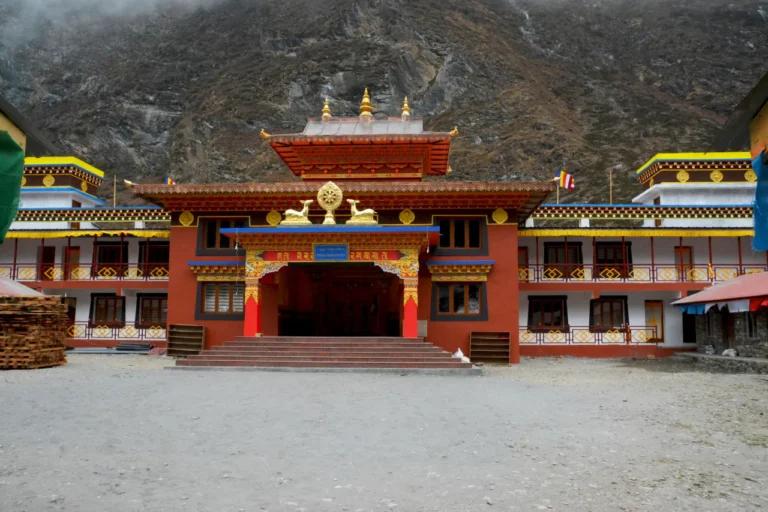
Mu Gompa (3,700 m) stands alone on a shelf near the head of the valley, below the Tibetan border. It is the highest and largest monastery in Tsum, and it is the furthest point of the trek.
Rachen Gompa sits lower down on the valley floor. It is a nunnery, and it houses one of the larger communities of Buddhist nuns in Nepal. The prayer hall is richly painted, and visitors are usually welcome.
Piren Phu is a cave shrine near Burgi village. Local tradition holds that the Tibetan poet-saint Milarepa meditated here. Inside there are wall paintings, carved stone tablets and old scriptures.
Above all this stand the mountains. Ganesh Himal fills the valley on clear mornings, with Sringi Himal and Boudha Himal visible from the upper villages.
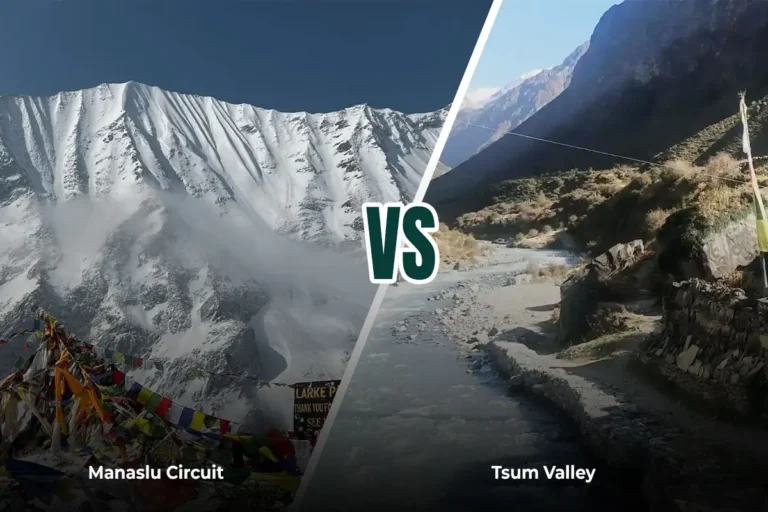
Tsum Valley or the Manaslu Circuit?
They share a trail for four days and then split, so this is a real decision rather than a false one.
| Tsum Valley | Manaslu Circuit | |
|---|---|---|
| Highest point | 3,700 m, no pass | Larkya La, 5,106 m |
| Grade | Moderate | Moderate to strenuous |
| Restricted permit | About US$40 per week | About US$100 per week in autumn |
| Main draw | Tibetan Buddhist culture | Big mountain scenery |
| Crowds | Very few | Busy in season |
Take the Manaslu Circuit if you want to circle an 8,000 m peak and cross a serious pass. Take Tsum if the culture is the point, if you would rather avoid a 5,000 m crossing, and if you want to see far fewer people.
We compare them properly in Tsum Valley vs Manaslu Circuit. You can also walk both as one trip, which we cover in our guide to the combined Manaslu and Tsum trek.
When is the best time to trek Tsum Valley?
October and November are the best months, then March to May.
First, autumn gives you the clearest air and the most stable weather, and October is when the valley looks its best. Spring is the second window, warmer, with rhododendron in flower lower down.
Still, winter is possible but cold, and some lodges high in the valley close. If you go in December or January, expect hard frost and possible snow above Chhokangparo.
The monsoon, roughly June to mid September, is the harder call. Rain brings leeches and landslides on the approach, and the long drive becomes unreliable. However, the upper valley sits partly in a rain shadow, so it stays drier up there than the approach suggests. It is doable, but it is not the trek at its best.
See our overview of the best time to trek in Nepal.
What is the accommodation and food like?
Simple teahouses and family lodges the whole way, and they are more basic than on the Everest or Annapurna routes.
So expect a twin room with a plywood partition and a shared toilet. At Mu Gompa the accommodation is very simple and may be in the monastery guesthouse. Rooms are unheated everywhere, so a sleeping bag liner is worth carrying.
Also meals are ordered from a short menu and cooked to order. Because the valley is vegetarian, the range is narrower than elsewhere, but the quality is good.
Two practical points people underestimate. There are no ATMs anywhere on this trek, so draw your cash in Kathmandu and carry Nepali rupees. And mobile signal is patchy as far as Chumling, then absent above Nile. So tell people at home you will be out of contact for several days.
Our Nepal trekking packing list covers what to bring.
How much does the Tsum Valley Trek cost?
A guided 15-day trip generally runs between about US$1,200 and US$2,200 per person, depending on group size and what is included.
Here the spread is wide because operators include different things. Permits, the long drive at both ends, teahouse nights, meals on the trail, the guide and a porter are the main components. So when you compare quotes, ask for the list of what is not included, in writing.
Our own Tsum Valley Trek sets out exactly what is covered. For a full breakdown of where the money goes, see our overview of trekking costs in Nepal.
Who is this trek right for?
It suits people who want remoteness and culture more than summits.
So it is a good choice if you are reasonably fit, if you have walked multi-day trails before, and if a week without meat, hot showers or mobile signal sounds acceptable rather than grim.
It is a poor choice if you want mountain views above all else. Tsum has fine views, but it is not the Everest or Annapurna experience. It is also a poor choice if you need reliable connectivity or a short trip, because the drive alone eats two days.
If the idea of a quiet restricted valley appeals, the Nar Phu Valley Trek has a similar feel in the Annapurna region.
FAQs
How long is the Tsum Valley Trek?
Fifteen days from Kathmandu, including two long road days and about ten days of walking. Shorter versions of twelve or thirteen days exist, but they compress the return leg and leave no buffer if weather or a road closure delays you.
How high does the Tsum Valley Trek go?
The highest place you sleep is Mu Gompa at 3,700 m. On the acclimatization day you walk a few hundred metres higher and come back down. There is no pass on the route.
Do you need a guide for the Tsum Valley Trek?
Yes. It is a restricted area, so a licensed guide is required by law and the permit must be issued through a registered agency. The March 2026 change removed the old two-person minimum, but it kept both of those rules.
How much are Tsum Valley permits?
The Tsum Valley Restricted Area Permit is about US$40 per person for the first seven days from September to November, or about US$30 from December to August, then roughly US$7 per day. You also need the Manaslu Conservation Area Permit at about NPR 3,000 and a small local municipality fee. You do not need a TIMS card.
Is there meat in the Tsum Valley?
No. The valley follows a shyagya vow that prohibits killing animals, so no meat is served anywhere in it. Plan to eat vegetarian for about a week.
Can you combine Tsum Valley with the Manaslu Circuit?
Yes, and many people do. It takes roughly 21 to 24 days and you need both restricted-area permits, the Tsum one and the Manaslu one. It is the most complete way to see the region.
Is the Tsum Valley Trek dangerous?
It is not technically dangerous, and the altitude profile is gentler than most Nepali treks. The real risks are the remoteness and the road. Evacuation takes longer here than on busier routes, so travel insurance covering helicopter evacuation is essential rather than optional.
Accuracy note: Tsum Valley restricted-area permit fees and the Manaslu Conservation Area Permit come from our Nepal trekking permits guide. The removal of the two-trekker minimum in restricted areas on 22 March 2026, and the fact that the licensed-guide and registered-agency rules were kept, is reported by the Kathmandu Post. The contrast with the Manaslu restricted-area permit is set out in our Manaslu permit guide; altitudes (Mu Gompa 3,700 m, Chhokangparo 3,031 m, Nile 3,361 m, Lokpa 2,240 m) and the 15-day route reflect the itinerary Spade Himalaya actually runs, published on our Tsum Valley Trek (retrieved 2026-08-20); the 2008 opening of the valley to foreign trekkers and the shyagya vow of non-violence are long-standing local facts confirmed by our guides who work the valley each season. Route details reviewed by Yubaraj Katel, government-licensed trekking guide (Licence No. 19827) with 10 years of experience leading treks in the Manaslu region.

Start Planning Your Trek
Updated: 11 Sep, 2026
8 min
Tsum Valley Trek Permit Cost 2026: What You Actually Need
Tsum Valley permits in 2026: the restricted-area permit is US$40 a week, not the Manaslu US$100....
Updated: 7 Sep, 2026
7 min
Tsum Valley vs Manaslu Circuit: Which Should You Walk?
Tsum Valley or Manaslu Circuit? One has a 5,106 m pass, the other has no pass...
Updated: 18 Aug, 2026
8 min
Tsum Valley Trek Itinerary, Distances and Daily Altitude
A 15-day Tsum Valley itinerary with daily distances, hours, and net ascent and descent for every...